Perspective - (2025) Volume 16, Issue 2
Received: 01-Apr-2025, Manuscript No. jar-25-176283;
Editor assigned: 03-Apr-2025, Pre QC No. P-176283;
Reviewed: 17-Apr-2025, QC No. Q-176283;
Revised: 22-Apr-2025, Manuscript No. R-176283;
Published:
29-Apr-2025
, DOI: 10.37421/2155-6113.2025.16.1058
Citation: Fernandez, Miguel. "New HIV-1 Insights: Latency,
Mechanisms, Cure." J AIDS Clin Res 16 (2025):1058.
Copyright: © 2025 Fernandez M. This is an open-access article distributed under the terms of the Creative Commons Attribution License, which permits unrestricted use,
distribution and reproduction in any medium, provided the original author and source are credited.
The pervasive challenge of Human Immunodeficiency Virus type 1 (HIV-1) infection continues to drive extensive scientific inquiry, with a primary focus on understanding its sophisticated mechanisms of latency, replication, and interaction with host cellular systems. Groundbreaking research has shed light on how HIV-1 establishes and escapes latency, a formidable barrier to eradication. Specifically, recent findings reveal novel mechanisms for HIV-1 latency escape that operate independently of NF-κB, emphasizing the critical involvement of proteins like Tat and Brd4. Deciphering these pathways is fundamental for devising new strategies aimed at dismantling the latent HIV reservoir, which remains a significant impediment to achieving a permanent cure [1].
Similarly, the virus employs an accessory protein, Vpr, to suppress non-canonical NF-κB signaling through the induced degradation of TRAF3. This intricate mechanism likely plays a crucial role in promoting viral persistence and enabling the virus to evade host immune responses, thereby offering fresh insights into HIV pathogenesis and identifying potential new therapeutic targets [3].
Further crucial advancements have been made in understanding the basic molecular biology underpinning viral replication and the efficacy of current antiretroviral strategies. Detailed investigations have elucidated the precise molecular mechanisms by which non-nucleoside reverse transcriptase inhibitors (NNRTIs) effectively block HIV-1 reverse transcriptase activity. This deeper understanding of drug-target interactions is indispensable for developing more potent and resistance-proof antiretroviral therapies that can combat evolving viral strains [2].
The pursuit of an HIV cure is intrinsically linked to overcoming latency, a state where the virus lies dormant within host cells, particularly in specific anatomical compartments. The unique challenges posed by HIV-1 latency within the Central Nervous System (CNS) are also being actively explored, with research detailing its specific mechanisms and therapeutic implications. A comprehensive understanding of CNS latency is absolutely critical for developing effective strategies to eradicate HIV from this vital sanctuary site and, consequently, prevent the associated neurocognitive disorders that often plague infected individuals [4].
To gain a clearer picture of viral persistence in vivo, advanced techniques such as single-cell RNA sequencing are being utilized. This approach has mapped the landscape of HIV-1 persistence and latency at an unprecedented resolution, identifying distinct cellular reservoirs and the specific molecular pathways that are instrumental in maintaining latency, thereby revealing how the virus cleverly evades elimination [5].
Furthermore, an updated perspective on the intricate mechanisms of HIV-1 latency and contemporary strategies for viral reactivation consistently highlights that overcoming latency is undeniably the central challenge in achieving a functional cure. These continuous insights into latency and reactivation processes are therefore invaluable for future therapeutic development [10].
Beyond latency and replication, the processes involved in forming new, infectious virions are equally vital for vaccine development. A focused review of the intricate mechanisms governing the incorporation of HIV-1 envelope glycoproteins into nascent virions provides foundational knowledge. A thorough grasp of this complex process is fundamental for the rational design of effective vaccines, especially those aimed at eliciting broadly neutralizing antibodies, which are essential for robust and lasting protection against diverse viral strains [6].
In parallel, research delves into the initial stages of infection by examining the molecular mechanisms that dictate HIV-1 tropism and coreceptor usage. Understanding precisely how the virus selects its entry receptors is crucial for developing targeted therapies that can effectively block viral entry and for informing the design of preventive vaccines [9].
The virus's profound manipulation of host cellular systems represents another critical area of study. The complex interplay between HIV-1 infection and mitochondrial dynamics, for instance, details how the virus actively alters mitochondrial function. These discoveries could pave the way for novel therapeutic strategies that specifically target these crucial host-pathogen interactions at the cellular energy level [7].
Similarly, the multifaceted roles of the ubiquitin-proteasome system (UPS) during HIV-1 infection are being comprehensively detailed. The UPS is implicated in various stages, including viral replication, assembly, budding, and the host's innate immune response. Given its central role, targeting the UPS offers promising avenues for innovative antiviral therapies that could disrupt multiple stages of the viral life cycle [8].
This ongoing research collectively underscores the dynamic and intricate nature of HIV-1, driving forward the development of more effective treatments and preventive measures.
Understanding the intricate life cycle of Human Immunodeficiency Virus type 1 (HIV-1) is paramount for developing effective treatments and ultimately achieving a cure. Recent research has delved deeply into various aspects of HIV-1 pathogenesis, from viral latency and replication to host-pathogen interactions and strategies for immune evasion. A significant focus remains on HIV-1 latency, the state where the virus remains dormant within host cells, effectively hiding from both the immune system and antiretroviral drugs. Studies have identified novel mechanisms for HIV-1 escape from latency that function independently of NF-κB, specifically highlighting the involvement of viral proteins like Tat and host factors such as Brd4. These findings are crucial for informing new therapeutic approaches aimed at reactivating and subsequently eradicating the latent viral reservoir [1]. The challenge of latency is not uniform across the body; for instance, HIV-1 latency in the Central Nervous System (CNS) presents unique mechanisms and therapeutic implications, making it a critical area for research to prevent neurocognitive disorders and achieve full viral eradication [4]. Further enhancing this understanding, single-cell RNA sequencing has been employed to map the landscape of HIV-1 persistence and latency in vivo, uncovering distinct cellular reservoirs and molecular pathways that contribute to the virus's ability to evade elimination [5]. An updated perspective on these latency mechanisms and viral reactivation strategies consistently shows that overcoming latency is the central hurdle in achieving a functional cure for HIV [10].
Viral replication is another fundamental area of study, with a continuous need to understand how the virus replicates and how existing drugs inhibit this process. For instance, detailed molecular insights have been gained into how non-nucleoside reverse transcriptase inhibitors (NNRTIs) block HIV-1 reverse transcriptase activity. This understanding of drug-target interactions is vital for designing more effective and resistance-proof antiretroviral therapies, ensuring that treatments remain potent against evolving viral strains [2]. The virus also employs sophisticated strategies to manipulate host cell machinery to its advantage. The HIV-1 accessory protein Vpr, for example, has been shown to suppress non-canonical NF-κB signaling by promoting the proteasomal degradation of TRAF3. This manipulation likely contributes significantly to viral persistence and its capacity for evading host immune responses, offering new avenues for therapeutic intervention [3]. Similarly, the multifaceted roles of the ubiquitin-proteasome system (UPS) during HIV-1 infection have been extensively documented. The UPS is involved in various stages, including viral replication, assembly, budding, and modulating the host's innate immune response. Targeting the UPS thus represents a promising strategy for developing novel antiviral therapies [8].
Beyond replication and host manipulation, the formation of new, infectious virions and the initial entry into host cells are critical processes. Research into the mechanisms governing the incorporation of HIV-1 envelope glycoproteins into nascent virions is crucial. A thorough comprehension of this intricate process is foundational for the rational design of vaccines, particularly those aiming to elicit broadly neutralizing antibodies, which are essential for comprehensive protection [6]. Complementing this, investigations into the molecular mechanisms dictating HIV-1 tropism and coreceptor usage provide insights into how the virus selectively binds and enters target cells. Understanding this specific selection process is vital for developing therapies that effectively block viral entry and for informing vaccine design strategies [9]. These studies collectively aim to prevent infection and block subsequent viral spread.
The broader interactions between HIV-1 and host cellular dynamics are also under scrutiny, revealing complex manipulations that can be exploited for therapeutic gain. One such area is the interplay between HIV-1 infection and mitochondrial dynamics. This research outlines how the virus manipulates mitochondrial function, impacting cellular energy and survival. The insights gained from these studies could lead to innovative therapeutic strategies specifically targeting host-pathogen interactions at the cellular energy level, potentially disrupting viral persistence and pathogenesis [7]. Taken together, this body of research underscores a comprehensive scientific effort to unravel the complexities of HIV-1, from its molecular components to its systemic effects on the host, paving the way for advanced diagnostics, more effective treatments, and the ultimate goal of an HIV cure. The focus on intricate molecular pathways, host factor interactions, and the challenges of viral latency highlights the sophistication required to combat this persistent global health threat.
Recent scientific endeavors significantly advance our understanding of HIV-1, particularly focusing on its latency, replication mechanisms, and interactions with host cells. Studies reveal novel pathways for HIV-1 latency escape, independent of NF-κB, involving Tat and Brd4, which are crucial for targeting the latent reservoir [1]. Research also details how non-nucleoside reverse transcriptase inhibitors block HIV-1 activity, vital for designing resistance-proof therapies [2]. HIV-1 accessory protein Vpr inhibits non-canonical NF-κB signaling, promoting viral persistence and immune evasion [3]. The distinct challenges of HIV-1 latency in the Central Nervous System are being explored to eradicate the virus from this sanctuary site [4]. Single-cell RNA sequencing offers unprecedented insights into HIV-1 persistence and latency in vivo, identifying specific cellular reservoirs [5]. Understanding HIV-1 envelope glycoprotein incorporation into virions is fundamental for vaccine design, especially for eliciting broadly neutralizing antibodies [6]. The complex interplay between HIV-1 and mitochondrial dynamics reveals how the virus manipulates host cellular function, suggesting new therapeutic targets [7]. The ubiquitin-proteasome system's multifaceted roles in viral replication, assembly, budding, and host defense are also detailed, offering avenues for antiviral therapies [8]. Molecular mechanisms of HIV-1 tropism and coreceptor usage are crucial for blocking viral entry and designing effective vaccines [9]. An updated perspective emphasizes that overcoming HIV-1 latency remains the central challenge for achieving a functional cure, underscoring the value of insights into viral reactivation strategies [10]. This collective research provides a comprehensive view of HIV-1, guiding the development of new treatments and prevention methods.
Indexed at, Google Scholar, Crossref
Indexed at, Google Scholar, Crossref
Indexed at, Google Scholar, Crossref
Indexed at, Google Scholar, Crossref
Indexed at, Google Scholar, Crossref
Indexed at, Google Scholar, Crossref
Indexed at, Google Scholar, Crossref
Indexed at, Google Scholar, Crossref
Indexed at, Google Scholar, Crossref
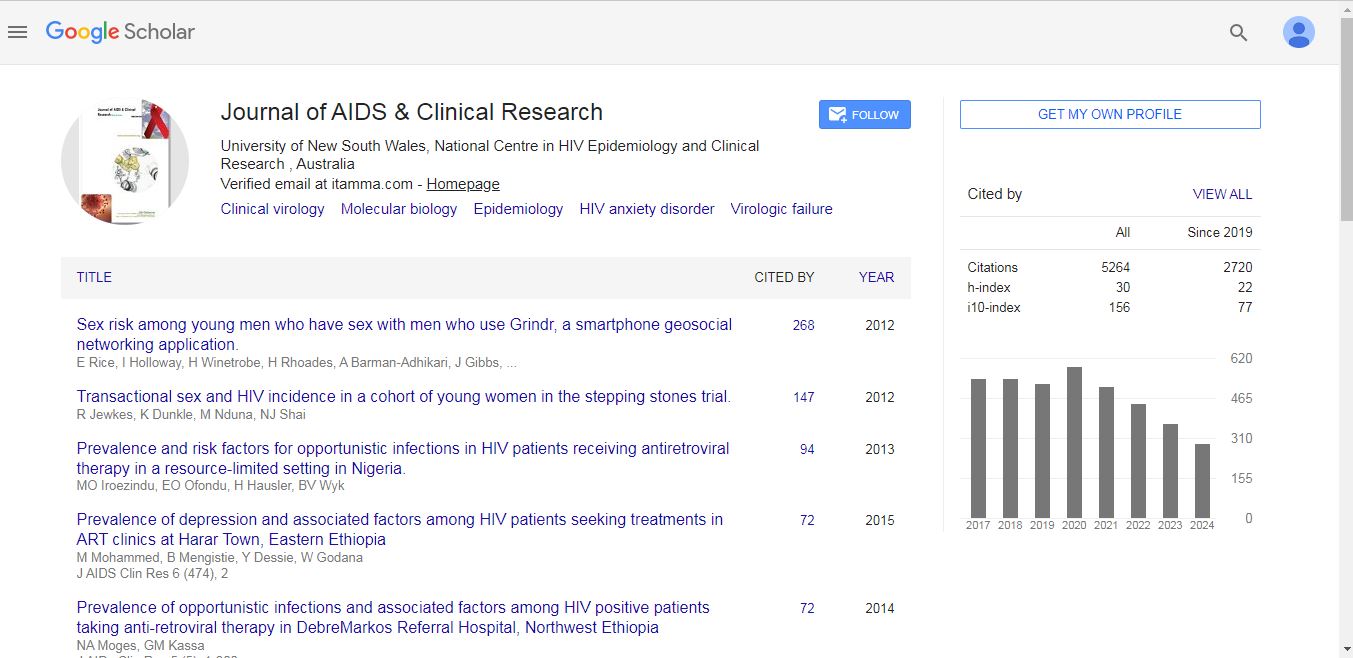
Journal of AIDS & Clinical Research received 5264 citations as per Google Scholar report