Commentary - (2025) Volume 11, Issue 3
Received: 02-Jun-2025, Manuscript No. jctt-26-188405;
Editor assigned: 04-Jun-2025, Pre QC No. P-188405;
Reviewed: 18-Jun-2025, QC No. Q-188405;
Revised: 23-Jun-2025, Manuscript No. R-188405;
Published:
30-Jun-2025
, DOI: 10.37421/2471-9323.2024.10.323
Citation: Petrova, Sofia. "Natural Approaches to Hair Health and Growth." J Cosmo Tricho 11 (2025):323.
Copyright: © 2025 Petrova S. This is an open-access article distributed under the terms of the Creative Commons Attribution License, which permits unrestricted use, distribution and reproduction in any medium, provided the original author and source are credited.
The exploration of botanical extracts and natural compounds for hair follicle regeneration and scalp health represents a rapidly advancing field within dermatology and trichology. This burgeoning area of research is uncovering how specific plant-derived ingredients can effectively modulate crucial cellular signaling pathways that govern hair growth cycles. Furthermore, these natural agents demonstrate potential in combating scalp inflammation, thereby offering a promising natural alternative for individuals experiencing common hair and skin concerns related to the scalp [1].
The intricate relationship between the skin microbiome and the overall health of hair follicles is becoming increasingly apparent through ongoing scientific investigation. A deeper understanding of how distinct microbial communities within the scalp influence follicular stem cells and the inflammatory responses within the skin microenvironment is paving the way for the development of innovative cosmeceutical strategies. These strategies aim to simultaneously address scalp health and promote hair regeneration [2].
Investigating the specific signaling pathways that orchestrate hair follicle morphogenesis and cycling, such as the Wnt/β-catenin and Hedgehog pathways, provides profound insights into potential therapeutic interventions for hair loss. The ability to modulate these fundamental pathways using natural compounds holds significant promise for stimulating dormant follicles and encouraging robust hair growth, offering new avenues for treatment [3].
The substantial impact of oxidative stress on hair follicle stem cells and their inherent regenerative capacity is a critical area of concern. Elucidating how antioxidants, particularly those derived from natural sources, can effectively protect these vital stem cells from damage and simultaneously enhance their functional capabilities is paramount. This understanding is crucial for the development of truly effective treatments for various forms of hair loss [4].
Nutritional deficiencies have been long recognized as having a profound effect on both the general health of hair and its growth cycle. A comprehensive examination of how essential vitamins, minerals, and amino acids contribute to the proper functioning of hair follicles is vital. This research highlights how targeted supplementation, especially from natural food sources, can effectively address issues of hair thinning and loss [5].
Research into the anti-inflammatory and immunomodulatory effects of various natural compounds on prevalent scalp conditions, such as psoriasis and seborrheic dermatitis, is of critical importance. Identifying specific agents that can effectively calm inflammation without negatively impacting the skin barrier function is key. Such discoveries can lead to significant improvements in overall scalp health, fostering a more conducive environment for healthy hair growth [6].
The application of exosomes, particularly those derived from plant sources, presents a novel and exciting approach to enhancing skin barrier function and promoting hair growth. These nanoscale vesicles possess the unique ability to deliver bioactive molecules that can significantly improve cellular communication and stimulate regenerative processes within the skin and hair follicles [7].
Understanding the multifaceted role of various telogen effluvium triggers, including significant stress and hormonal fluctuations, is critical for effective management. This study delves into how specific natural compounds might offer a means to mitigate these detrimental effects by modulating stress response pathways and supporting hormonal balance, thereby indirectly aiding in hair regrowth [8].
The documented efficacy of certain natural oils in improving scalp hydration and enhancing the integrity of the hair shaft underscores their therapeutic potential. This research aims to explore the precise mechanisms by which these oils can reduce transepidermal water loss and strengthen hair fibers, ultimately contributing to the development of healthier, more resilient hair [9].
Investigating the anti-androgenic properties inherent in specific plant extracts is crucial for developing effective strategies against androgenetic alopecia. Certain botanicals have demonstrated the capacity to inhibit the conversion of testosterone into dihydrotestosterone (DHT) or to effectively block DHT receptors, thereby actively mitigating the miniaturization of hair follicles associated with this common condition [10].
The therapeutic potential of botanical extracts and natural compounds in promoting hair follicle regeneration and maintaining scalp health is a rapidly expanding area of scientific inquiry. This research highlights how selected plant-derived ingredients can influence cellular signaling pathways critical to the hair growth cycle and combat scalp inflammation, thereby presenting a natural alternative for prevalent hair and skin concerns [1].
Emerging evidence increasingly clarifies the complex interplay between the skin's microbiome and the health of hair follicles. Comprehending the mechanisms by which particular microbial communities affect follicular stem cells and inflammatory processes is crucial for pioneering novel cosmeceutical approaches that target both scalp vitality and hair regeneration [2].
The study of specific signaling pathways, including the Wnt/β-catenin and Hedgehog pathways, in hair follicle morphogenesis and cycling provides deep insights into potential therapeutic avenues. The modulation of these pathways through natural compounds could serve to stimulate dormant follicles and foster enhanced hair growth [3].
The significant influence of oxidative stress on hair follicle stem cells and their regenerative capabilities necessitates further investigation. Understanding how natural antioxidants can protect these cells from damage and improve their function is essential for creating effective hair loss treatments [4].
Nutritional deficits are known to considerably impact hair health and growth. This review examines the role of essential vitamins, minerals, and amino acids in supporting hair follicle function and explores how supplementation, particularly from natural food sources, can address hair thinning and loss [5].
Exploring the anti-inflammatory and immunomodulatory effects of natural compounds on scalp conditions like psoriasis and seborrheic dermatitis is vital. Identifying agents that soothe inflammation without compromising the skin barrier can lead to improved scalp health and a more favorable environment for hair growth [6].
The application of plant-derived exosomes offers a novel strategy for enhancing skin barrier function and promoting hair growth. These nanoscale vesicles can deliver bioactive molecules that improve cellular communication and stimulate regenerative processes [7].
Investigating the triggers of telogen effluvium, such as stress and hormonal changes, is critical. This study explores how natural compounds might help mitigate these effects by modulating stress response pathways and supporting hormonal balance, thus aiding in hair regrowth [8].
The effectiveness of certain natural oils in improving scalp hydration and hair shaft integrity is well-supported by evidence. This research investigates the mechanisms by which these oils reduce transepidermal water loss and strengthen hair fibers, contributing to healthier, more resilient hair [9].
Research into the anti-androgenic properties of plant extracts is paramount for addressing androgenetic alopecia. Specific botanicals can inhibit testosterone-to-DHT conversion or block DHT receptors, thereby reducing hair follicle miniaturization [10].
This collection of research explores various natural approaches to improving hair health and addressing hair loss. Key areas of focus include the therapeutic effects of botanical extracts on hair follicle regeneration and scalp inflammation, the role of the scalp microbiome in follicular health, and the impact of signaling pathways like Wnt/β-catenin and Hedgehog on hair growth. The influence of oxidative stress on hair follicle stem cells and the protective role of natural antioxidants are also examined. Nutritional deficiencies and their impact on hair health are discussed, alongside the potential of natural compounds to manage scalp inflammation and conditions like psoriasis and seborrheic dermatitis. Furthermore, the use of plant-derived exosomes for skin barrier enhancement and hair growth promotion is highlighted. The study also investigates triggers of telogen effluvium and how natural compounds might help mitigate these effects. Finally, the benefits of natural oils for scalp hydration and hair strength, as well as the anti-androgenic properties of plant extracts in combating androgenetic alopecia, are explored.
None
None
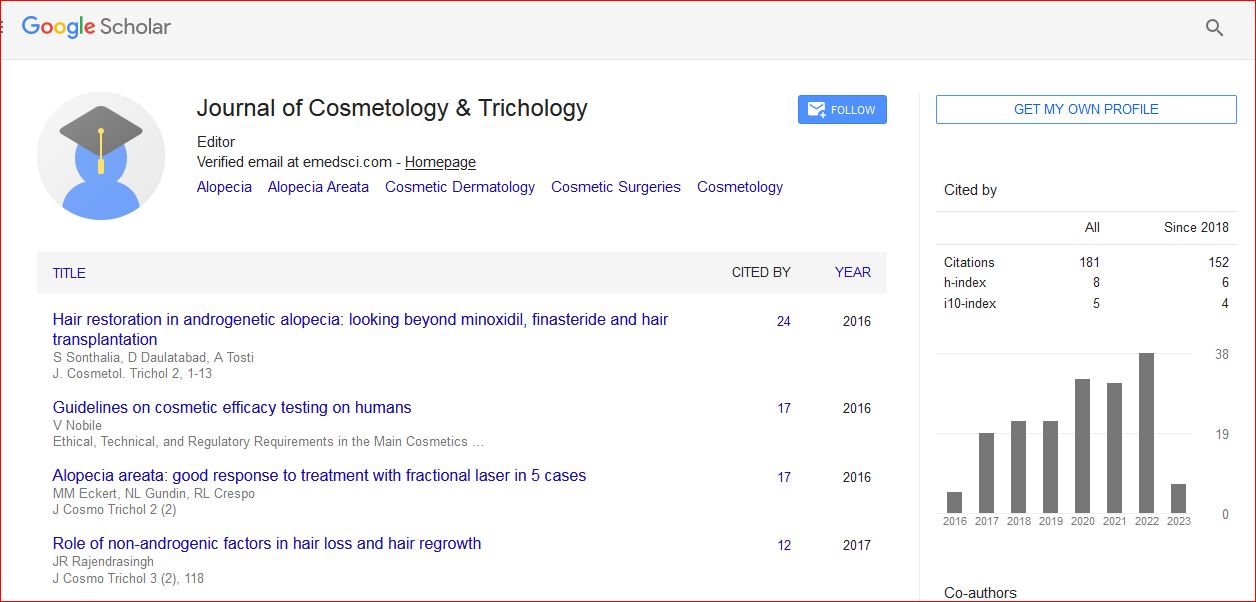
Journal of Cosmetology & Trichology received 180 citations as per Google Scholar report