Research Article - (2026) Volume 12, Issue 1
Received: 02-Feb-2026, Manuscript No. jctt-26-183776;
Editor assigned: 04-Feb-2026, Pre QC No. P-183776;
Reviewed: 20-Feb-2026, QC No. Q-183776;
Revised: 28-Feb-2026, Manuscript No. R-183776;
Published:
09-Mar-2026
, DOI: 10.37421/2471-9323.2026.12.365
Citation: Yu, Xiaoyan, Gloria Roveda, MediAbout s.r.l. Medical Department and Vincenzo Nobile. “Multiethnic Clinical-instrumental Evaluation of the Efficacy of a Nutritional Supplement on Hair Shedding and Hair Health: A Randomized, Placebo-controlled Clinical Trial.” J Cosmo Tricho 12 (2026): 365.
Copyright: © 2026 Yu X, et al. This is an open-access article distributed under the terms of the Creative Commons Attribution License, which permits unrestricted use, distribution and reproduction in any medium, provided the original author and source are credited.
Telogen effluvium • Dietary supplement • Hair shedding • Phytosterols • Fatty acids • Hair density • Randomized controlled trial
The human hair follicle follows a cyclic growth pattern consisting of three distinct phases: anagen (growth), catagen (regression) and telogen (resting). The anagen phase is the most prolonged and metabolically active period, lasting from 2 to 8 years, during which hair actively grows due to rapid matrix cell proliferation and melanin production [1]. Following anagen, hair enters the catagen phase, a short transitional stage (4 to 6 weeks) marked by apoptosis of epithelial cells in the bulb and Outer Root Sheath (ORS), the outermost epithelial layer [2]. The follicle then progresses to the telogen phase, which lasts for 2 to 3 months, during which the hair shaft matures into a club hair, which is eventually shed from the follicle [3]. At any given time, approximately 80–90% of the human scalp HFs are in the anagen phase, whereas only 1–2% and 5–15% reside in the catagen or telogen phases, respectively [1].
Hair loss, or alopecia, is a common condition among individuals of all genders and ages, that often affects social and psychological well-being. While Andro Genetic Alopecia [AGA] and Female Pattern Hair Loss (FPHL) represent causes of permanent hair loss [4], acute Telogen Effluvium (aTE) is a form of nonscarring alopecia characterized by diffuse hair shedding [5]. It is characterized by a premature shift of follicles from the anagen to the telogen phase, resulting in diffuse non-scarring shedding of hair [6]. This condition, often reversible, is typically triggered by stress, illness, nutritional deficiencies, or hormonal changes [7].
TE can be triggered by hormonal changes, metabolic stress or medications. Common triggering events include severe infection and trauma, postpartum hormonal changes (particularly estrogen decrease), diet imbalances (i.e., low protein intake, heavy metal ingestion and iron deficiency). Many medications, such as beta-blockers and retinoids, have also been linked to TE [5]. Diffuse shedding of telogen hair was observed after 3-4 months of the triggering event [7].
Data on the epidemiology of TE are limited, but it is considered a common condition. One study reported that approximately 40% of women not suffering from FPHL experienced excessive hair shedding (as defined by the Sinclair Hair Shedding Scale) on hair washing days and 8% of them on non‐hair‐washing days [8]. Moreover, another study found 1.74% incidence of TE among female patients, with 20.8% of them reporting aTE [9]. In general, many adults experience an episode of TE at some point in their lifetime [10]. Although TE can manifest in both men and women, women tend to be more susceptible because of postpartum hormonal changes. Moreover, women are more disturbed by hair shedding compared to men and are more likely to seek medical attention [5, 11].
Hair shedding can significantly impact an individual’s self-esteem, psychological well-being and perceived attractiveness [7, 12]. In recent years, the concept of “beauty from within” has gained recognition, emphasizing the influence of internal health, including nutritional and metabolic balance, on outward appearance and skin and hair vitality [13].
Several plant-based actives have demonstrated the ability to modulate key pathways involved in the hair cycle [14]. Beaulixir® is a proprietary blend containing oils from Borago officinalis, Linum usitatissimum, Triticum vulgare and Serenoa repens, enriched with phytosterols from Pinus sylvestris and Secale cereale extract Serenoa repens. (saw palmetto) oil has demonstrated to induce hair regrowth among patients with AGA, FPHL, TE [15]. Borago officinalis (borage) oil is rich in Gamma-Linolenic Acid (GLA), a potent anti-inflammatory omega-6 fatty acid that modulates prostaglandin metabolism and helps restore the scalp’s lipid barrier [16, 17]. Linum usitatissimum (linseed/Flaxseed) oil provides Alpha-Linolenic Acid (ALA), an omega-3 fatty acid known for its antioxidant and membrane-stabilizing effects [18]. Additionally, Pinus sylvestris (Scots pine) and Secale cereale (rye) are natural sources of phytosterols, which can decrease lipid peroxidation, improve scalp microcirculation and support cellular turnover in the follicular matrix [19]. These actions may contribute to improved resilience of the hair shaft and regulation of follicular cycling. The last two components are wheat germ oil (Triticum vulgare) and rye extract (Secale cereale). Wheat germ oil is rich in essential fatty acids (especially linoleic and alpha-linolenic acid), tocopherols (vitamin E) and phytosterols, which collectively contribute to antioxidant protection, improved skin barrier function and reduced scalp inflammation, crucial factors for maintaining healthy hair follicles [20]. Rye extract provides bioavailable micronutrients and bioactives that have been shown to support microcirculation and exert anti-inflammatory effects on the scalp environment, helping to restore hair density and reduce follicular miniaturization [14].
Phytosterols (especially β-sitosterol), present in plant oils like rye and pine, omega-3 and omega-6 Polyunsaturated Fatty Acids (PUFAs) such as Linolenic Acid (LA) and γ-Linolenic Acid (GLA) particularly abundant in flaxseed, borage oil, Serenoa repens and wheat germ oil, contribute to the inhibition of 5α-reductase activity [21]. In a clinical study on female-pattern hair loss, supplementation with omega-3 and omega-6 fatty acids plus antioxidants led to significant improvements in hair density and reduction in telogen percentage, corroborating the anti-inflammatory and follicle-strengthening action [22]. Their antioxidant and anti-inflammatory effects are primarily mediated through modulation of the arachidonic acid cascade. Moreover, by incorporating into cell membranes, these fatty acids support cell growth, regeneration and membrane fluidity, contributing to overall tissue health [23].
Using a phytocomplex offers pleiotropic and synergistic benefits. Individually, these ingredients target distinct pathways (inflammation, hormonal modulation, oxidative protection), but when combined, the formulation provides a multi‐mechanistic action that addresses the complex biology of hair loss. This synergy was predicted in the design of Beaulixir® and confirmed by preclinical data from enzymatic assays. The In vitro testing campaign showed that the nutritional supplement selectively inhibits the activity of type II 5α-reductase, suggesting a targeted anti-androgenic action with potentially fewer off-target effects.
The first open label clinical trial demonstrated In vivo Beaulixir’s concurrent inhibition of 5alfa reductase, reduction of scalp inflammation and microcirculation improvement, which ultimately led to visible enhancement of hair density and quality [14]. The study was conducted on subjects affected by TE, AGA I to IV of Norwood Hamilton scale and FPHL grade I to III of Ludwig Scale. The second clinical trial, here discussed, was designed to clinically assess the efficacy of the nutritional supplement on hair parameters in a controlled population of patients affected by aTE, using cutting-edge techniques to further investigate its potential. The main tool used to carry out this investigation was the Phototrichogram, a non-invasive and reproducible technique extensively recognized in dermatology for quantitative analysis of hair growth dynamics. Phototrichogram involves shaving a defined scalp area (typically 1 cm²), capturing baseline and follow-up macro photographs (usually 48 hours later) and using image analysis software to calculate hair density, shaft diameter, growth rate and the ratio of anagen to telogen hairs [24]. Compared to traditional pluck-based methods, the phototrichogram offers several key advantages: it is pain-free, avoids disturbing the hair cycle, enables automated and objective measurements and enhances reproducibility making it ideal for monitoring therapeutic outcomes in clinical trials. Its ability to accurately track subtle changes in the anagen/telogen ratio also makes it essential for differentiating hair loss types and validating the efficacy of new treatments [24, 25].
Study design and population
A randomized, placebo-controlled, double-blind trial included 72 healthy volunteers (50% male, 50% female; 50% Asian, 50% Caucasian), aged 18–65 years, with acute TE (<6 months) and ≥15% telogen hairs confirmed by phototricogram. Participants were randomized into three groups (n=24/group): 400 mg/day of supplement, 600 mg/day of supplement, or placebo (300 mg sunflower oil/day). The study was conducted at Complife Italia (PV, Italy) and Complife Asia Testing Technology (Beijing China).
Intervention
Beaulixir®, kindly provided by ROELMI HPC, Origgio, VA (Italy), was administered in two formulations: 400 mg (1 capsule/day) and 600 mg (2 capsules/day). The placebo contained sunflower oil. All products were encapsulated in carrageenan softgels and indistinguishable by appearance. Subjects received 1 or 2 capsules daily depending on assigned group, taken in the morning on an empty stomach with water, for 84 days.
Evaluations/Assessments
Primary endpoints included hair density (total, anagen, telogen), anagen/telogen ratio and hair thickness using TrichoScan®. Secondary endpoints included hair brightness (colorimeter), elasticity (dynamometer), digital photographs and a self-assessment questionnaire. Clinical evaluations were performed at Day 0 (T0), Day 28 (T28) and Day 84 (T84).
Measurement techniques
Phototrichogram (T0, T28, T84): The phototrichogram was performed following standardized procedures recommended by the TrichoScan® system manufacturer. A target scalp area, located two finger widths from the parting line either in the fronto-temporal region or on the vertex, was selected and clipped using a circular template (Ø 1.8 cm). Residual hair fragments were removed using adhesive tape. A contrast dye was applied to the clipped area to enhance image quality, followed by careful removal of excess dye using a sterile swab and an alcohol-based solution. High-resolution digital photographs were captured 48 hours post-clipping (T48). The images were analyzed using TrichoScan® software, which provided quantitative measurements of total hair density (total hair/cm²), anagen and telogen hair density (number of hair in anagen phase per cm²) and proportion (%) and hair thickness (μm). This method ensures objective, reproducible assessment of hair growth parameters across timepoints.
Colorimeter (T0, T84): A spectrophotometer/colorimeter CM 700D (Konica-Minolta) was used to measure hair brightness on 5 points near the hairline. The measured parameter is the 8° gloss value (average value of the 5 measures).
Dynamometer (T0, T84): Hair elasticity is measured using a dynamometer (Tensolab 2512A, Mesdan Lab, Fig. 5) in accordance with UNI EN ISO 5079:1998 standard procedure. Hair elasticity is calculated as the maximum elongation before hair breakage. Fifteen hair are collected and measured; the average elasticity calculated at each study check is reported. The dynamometer reading is done on a single hair setting the instruments as follows: elongation velocity: 50 mm/min; pre-tension: 5 cN.
Digital macrophotography (T0, T28, T84): Photographic pictures are taken under standard lighting conditions, using a professional digital reflex camera. Two images per subject are taken: one from the back and one image at vertex level. Images are taken under standard reproducible lighting conditions; at each study time, the technician verifies the correspondence between the pictures and the initial ones.
Self-assessment questionnaire (T84): At the end of the study, subjects are asked to express their opinion on the tested product by answering a questionnaire about products acceptability and efficacy.
Statistical analysis
Statistical analyses were conducted using NCSS 10 software (vers. 10.0.7; NCSS, LLC. Kaysville, UT, USA). Data were evaluated for normality and analyzed via RM-ANOVA or Friedman test for intra-group comparisons and the Student’s t-test for inter-group comparisons. A p-value <0.05 was considered statistically significant.
Study population for analysis
A total of 72 subjects were enrolled in the study. Efficacy analysis was based on the Per Protocol Population (PP). The PP population is defined as all subjects who completed the study without any major protocol violations. Subjects were excluded from the PP population if: they missed one or more evaluation visit; or they did not use the product properly during the study period (as referred by the subject itself).
Improvements in hair density and follicular modulation
After only 28 days of treatment, both Beaulixir® dosages (400 mg and 600 mg/day) led to a statistically significant increase in total hair density compared to baseline (T0) (p<0.05) (Figure 1a). By day 84, total hair density had further increased in both active groups. Importantly, the 600 mg/day group demonstrated a statistically significant improvement compared to the placebo group (p < 0.01), confirming a dose-dependent effect on this primary endpoint. Treatment with the supplement also induced favorable changes in the hair growth cycle. Specifically, a significant increase in anagen-phase hair density was observed as early as day 28 in both dosage groups, with values continuing to rise through day 84. At the final timepoint, anagen hair density was significantly higher in both treated groups compared to placebo (p < 0.01 and p < 0.001, respectively) (Figure 1b). In parallel, a reduction in telogen-phase hair density was observed beginning at day 28 compared to T0, reaching statistical significance at day 84 (p < 0.001) (Figure 1c). These changes contributed to a progressive increase in the anagen-to-telogen (A/T) ratio, which became statistically significant after 84 days in both treatment groups compared to baseline (p < 0.001) and placebo (p < 0.01). The A/T ratio is a well-established indicator of hair cycle health and was notably more favorable in the 600 mg group (Figure 1d).
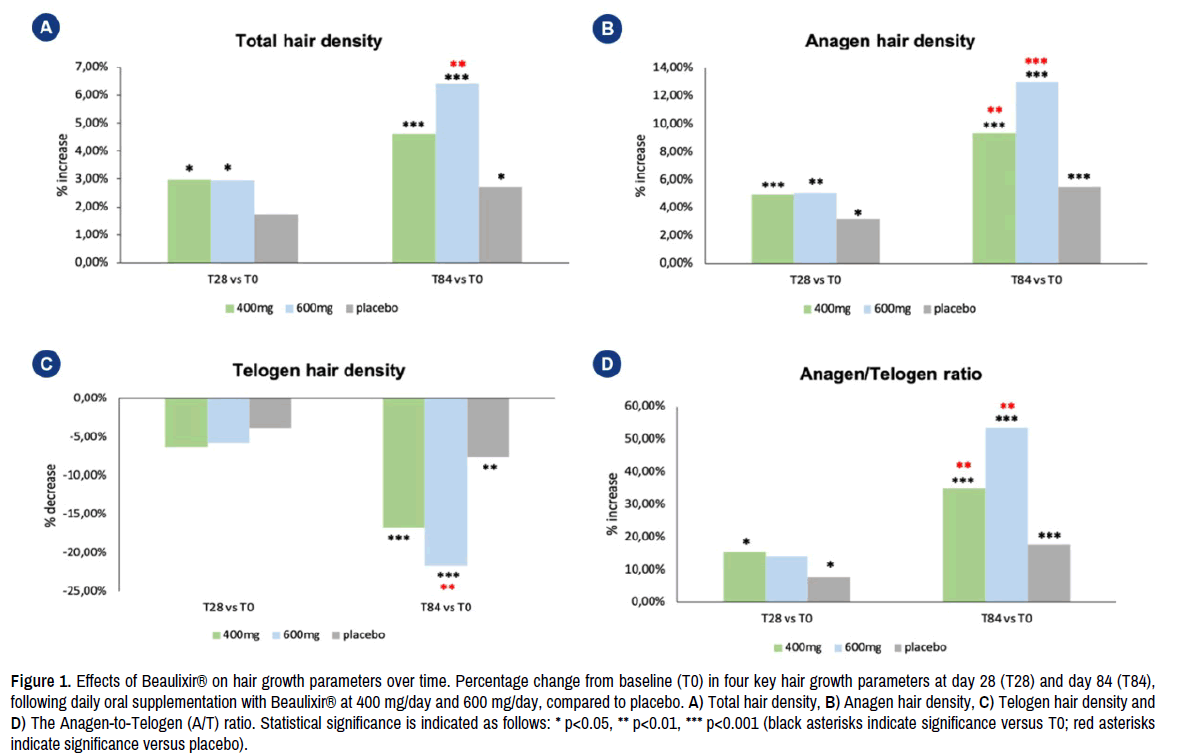
Figure 1. Effects of Beaulixir® on hair growth parameters over time. Percentage change from baseline (T0) in four key hair growth parameters at day 28 (T28) and day 84 (T84), following daily oral supplementation with Beaulixir® at 400 mg/day and 600 mg/day, compared to placebo. A) Total hair density, B) Anagen hair density, C) Telogen hair density and D) The Anagen-to-Telogen (A/T) ratio. Statistical significance is indicated as follows: * p<0.05, ** p<0.01, *** p<0.001 (black asterisks indicate significance versus T0; red asterisks indicate significance versus placebo).
Ethnic-specific outcomes
In the Caucasian population, a progressive increase in hair shaft thickness was observed beginning at day 28, reaching statistical significance after 84 days of treatment with 600 mg/day of Beaulixir® This increase was significant both vs. baseline (T0) (p < 0.001) and vs. the placebo group (p < 0.05) (Figure 2d). A significant improvement in hair elasticity (elongation) among Caucasian subjects was also observed after 84 days of treatment with 600 mg/day (p < 0.05) (Figure 2c). As for hair luminosity, in the Caucasian group, a statistically significant increase in brightness was observed in the 600 mg/day-treatment group, both compared to baseline (p < 0.01) and placebo group (p < 0.05) (Figure 2b). In the Asian subgroup, hair luminosity also increased after 84 days of treatment with 400 mg/day of Beaulixir®, although this change did not reach statistical significance. In contrast, the 600 mg/day dose produced a stunning (almost +30%) and statistically significant improvement in brightness compared to baseline (p < 0.01) and placebo (p < 0.001) (Figure 2a).
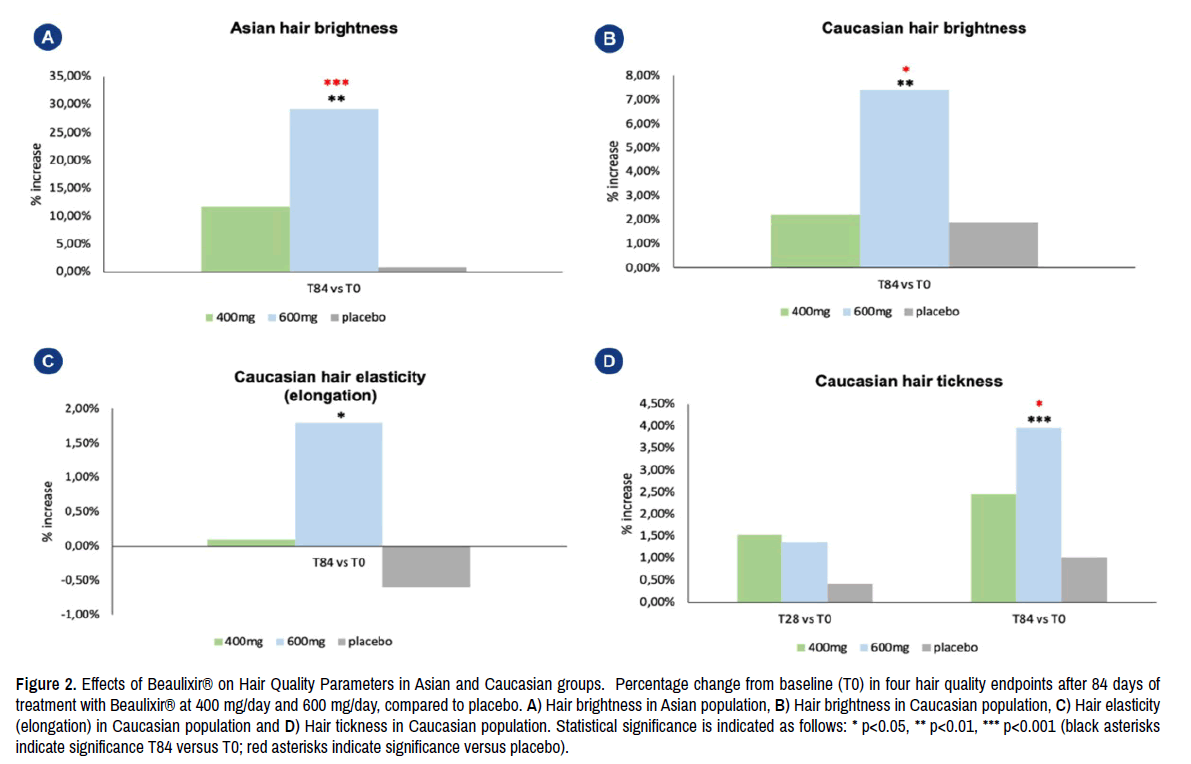
Figure 2. Effects of Beaulixir® on Hair Quality Parameters in Asian and Caucasian groups. Percentage change from baseline (T0) in four hair quality endpoints after 84 days of treatment with Beaulixir® at 400 mg/day and 600 mg/day, compared to placebo. A) Hair brightness in Asian population, B) Hair brightness in Caucasian population, C) Hair elasticity (elongation) in Caucasian population and D) Hair tickness in Caucasian population. Statistical significance is indicated as follows: * p<0.05, ** p<0.01, *** p<0.001 (black asterisks indicate significance T84 versus T0; red asterisks indicate significance versus placebo).
Phototrichogram analysis
Figures 3 and 4 present representative phototrichograms from two subjects treated with Beaulixir® at different dosages, illustrating the progression of hair regrowth parameters over the 84-day intervention period.
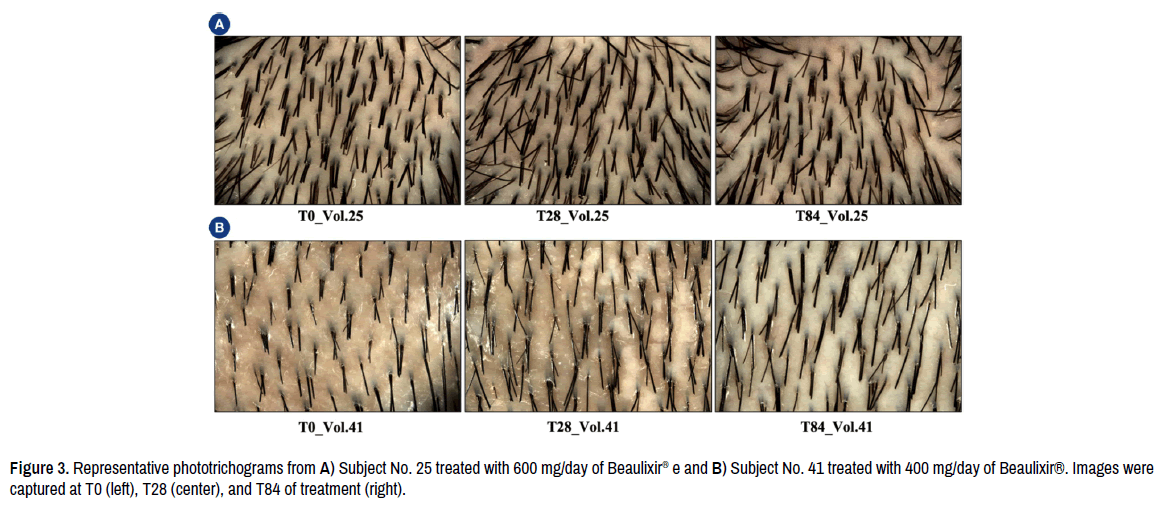
Figure 3. Representative phototrichograms from A) Subject No. 25 treated with 600 mg/day of Beaulixir® e and B) Subject No. 41 treated with 400 mg/day of Beaulixir®. Images were captured at T0 (left), T28 (center), and T84 of treatment (right).
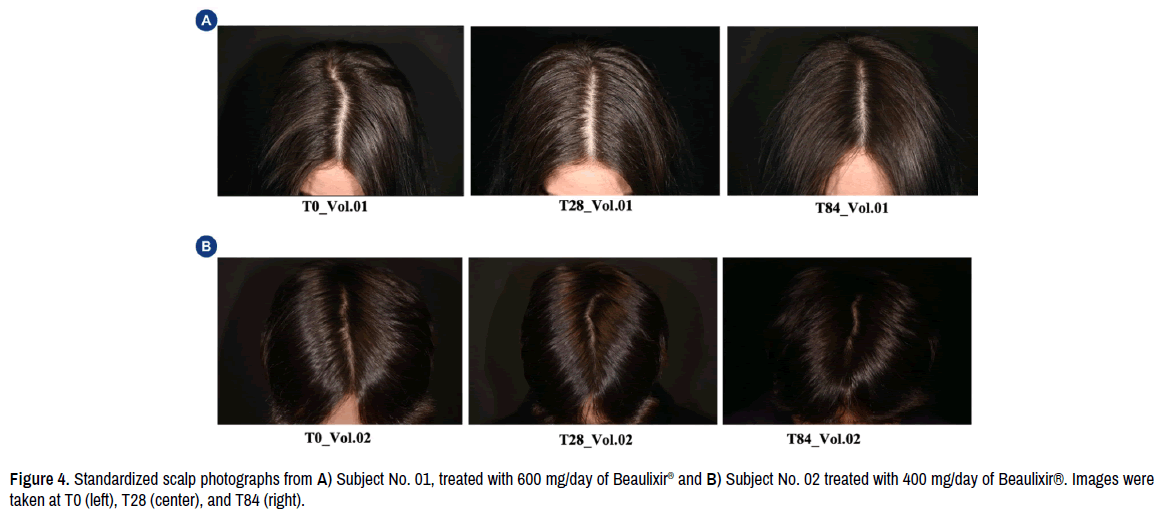
Figure 4. Standardized scalp photographs from A) Subject No. 01, treated with 600 mg/day of Beaulixir® and B) Subject No. 02 treated with 400 mg/day of Beaulixir®. Images were taken at T0 (left), T28 (center), and T84 (right).
Subject No. 25, who received 600 mg/day of Beaulixir®, is shown in Figure 3a. At baseline (T0), the scalp displays sparse hair density with multiple follicles occupied by single, thin hair shafts. After 28 days of treatment (T28), a visible increase in follicular occupancy is evident. The density of double and triple follicular units begins to rise, suggesting a potential modulation of the anagen-phase follicles. The hair shafts also appear structurally aligned. By day 84 (T84), there is a marked improvement in total hair density, with robust and uniformly thick terminal hairs distributed across the scalp, reduced inter-follicular spacing and a clear rejuvenation of the scalp microenvironment. Subject No. 41, treated with 400 mg/day of Beaulixir®, is depicted in Figure 3b. At baseline (T0), the hair density is similarly reduced, with thin shafts and frequent follicular units harboring single hairs. After 28 days of treatment (T28), subtle improvements in hair shaft thickness and follicular activity can be observed, although less pronounced than in the 600 mg group. By day 84 (T84), a further increase in density and shaft caliber is evident, including a modest rise in multi-hair follicular units. However, the extent of improvement is comparatively lower than in Subject 25, supporting a dose-dependent effect of Beaulixir®.
Together, these results support the quantitative findings of the study, demonstrating increased total and anagen hair density, reduced telogen hair count and improvement in the anagen-to-telogen ratio over time. The more prominent effects observed in the 600 mg group underscore the greater efficacy of the higher dosage in promoting scalp revitalization.
Clinical photography evaluation
Standardized global scalp photographs were obtained under consistent lighting and positioning conditions at baseline, day 28 and day 84 for two representative subjects treated with Beaulixir®. Subject No. 01, treated with 600 mg/day of Beaulixir®, is shown in Figure 4a. At baseline (T0), the subject presents with visible hair thinning along the central part line, with sparse coverage and noticeable scalp visibility. After 28 days of treatment (T28), a modest visual improvement is evident, with a slight reduction in part width At day 84 (T84), the improvement becomes more pronounced, with significantly greater hair density and coverage, reduced scalp exposure and improved hair luster. The hair appears more voluminous, supporting the quantitative data regarding increased hair density, thickness and shaft integrity. Subject No. 02, who received 400 mg/day of the supplement, is depicted in Figure 4b. At baseline (T0), the central parting area appears widened with clearly visible scalp. After 28 days (T28), a reduction in part width is observed, along with signs of improved hair distribution. By day 84 (T84), further improvement is noted, including enhanced hair volume and reduced scalp visibility. However, the overall extent of improvement is less pronounced than that observed in the 600 mg subject, supporting the observed dose–response trend. These findings provide visual confirmation of Beaulixir®’s efficacy in promoting scalp coverage and improving hair quality over the 84-day treatment period. Notably, the improvements in both groups align with the trichometric and phototrichogram data, reinforcing the potential of Beaulixir® as an effective oral intervention for hair thinning, with greater outcomes at the higher dosage.
Self-assessment outcomes
Over 70% of subjects in both active groups reported improvement in hair strength, brightness and volume. More than 60% reported reduced hair loss. Treatment satisfaction was rated “good” to “excellent” by >80% of users (Figure 5).
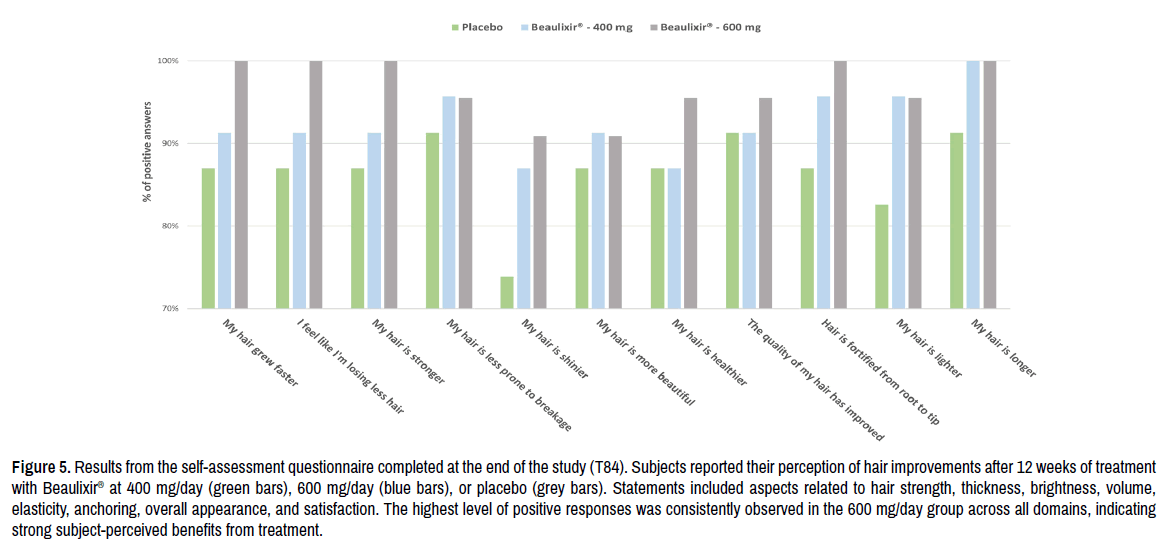
Figure 5. Results from the self-assessment questionnaire completed at the end of the study (T84). Subjects reported their perception of hair improvements after 12 weeks of treatment with Beaulixir® at 400 mg/day (green bars), 600 mg/day (blue bars), or placebo (grey bars). Statements included aspects related to hair strength, thickness, brightness, volume, elasticity, anchoring, overall appearance, and satisfaction. The highest level of positive responses was consistently observed in the 600 mg/day group across all domains, indicating strong subject-perceived benefits from treatment.
This randomized, placebo-controlled clinical trial demonstrated the significant efficacy of Beaulixir® in improving hair parameters in subjects affected by acute Telogen Effluvium (aTE) in the six months before the study. Beyond traditional clinical assessments, the integration of instrumental evaluations such as phototrichogram, spectrophotometry and dynamometry has allowed for a precise, reproducible and objective characterization of follicular activity and hair shaft properties across different subject groups. The phototrichogram, as applied in this study, represents a cornerstone in trichological research due to its ability to quantify changes in hair growth dynamics over time [24, 25]. By evaluating parameters such as total hair density, anagen/telogen ratio and shaft thickness, phototrichogram provides a direct reflection of follicular response to therapeutic interventions. The methodology used, based on the TrichoScan® system, enabled accurate, non-invasive monitoring at baseline and follow-up timepoints (T28, T84), yielding data that corroborate the clinical progression observed in macrophotography and patient self-assessments. Moreover, the capability to detect early improvements in anagen-phase activation as soon as 28 days post-treatment highlights its utility in tracking biologically relevant endpoints in short- to mid-term studies.
The molecular mechanisms underlying the clinical efficacy of Beaulixir® can be attributed to the synergistic action of its phytocomplex, which targets multiple biological pathways involved in the pathogenesis of aTE and hair fiber degradation. The formulation includes plant-derived oils [e.g., Borago officinalis, Linum usitatissimum, Triticum vulgare, Serenoarepens] and phytosterols from Pinus sylvestris and Secale cereale, each of which contributes to a specific mechanism.
One of the most compelling outcomes of this clinical trial is the early onset of significant improvements observed in both active treatment groups as early as 28 days (T28) after initiating the nutritional supplementation. This rapid clinical response is particularly relevant in the context of aTE, a condition often characterized by acute onset and high psychological burden. At T28, both the 400 mg/day and 600 mg/day groups showed statistically significant increases in total hair density compared to baseline (T0), indicating a rapid follicular response to treatment and suggesting prompt activation of the anagen phase. Notably, the 600 mg group already demonstrated a significant difference vs. placebo at T28, underscoring the superior efficacy of the higher dosage even within the first month of treatment.
The increase in the anagen hair density accompanied by a parallel decrease in telogen hair density reflects a biologically meaningful modulation of the hair cycle and suggests that the phytocomplex contained in Beaulixir® begins to exert its effect within the first 4 weeks of use. This supplement demonstrated clinical efficacy within one month, confirmed through standardized and instrument-based assessments.
Furthermore, although not all secondary endpoints reached significance at T28, improvements in hair shaft diameter, follicular occupancy and hair texture were already visible in phototrichograms and macrophotographs particularly in subjects treated with 600 mg/day. These visual outcomes provide qualitative support for the quantitative instrumental findings and further reinforce the biological plausibility of a fast-acting, multi-target mechanism. By T84, these effects were even more pronounced and statistically robust across nearly all endpoints (hair density, anagen/telogen ratio, brightness, thickness, elasticity), with significant differences compared to both baseline and placebo. However, the early significant effects of the tested nutritional supplement at T28 represent a major strength of this study.
Importantly, Beaulixir® demonstrated efficacy across all subgroups: In both males and females, indicating that the supplement is effective regardless of sex-based hormonal differences. Among Caucasian subjects, the 600 mg dose produced significant improvements in hair thickness, elasticity and brightness, indicating a potential structural benefit tailored to this subgroup’s hair morphology. The phototrichogram and dynamometry data confirm a structural benefit at the follicle and shaft level. In Asian subjects, while elasticity improvements were less pronounced (likely due to naturally lower hair fiber extensibility), a significant enhancement in brightness was observed, even with the 400 mg dose. This suggests that Beaulixir® may offer cosmetic and structural advantages tailored to the physicochemical properties of Asian hair. Together, these findings suggest ethnically tailored advantages, likely attributable to inherent differences in hair morphology and follicular response, further supporting the benefits Beaulixir® provides in multi-ethnic populations.
In addition to objective measurements, the self-assessment data revealed a high level of perceived improvement among participants taking the active supplement. The alignment between instrumental results and subjective perception is a critical factor for long-term adherence and satisfaction in hair health interventions. Over 70% of subjects in both treated groups reported enhanced strength, shine and volume of hair, as well as reduced hair shedding findings that support both the biological activity and cosmetic appeal of the product. Importantly, the product was well tolerated across all groups, with no serious adverse events and an overall compliance rate exceeding 80%. The multiethnic nature of the study population, including both Asian and Caucasian individuals, increases the generalizability of these findings and highlights the broad applicability of the formulation across different hair types and scalp conditions.
Some limitations of the study should also be acknowledged. The duration of 84 days may underestimate the long-term benefits and sustainability of the treatment and future research should investigate the long-term sustainability of these effects, ideally over 6–12 months. These data could be informative for the potential use of Beaulixir® in chronic or relapsing TE subjects.
In conclusion, the combined use of objective measures (phototrichogram, spectrophotometry, dynamometry) and subjective assessments provides a holistic understanding of the supplement’s impact. The alignment between biological improvements and patient satisfaction (reported by over 80% of users) suggests a high likelihood of real-world compliance and long-term use. Furthermore, the lack of serious adverse events and high compliance rate across males and females, Caucasians and Asians, supports Beaulixir® as a safe and effective nutraceutical intervention with a favorable risk–benefit profile.
Institutional Review Board and Informed Consent Statement
The protocol H.E.HU.TE.NHL00.060.08.00_IT0006541/23 Rev.01 by 28th December 2023, the clinical study informed consent, the clinical study information sheet and the documents titled “SINOSSI”, “CONSENSO INFORMATO”, “INFORMATIVA PRIVACY” and “FINAL QUESTIONNAIRE” were evaluated and approved by an Independent Ethical Committee “Comitato Etico Indipendente per le indagini Cliniche Non Farmacologiche”.
The APC was funded by ROELMI HPC, Origgio, VA (Italy), which had no role in the study design, data collection, or interpretation.
AI-based tools were used to support the text revision. The authors wish to acknowledge MediAbout Srl, Milan, Italy, for editorial assistance.
The sponsors had no role in the design, execution, interpretation, or writing of the study.
Google Scholar, Cross Ref, Indexed at
Google Scholar, Cross Ref, Indexed at
Google Scholar, Cross Ref, Indexed at
Google Scholar, Cross Ref, Indexed at
Google Scholar, Cross Ref, Indexed at
Google Scholar, Cross Ref, Indexed at
Google Scholar, Cross Ref, Indexed at
Google Scholar, Cross Ref, Indexed at
Google Scholar, Cross Ref, Indexed at
Google Scholar, Cross Ref, Indexed at
Google Scholar, Cross Ref, Indexed at
Google Scholar, Cross Ref, Indexed at
Google Scholar, Cross Ref, Indexed at
Google Scholar, Cross Ref, Indexed at
Google Scholar, Cross Ref, Indexed at
Google Scholar, Cross Ref, Indexed at
Google Scholar, Cross Ref, Indexed at
Google Scholar, Cross Ref, Indexed at
Google Scholar, Cross Ref, Indexed at
Google Scholar, Cross Ref, Indexed at
Google Scholar, Cross Ref, Indexed at
Google Scholar, Cross Ref, Indexed at
Journal of Cosmetology & Trichology received 180 citations as per Google Scholar report