Short Communication - (2025) Volume 15, Issue 2
Received: 02-Jun-2025, Manuscript No. jpdbd-25-164664;
Editor assigned: 04-Jun-2025, Pre QC No. P-164664;
Reviewed: 16-Jun-2025, QC No. Q-164664;
Revised: 23-Jun-2025, Manuscript No. R-164664;
Published:
30-Jun-2025
, DOI: 10.37421/2153-0769.2025.15.421
Citation: Lucas, Hudson. “Metabolomic Methodologies: Bridging Scientific Research and Clinical Practice.” Metabolomics 15 (2025): 421.
Copyright: © 2025 Lucas H. This is an open-access article distributed under the terms of the Creative Commons Attribution License, which permits unrestricted use, distribution, and reproduction in any medium, provided the original author and source are credited.
Metabolomic methodologies have become a cornerstone of modern biomedical research offering powerful tools that bridge the gap between basic scientific discovery and clinical practice. Metabolomics refers to the comprehensive study of small molecules commonly known as metabolites within cells tissues or organisms. These metabolites are the end products of cellular processes and their levels can be seen as the final response of biological systems to genetic regulation environmental stimuli or disease processes. Because of this unique position metabolites offer a snapshot of the physiological state of an organism providing crucial insights that can be used for both diagnostics and therapeutic interventions. The growing interest in metabolomics over the past two decades has been driven by technological advancements improved data analysis techniques and the increasing need for more personalized approaches in healthcare. At the heart of metabolomics is the ability to detect quantifies and interprets the presence of thousands of metabolites in a given biological sample. These samples can include blood urine saliva cerebrospinal fluid and tissue extracts each offering different insights depending on the context of the study. The complexity and diversity of metabolites in these samples require sophisticated analytical platforms with high sensitivity and resolution. The two most commonly employed techniques in metabolomics analysis are mass spectrometry and nuclear magnetic resonance spectroscopy. Mass spectrometry provides highly sensitive and specific detection of a wide range of metabolites especially when coupled with chromatographic techniques such as gas chromatography or liquid chromatography. These methods allow for the separation of complex mixtures and help identify specific metabolic signatures associated with particular physiological or pathological states [1].
Nuclear magnetic resonance spectroscopy on the other hand is known for its reproducibility and minimal sample preparation requirements. It is especially useful for analyzing biofluids and offers nondestructive analysis with high reproducibility which makes it ideal for longitudinal studies where samples may be limited. Although NMR has lower sensitivity compared to mass spectrometry its ability to provide structural information and its quantitative robustness make it a valuable tool in the metabolomic toolkit. The complementary nature of these analytical techniques often leads to integrated workflows where both mass spectrometry and NMR are used together to increase coverage and confidence in metabolite identification. Beyond the analytical techniques the success of metabolomic studies also relies on meticulous experimental design and sample preparation. Factors such as sample storage time temperature and preparation protocols can greatly affect metabolite stability and therefore the reliability of the data. Researchers have to carefully control these variables to ensure reproducibility and minimize noise in the data. Furthermore data preprocessing normalization and statistical analysis are essential steps that require robust computational pipelines. Software tools and bioinformatics platforms have been developed to handle large metabolomic datasets including feature extraction peak alignment and metabolite annotation. The integration of statistical tools such as principal component analysis partial least squares discriminant analysis and machine learning algorithms enables researchers to identify meaningful patterns and biomarkers from complex datasets [2].
In infectious diseases metabolomics can be used to understand host pathogen interactions and the metabolic changes that occur during infection. For instance during a viral infection the host metabolism is often hijacked to facilitate viral replication. By analyzing these changes researchers can identify potential therapeutic targets or markers that predict disease severity. In the context of pandemics such as COVID 19 metabolomics was employed to study the metabolic alterations in infected patients helping to identify biomarkers for disease severity prognosis and therapeutic response. This approach added a new dimension to our understanding of viral pathogenesis and host immune response. A crucial aspect of translating metabolomic findings into clinical practice is the validation and standardization of methodologies. Because of the inherent variability in biological samples and analytical techniques it is essential to establish standardized protocols and reference materials. Large scale multi center studies and biobanks play a key role in this process enabling the validation of biomarkers across different populations and settings. Regulatory bodies and professional organizations are also working to establish guidelines for the clinical application of metabolomics including quality control data interpretation and clinical reporting. This is essential to ensure that metabolomic tests meet the stringent requirements for clinical diagnostics and are accepted by healthcare providers and regulatory agencies [3].
Another important consideration is the integration of metabolomics with other omics technologies such as genomics transcriptomics and proteomics. This systems biology approach allows for a more comprehensive understanding of disease mechanisms by linking genetic variations gene expression patterns protein activity and metabolic changes. Integrative analysis can reveal how genetic predispositions manifest as metabolic phenotypes or how environmental exposures influence gene expression through metabolic intermediates. Such holistic perspectives are particularly valuable in complex multifactorial diseases where single omics approaches may fall short in capturing the full picture. Personalized medicine is perhaps the most compelling application of metabolomics in clinical practice. By tailoring medical treatments to the individual characteristics of each patient including their metabolic profile healthcare can become more precise and effective. Metabolomics can help identify responders and non-responders to specific therapies predict adverse reactions and monitor therapeutic efficacy in real time. For instance in oncology metabolic profiling can be used to identify patients who are likely to benefit from specific chemotherapeutic agents or targeted therapies. In psychiatry metabolic markers could help distinguish between patients who are likely to respond to selective serotonin reuptake inhibitors versus other classes of antidepressants thus reducing the trial and error approach currently used in prescribing psychiatric medications [4].
Despite the enormous potential of metabolomics several challenges remain in its widespread adoption in clinical settings. One major hurdle is the complexity of data interpretation. The human metabolome is vast dynamic and influenced by numerous factors including diet lifestyle microbiome medications and circadian rhythms. Distinguishing disease specific signals from background noise requires sophisticated statistical models and validation in diverse populations. Moreover the high cost of metabolomic platforms and the need for specialized expertise can be barriers to implementation particularly in resource limited settings. Efforts are underway to address these challenges through technological innovation training of healthcare professionals and development of user friendly analytical tools. Advances in miniaturization and automation are making metabolomic instruments more accessible while cloud based platforms and artificial intelligence are simplifying data analysis and interpretation. Education and training programs are also being developed to equip clinicians and laboratory personnel with the skills needed to incorporate metabolomics into routine practice [5].
Google Scholar Cross Ref Indexed at
Google Scholar Cross Ref Indexed at
Google Scholar Cross Ref Indexed at
Google Scholar Cross Ref Indexed at
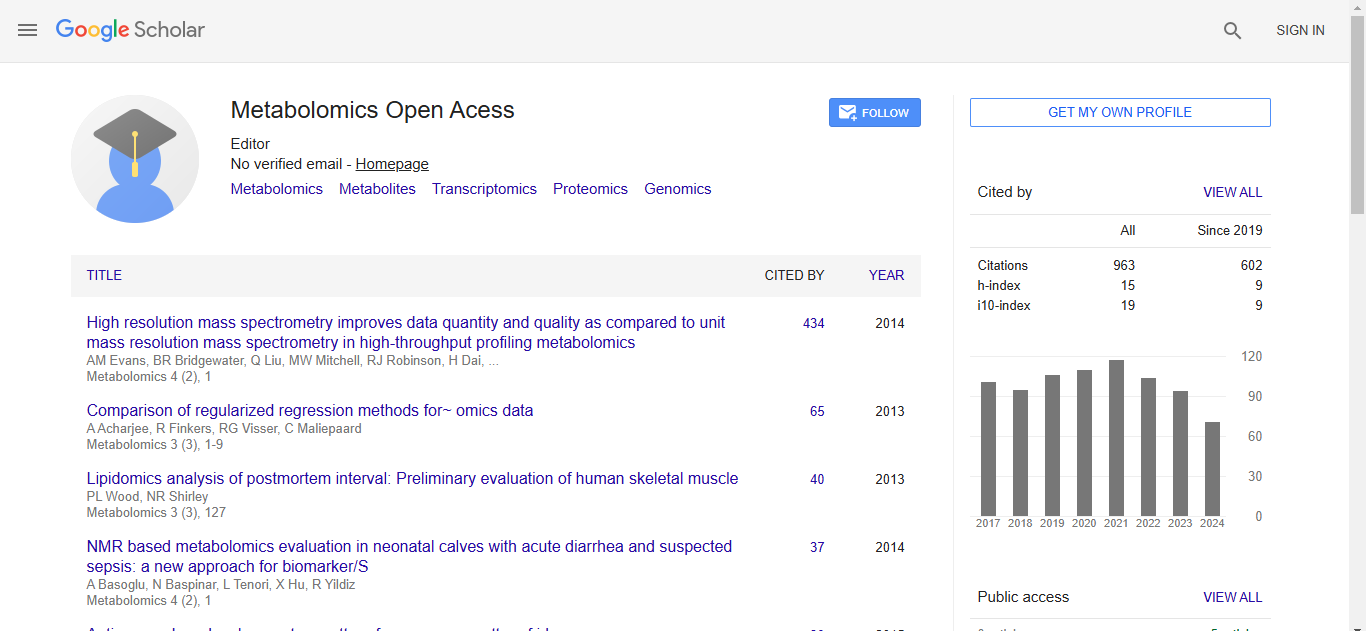
Metabolomics:Open Access received 895 citations as per Google Scholar report