Opinion - (2025) Volume 11, Issue 2
Received: 01-Apr-2025, Manuscript No. jctt-26-188389;
Editor assigned: 03-Apr-2025, Pre QC No. P-188389;
Reviewed: 17-Apr-2025, QC No. Q-188389;
Revised: 22-Apr-2025, Manuscript No. R-188389;
Published:
29-Apr-2025
, DOI: 10.37421/2471-9323.2024.10.315
Citation: Carter, Emily. ”Science-Driven Holistic Approach to Radiant Skin, Hair.” J Cosmo Tricho 11 (2025):315.
Copyright: © 2025 Carter E. This is an open-access article distributed under the terms of the Creative Commons Attribution License, which permits unrestricted use, distribution and reproduction in any medium, provided the original author and source are credited.
The burgeoning field of cosmetic and trichological science increasingly recognizes the profound influence of natural ingredients on skin and hair vitality. Traditional knowledge, once considered anecdotal, is now being rigorously validated by modern scientific inquiry, revealing synergistic effects of botanical extracts and active compounds that promote radiance and health [1].
Skin health is significantly impacted by the efficacy of active ingredients, which can be dramatically enhanced through advanced delivery systems. Technologies such as liposomes and nanoparticles are crucial for improving the penetration and bioavailability of beneficial compounds, leading to superior hydration and a luminous complexion [2].
The scalp microbiome plays a pivotal role in maintaining healthy hair growth. An imbalance, or dysbiosis, in the delicate ecosystem of microorganisms on the scalp can manifest as common issues like dandruff and hair thinning, necessitating targeted interventions for microbial equilibrium [3].
Environmental stressors, particularly ultraviolet radiation and atmospheric pollution, pose significant threats to skin integrity, accelerating aging and diminishing radiance. Understanding the molecular mechanisms of damage is key to developing effective protective strategies [4].
Bioactive peptides are emerging as potent agents in both hair regeneration and anti-aging skincare. By stimulating cellular processes vital for collagen production and hair follicle activity, these peptides contribute to a healthier scalp and more vibrant skin [5].
Novel natural compounds, particularly plant-derived polyphenols, are being investigated for their remarkable photoprotective and antioxidant properties. Their ability to scavenge free radicals and absorb UV radiation offers enhanced protection against photodamage and premature aging [6].
Dietary intake significantly influences skin health and appearance, with micronutrients playing a critical role in achieving radiance. Vitamins, minerals, and essential fatty acids are fundamental for robust skin barrier function and antioxidant defense [7].
Fermented ingredients represent a promising advancement in skincare, offering enhanced skin microbiome balance and barrier function. The fermentation process can increase ingredient bioavailability, leading to improved hydration and reduced inflammation [8].
Air pollution presents a tangible threat to hair fiber integrity and scalp health. Environmental pollutants can degrade hair quality, leading to dullness and increased breakage, underscoring the need for protective hair care formulations [9].
Biochemical pathways governing skin hydration are central to maintaining a healthy barrier, which is essential for moisture retention and protection against irritants. Key ingredients like humectants, emollients, and occlusives work synergistically to achieve optimal skin radiance [10].
The efficacy of botanical extracts in cosmetic and trichological applications is a growing area of research, driven by a desire to harness natural ingredients. This field integrates traditional wisdom with scientific validation to develop innovative formulations that enhance skin and hair health, emphasizing the synergistic effects of plant-derived compounds for radiance and vitality [1].
Advanced delivery systems are transforming the performance of active ingredients in skincare. Encapsulation technologies, such as liposomes and nanoparticles, are essential for optimizing the penetration and bioavailability of compounds like antioxidants and humectants, ultimately improving skin hydration and luminosity [2].
The scalp microbiome's delicate balance is fundamental to hair health and growth. Research highlights how disruptions in this microbial community can lead to conditions such as dandruff and hair thinning, making interventions that restore equilibrium crucial for a healthy scalp environment [3].
Environmental factors, notably UV radiation and pollution, significantly contribute to skin aging and loss of radiance. Understanding the molecular pathways by which these stressors damage skin cells and impair collagen synthesis is critical for developing effective protection strategies [4].
Peptides are increasingly recognized for their therapeutic potential in hair regeneration and anti-aging skincare. Specific bioactive peptides can stimulate cellular processes like collagen production and hair follicle activity, leading to improved scalp health and skin vibrancy [5].
Novel natural compounds possess significant photoprotective and antioxidant properties, making them valuable for cosmetic applications. Plant-derived polyphenols, for instance, can effectively scavenge free radicals and absorb UV radiation, thus protecting skin from damage and premature aging [6].
Dietary factors play a crucial role in skin health and appearance, particularly the micronutrients essential for radiance. Vitamins, minerals, and essential fatty acids are vital for maintaining skin barrier function, supporting collagen synthesis, and bolstering antioxidant defenses [7].
Fermented ingredients offer a unique advantage in skincare by enhancing skin microbiome balance and barrier function. Fermentation can boost the bioavailability and efficacy of cosmetic ingredients, leading to better hydration, reduced inflammation, and a brighter complexion [8].
The impact of air pollution on hair and scalp health is a growing concern. Pollutants can damage the hair fiber, leading to dullness and increased susceptibility to breakage, necessitating protective measures in hair care product development [9].
Understanding the biochemistry of skin hydration is paramount for maintaining a healthy skin barrier. Ingredients like humectants, emollients, and occlusives work synergistically to ensure proper moisture retention, protection, and overall skin radiance [10].
This compilation of research explores various facets of skin and hair health, emphasizing the scientific validation of natural ingredients and advanced formulation techniques. It highlights the importance of botanical extracts, bioactive peptides, and fermented ingredients for enhancing radiance and vitality. The role of the scalp microbiome and the detrimental effects of environmental stressors like pollution and UV radiation are also discussed. Furthermore, the study delves into the impact of diet on skin health and the biochemical mechanisms of skin hydration, underscoring the significance of a healthy skin barrier. Advanced delivery systems are presented as crucial for maximizing the efficacy of active cosmetic ingredients, contributing to improved skin appearance and resilience. Overall, the content advocates for a science-driven, holistic approach to achieving luminous skin and healthy hair.
None
None
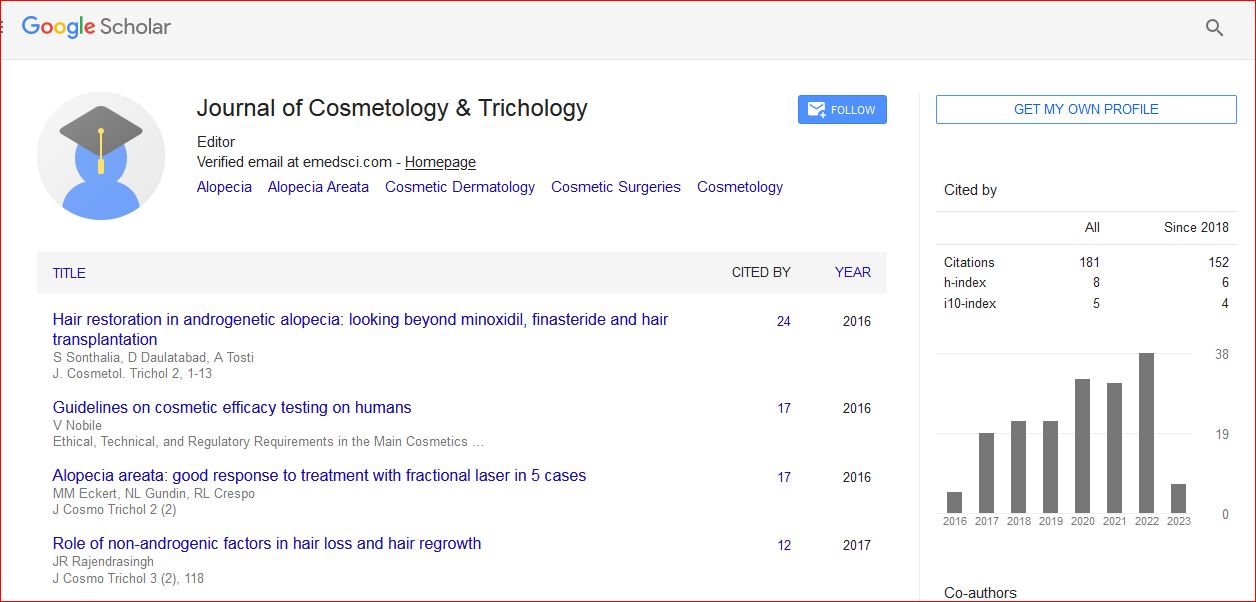
Journal of Cosmetology & Trichology received 180 citations as per Google Scholar report