Brief Report - (2025) Volume 15, Issue 4
Received: 01-Dec-2025, Manuscript No. jttr-25-175452;
Editor assigned: 03-Dec-2025, Pre QC No. P-175452;
Reviewed: 17-Dec-2025, QC No. Q-175452;
Revised: 22-Dec-2025, Manuscript No. R-175452;
Published:
29-Dec-2025
, DOI: 10.37421/2161-0991.2025.15.316
Citation: Brookfield, David N.. ”iPSCs: Revolutionizing Biomedical Research and Therapy.” J Transplant Technol Res 15 (2025):316.
Copyright: © 2025 Brookfield N. David This is an open-access article distributed under the terms of the Creative Commons Attribution License, which permits unrestricted use, distribution and reproduction in any medium, provided the original author and source are credited.
Induced pluripotent stem cells (iPSCs) have dramatically reshaped biomedical research, establishing a unique platform for modeling intricate human diseases and developing new therapeutic strategies. They are essential for personalized medicine, drug discovery, and regenerative approaches, though challenges in clinical translation persist [1].
Human iPSC-derived cardiomyocytes are increasingly vital in vitro models, enabling research into cardiovascular diseases, drug screening, and the development of regenerative therapies. They are crucial for understanding cardiac pathophysiology and assessing cardiotoxicity, moving beyond traditional animal models [2].
iPSC technology significantly impacts the understanding of neurodegenerative disorders, allowing for patient-specific neuronal models. This helps investigate disease mechanisms, identify therapeutic targets, and conduct preclinical drug screening for conditions like Alzheimer's and Parkinson's, offering a personalized treatment path [3].
Combining iPSCs with advanced genome editing, like CRISPR-Cas9, provides unprecedented potential to correct genetic defects in inherited diseases. This strategy enables the creation of disease-corrected, patient-specific cells for therapeutic transplantation, marking a major step towards curative treatments [4].
iPSCs present distinct opportunities in cancer research, including creating patient-specific tumor models, studying cancer initiation, progression, and developing new anti-cancer drug screening platforms. They can be engineered to mimic cancerous conditions, identify vulnerabilities, and contribute to novel immunotherapies or drug discovery for cancer [5].
Induced pluripotent stem cells are transforming drug discovery by offering patient-specific disease models for high-throughput screening, identifying effective compounds in human contexts. This reduces reliance on animal models and speeds up the development of precision medicines for complex genetic disorders and personalized therapies [6].
The clinical translation of iPSCs is rapidly advancing, with trials exploring their use for conditions such as macular degeneration, Parkinson's disease, and heart failure. This highlights the critical journey from basic research to therapeutic application, emphasizing safety, efficacy, and regulatory needs for bringing iPSC-based regenerative medicine to patients [7].
iPSCs are an invaluable tool for studying aging mechanisms and age-related diseases. By generating patient-specific cellular models from aged individuals, researchers investigate cellular senescence, mitochondrial dysfunction, and other aging hallmarks, leading to interventions that promote healthy aging and mitigate associated pathologies [8].
iPSC-derived organoids are revolutionizing biomedical research by creating 3D, self-organizing tissue models that closely mimic human organ physiology and pathology. These sophisticated models allow for more accurate disease modeling, drug toxicity screening, and regenerative medicine applications, bridging in vitro studies with in vivo complexity [9].
iPSCs offer a powerful platform for immunological research, enabling the generation of patient-specific immune cells to study immune diseases, develop immunotherapies, and understand host-pathogen interactions. This technology facilitates modeling immune deficiencies and autoimmune disorders, providing a customizable source for cellular immunotherapies, which advances precision immunology [10].
Induced pluripotent stem cells (iPSCs) are revolutionizing biomedical research by offering an unparalleled platform for modeling complex human diseases and developing innovative therapeutic strategies [1]. They hold immense potential in personalized medicine, facilitating drug discovery, and advancing regenerative approaches across various conditions. For instance, human iPSC-derived cardiomyocytes have emerged as powerful in vitro models for studying cardiovascular diseases, drug screening, and creating regenerative therapies [2]. These models are pivotal for understanding cardiac pathophysiology and assessing cardiotoxicity, providing a significant leap beyond traditional animal models.
The transformative impact of iPSC technology extends to complex neurodegenerative disorders. By enabling the generation of patient-specific neuronal models, iPSCs facilitate the investigation of disease mechanisms, identification of new therapeutic targets, and preclinical drug screening for conditions like Alzheimer's and Parkinson's [3]. This offers a more personalized approach to combating these challenging diseases. Furthermore, combining iPSCs with advanced genome editing tools, such as CRISPR-Cas9, presents an unprecedented opportunity for correcting genetic defects that underlie inherited diseases [4]. This strategy allows for the creation of disease-corrected, patient-specific cells that can be differentiated into various cell types for therapeutic transplantation, marking a crucial step towards curative treatments.
Beyond neurological and genetic conditions, iPSCs provide unique opportunities in cancer research. They allow for the creation of patient-specific tumor models, enabling the study of cancer initiation and progression, and the development of new anti-cancer drug screening platforms [5]. Researchers can engineer iPSCs to mimic cancerous conditions, identify vulnerabilities, and potentially contribute to novel cell-based immunotherapies or drug discovery for cancer treatment. In a broader sense, iPSCs are fundamentally transforming drug discovery by offering patient-specific cell models for various diseases. This facilitates high-throughput screening and helps identify compounds effective in relevant human contexts [6]. This approach minimizes reliance on animal models, thereby accelerating the development of precision medicines, especially for complex genetic disorders and personalized therapies.
The clinical translation of iPSCs is rapidly progressing, with ongoing trials exploring their use in treating conditions such as macular degeneration, Parkinson's disease, and heart failure [7]. This underscores the critical journey from basic research to therapeutic application, emphasizing the essential safety, efficacy, and regulatory considerations for bringing iPSC-based regenerative medicine to patients. Moreover, iPSCs serve as an invaluable tool for studying the fundamental mechanisms of aging and age-related diseases [8]. Generating patient-specific cellular models from aged individuals allows researchers to investigate cellular senescence, mitochondrial dysfunction, and other hallmarks of aging, paving the way for interventions that promote healthy aging and mitigate associated pathologies.
Innovative applications include iPSC-derived organoids, which are revolutionizing biomedical research by creating three-dimensional, self-organizing tissue models that closely mimic human organ physiology and pathology [9]. These sophisticated models enable more accurate disease modeling, drug toxicity screening, and regenerative medicine applications, bridging the gap between in vitro studies and in vivo complexity. Lastly, iPSCs offer a powerful platform for immunological research, facilitating the generation of patient-specific immune cells to study immune diseases, develop immunotherapies, and understand host-pathogen interactions [10]. This technology is key for modeling immune deficiencies and autoimmune disorders, providing a customizable source for cellular immunotherapies and pushing the boundaries of precision immunology.
Induced pluripotent stem cells (iPSCs) are revolutionizing biomedical research by providing an unparalleled platform for disease modeling, drug discovery, and regenerative medicine. These cells allow for the creation of patient-specific models, significantly advancing our understanding of complex human diseases like cardiovascular conditions, neurodegenerative disorders such as Alzheimer's and Parkinson's, and various cancers. iPSCs are critical for high-throughput drug screening, enabling the identification of effective compounds in human-relevant contexts and reducing reliance on traditional animal models. Their utility extends to correcting genetic defects in inherited diseases through advanced genome editing technologies like CRISPR-Cas9, paving the way for curative treatments. Moreover, iPSCs are invaluable for studying the fundamental mechanisms of aging and age-related pathologies, allowing researchers to investigate cellular senescence and mitochondrial dysfunction. The technology also supports the development of sophisticated iPSC-derived organoids, which are three-dimensional tissue models that closely mimic human organ physiology, enhancing disease modeling and drug toxicity screening. Furthermore, iPSCs serve as a powerful tool for immunological research, facilitating the generation of patient-specific immune cells to study autoimmune disorders and develop immunotherapies. The clinical translation of iPSCs is rapidly progressing, with trials demonstrating their potential for treating conditions like macular degeneration and heart failure, while underscoring the importance of safety and efficacy in their therapeutic application. This broad applicability positions iPSCs as a cornerstone for future precision medicine and therapeutic interventions.
None
None
Meysam M, Mohammad-Mahdi M, Mohammad RM. "Induced Pluripotent Stem Cells: A Powerful Tool for Disease Modeling and Therapy".Cell Mol Neurobiol 43 (2023):2487-2503.
Indexed at, Google Scholar, Crossref
Xiaochen G, Rui H, Min Z. "Human induced pluripotent stem cell-derived cardiomyocytes: a promising model for cardiovascular disease".Cell Death Dis 12 (2021):508.
Indexed at, Google Scholar, Crossref
Ai-Ling L, Kai-Chong L, Kai-Yuan T. "iPSC-based disease modelling in neurodegenerative disorders".Mol Cell Neurosci 108 (2020):103551.
Indexed at, Google Scholar, Crossref
Yuan-Yuan P, Rui H, Yong-Gang L. "Genome editing in iPSCs to correct inherited diseases".Cell Regeneration 10 (2021):16.
Indexed at, Google Scholar, Crossref
Anurag S, Saurabh A, Sumit B. "Induced pluripotent stem cells: applications in cancer research and therapy".Stem Cell Rev Rep 17 (2021):1694-1715.
Indexed at, Google Scholar, Crossref
Veronica V, Kevin GE, Lee LR. "Induced Pluripotent Stem Cells in Drug Discovery".Cell 185 (2022):1807-1823.
Indexed at, Google Scholar, Crossref
Shin K, Hiroaki G, Kiyofumi F. "Clinical translation of human induced pluripotent stem cells".Inflamm Regen 42 (2022):47.
Indexed at, Google Scholar, Crossref
Sungho K, Sang-Yeon K, Kyoung-Jin C. "Induced Pluripotent Stem Cells in Aging and Age-Related Diseases".Cells 10 (2021):1254.
Indexed at, Google Scholar, Crossref
Hyelim J, Hyerim H, Yong-Mahn H. "Organoids based on human induced pluripotent stem cells".Cell Mol Life Sci 79 (2022):355.
Indexed at, Google Scholar, Crossref
Lei S, Yue Y, Yuan F. "Applications of induced pluripotent stem cell technology in immunology".Cell Immunol 350 (2020):104052.
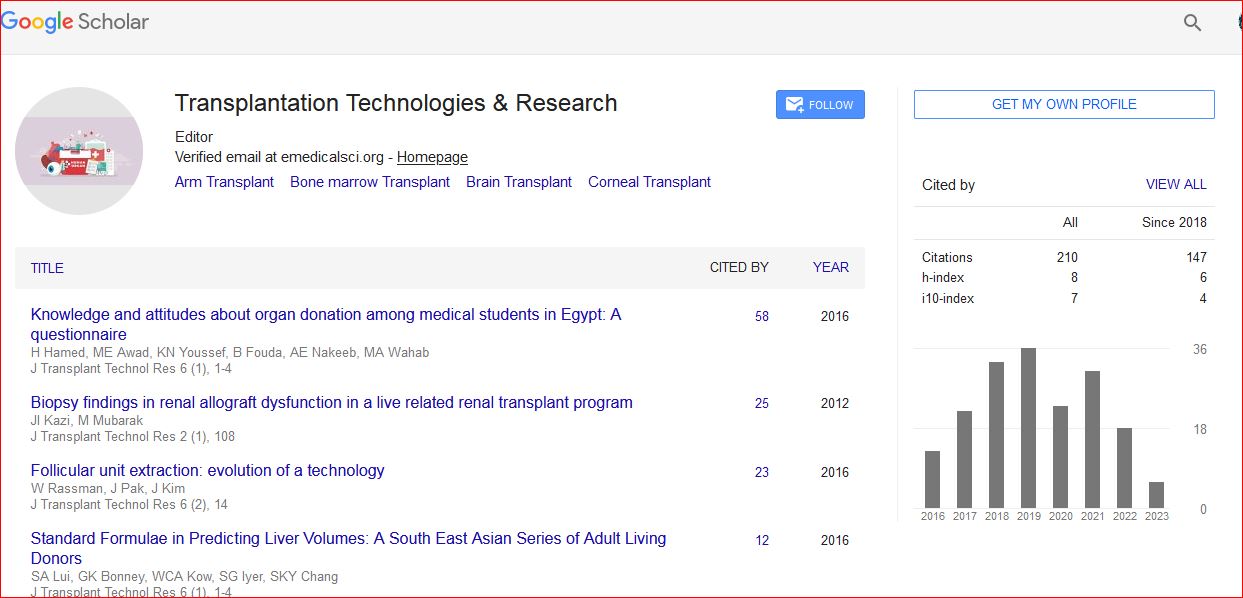
Transplantation Technologies & Research received 223 citations as per Google Scholar report