Commentary - (2025) Volume 11, Issue 2
Received: 01-Apr-2025, Manuscript No. jctt-26-188384;
Editor assigned: 03-Apr-2025, Pre QC No. P-188384;
Reviewed: 17-Apr-2025, QC No. Q-188384;
Revised: 22-Apr-2025, Manuscript No. R-188384;
Published:
29-Apr-2025
, DOI: 10.37421/2471-9323.2024.10.312
Citation: Okafor, Chiamaka. ”Holistic Hair and Skin Health: Integrated Cosmetology Solutions.” J Cosmo Tricho 11 (2025):312.
Copyright: © 2025 Okafor C. This is an open-access article distributed under the terms of the Creative Commons Attribution License, which permits unrestricted use, distribution and reproduction in any medium, provided the original author and source are credited.
The intricate relationship between hair health and skin radiance is a burgeoning area of scientific inquiry, with recent advancements in cosmetology and trichology illuminating novel pathways for achieving luminous locks and silken skin. These fields are increasingly converging, recognizing that holistic beauty stems from a comprehensive understanding of biomolecular mechanisms governing both hair follicles and the epidermis. This cross-disciplinary approach is essential for developing effective strategies that address the multifaceted nature of skin and hair well-being. Investigating the role of specific peptides and growth factors is crucial for stimulating cellular processes vital for both hair follicle vitality and skin rejuvenation. These biomolecules hold significant promise in enhancing the intrinsic properties of skin and hair, offering targeted solutions for cosmetic and dermatological concerns. The research in this domain aims to harness these natural regulators for improved aesthetic outcomes. Oxidative stress represents a significant environmental and biological challenge, negatively impacting both the aging process of the skin and the structural integrity of hair. Understanding its detrimental effects is paramount for developing effective interventions. Antioxidant strategies are being explored to mitigate these damages, promising to restore youthful appearance and hair vitality. The skin microbiome, a complex ecosystem of microorganisms residing on the skin's surface, plays a pivotal role in maintaining epidermal barrier function and influencing hair follicle activity. Emerging research highlights the potential of modulating this microbial community to foster healthier hair growth and improve overall skin health, presenting a new frontier in dermatological care. Mesenchymal stem cell-derived exosomes have emerged as a potent therapeutic agent in regenerative medicine, demonstrating remarkable potential for both hair regeneration and skin rejuvenation. Their ability to deliver therapeutic cargo and communicate with target cells offers a promising avenue for enhancing natural restorative processes. Nutritional status profoundly influences the health and appearance of hair and skin. Specific vitamins, minerals, and fatty acids are essential for critical biological processes, including keratin production, maintaining scalp health, and ensuring epidermal barrier integrity. Optimal nutrition is therefore a foundational element for achieving healthy hair and skin. Low-level laser therapy (LLLT) is gaining traction as a non-invasive therapeutic modality for a range of dermatological conditions, including hair loss and skin aging. Its photobiomodulation effects at the cellular level offer a mechanism for stimulating cellular activity, reducing inflammation, and promoting tissue repair, leading to improved aesthetic outcomes. Advanced delivery systems, such as liposomes and nanoparticles, are revolutionizing the efficacy of cosmetic and dermatological treatments. By enhancing the penetration and bioavailability of active ingredients, these nanocarriers can significantly amplify the beneficial effects on hair growth, strength, and skin hydration, leading to more noticeable and lasting results. Environmental pollutants pose a significant threat to skin and hair health, contributing to oxidative stress and compromising cellular defenses. Understanding these impacts is critical for developing protective strategies. Specialized skincare and haircare formulations are being designed to counteract these detrimental effects and maintain the integrity of hair follicles and the skin barrier. Scalp health is inextricably linked to the overall appearance and growth of hair, as well as contributing to skin health. A healthy scalp environment, characterized by proper hydration, balanced pH, and a robust microbiome, is fundamental for achieving lustrous hair and maintaining healthy skin. Treatments targeting the scalp offer a holistic approach to improving both hair and skin aesthetics.
The intricate relationship between hair follicle health and epidermal barrier function is explored from a biomolecular perspective, highlighting how advancements in cosmetology and trichology are unlocking new avenues for achieving luminous locks and silken skin. The study delves into the biochemical pathways and molecular mechanisms underlying hair growth, shine, and scalp health, alongside the epidermal factors contributing to skin texture and glow, emphasizing evidence-based approaches and emerging technologies for holistic beauty [1].
Specific peptides and growth factors are investigated for their role in stimulating keratinocyte proliferation and melanogenesis, offering insights into enhancing skin elasticity and hair follicle vitality. The research examines how targeted delivery systems can improve the efficacy of these biomolecules for achieving visibly smoother skin and healthier, more lustrous hair [2].
The impact of oxidative stress on hair aging and skin photodamage is reviewed, emphasizing the benefits of antioxidant interventions. The paper discusses novel antioxidant compounds and their mechanisms in protecting cellular structures, leading to improved hair texture and a more youthful skin appearance, with a focus on synergistic combinations for enhanced protective effects [3].
The influence of the skin microbiome on hair follicle function and epidermal barrier integrity is explored, identifying key microbial communities associated with healthy hair and skin. The study proposes microbiome-modulating agents as a promising approach to enhance scalp health, hair growth, and skin texture, offering a new perspective in dermatological and trichological care [4].
Topical exosomes derived from mesenchymal stem cells are investigated for their efficacy in promoting hair regeneration and improving skin quality. The study elucidates the paracrine signaling mechanisms by which exosomes stimulate hair follicle stem cells and enhance collagen synthesis, leading to noticeable improvements in hair density and skin firmness [5].
The impact of specific nutrient deficiencies on hair structure and skin barrier function is examined. The research highlights how essential vitamins, minerals, and fatty acids are critical for keratin production, scalp health, and maintaining a hydrated, supple epidermis, providing recommendations for dietary adjustments and targeted supplementation [6].
Low-level laser therapy (LLLT) is evaluated for its effectiveness in stimulating hair growth and improving skin texture. The study examines the photobiomodulation mechanisms at the cellular level, demonstrating how LLLT can enhance ATP production, reduce inflammation, and promote extracellular matrix remodeling for fuller hair and smoother skin [7].
Advanced delivery systems, such as liposomes and nanoparticles, are explored for their ability to enhance the penetration and efficacy of cosmetic ingredients for hair and skin. The discussion covers how these technologies can improve the bioavailability of active compounds, leading to more pronounced effects on hair growth, strength, and skin hydration and elasticity [8].
The influence of environmental pollutants on hair follicle stem cells and skin barrier integrity is investigated. The article highlights the protective role of specific anti-pollution skincare and haircare formulations, detailing their mechanisms in neutralizing free radicals and strengthening cellular defenses to maintain healthy hair and radiant skin [9].
The critical role of scalp health in overall hair appearance and growth is examined. Key factors contributing to a healthy scalp, including proper hydration, balanced pH, and a robust microbiome, are identified and linked to improved hair shaft quality and reduced shedding, with a discussion on the synergistic effects of scalp treatments on skin health [10].
This collection of research underscores the interconnectedness of hair and skin health, revealing how advancements in cosmetology and trichology offer holistic beauty solutions. Studies explore biomolecular pathways, peptide-based strategies, and antioxidant interventions to enhance skin elasticity, hair vitality, and combat oxidative stress. The influence of the skin microbiome, mesenchymal stem cell-derived exosomes, and essential nutrients are highlighted as crucial for hair regeneration and skin rejuvenation. Furthermore, innovative therapeutic modalities like low-level laser therapy and advanced delivery systems are presented as promising for improving hair growth, strength, and skin texture. The impact of environmental pollutants and the fundamental role of scalp health are also emphasized, collectively pointing towards integrated approaches for achieving optimal hair and skin aesthetics.
None
None
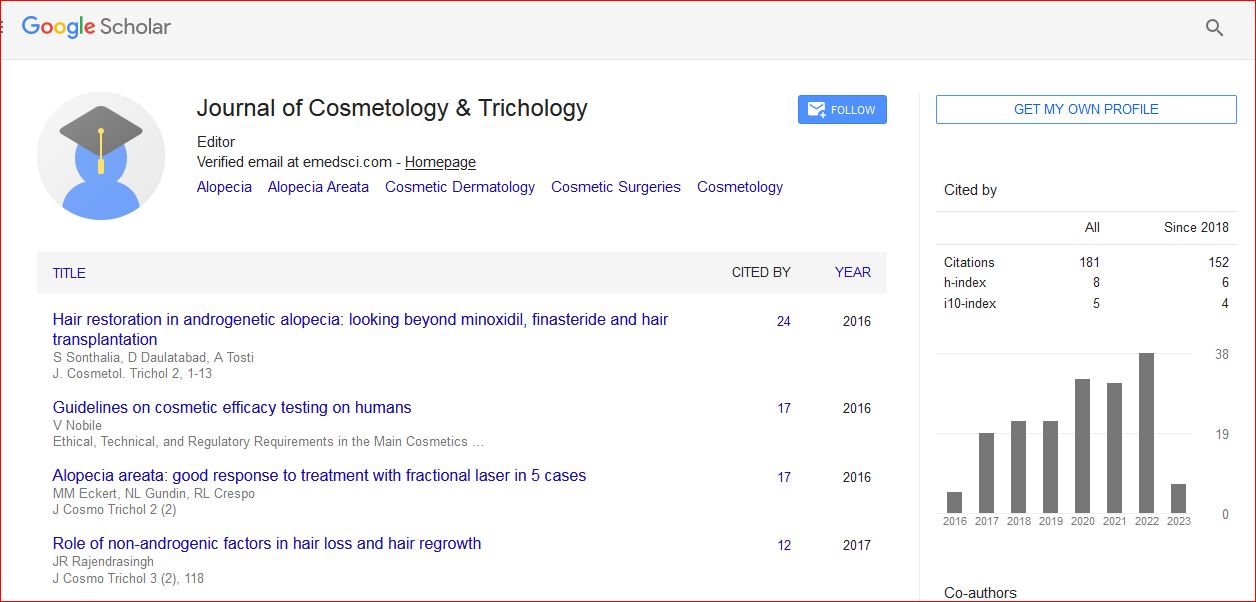
Journal of Cosmetology & Trichology received 180 citations as per Google Scholar report