Brief Report - (2025) Volume 14, Issue 4
Received: 04-Aug-2025, Manuscript No. jees-26-187884;
Editor assigned: 06-Aug-2025, Pre QC No. P-187884;
Reviewed: 20-Aug-2025, QC No. Q-187884;
Revised: 25-Aug-2025, Manuscript No. R-187884;
Published:
30-Aug-2025
, DOI: 10.37421/2332-0796.2025.14.185
Citation: Costa, Beatriz. ”High-Frequency Power Conversion:
Advanced Design And Applications.” J Electr Electron Syst 14 (2025):185.
Copyright: © 2025 Costa B. This is an open-access article distributed under the terms of the Creative Commons Attribution License, which permits unrestricted use, distribution
and reproduction in any medium, provided the original author and source are credited.
The relentless pursuit of higher efficiency and power density in power conversion systems has spurred significant advancements in high-frequency operation and novel circuit topologies. Resonant converter topologies, such as the LLC and those employing Zero Voltage Switching (ZVS) and Zero Current Switching (ZCS), are at the forefront of this evolution, enabling substantial improvements in performance for demanding applications like data centers and electric vehicles [1].
The emergence of wide bandgap semiconductor devices, particularly Gallium Nitride (GaN) and Silicon Carbide (SiC), has been a pivotal development, offering superior switching characteristics compared to traditional silicon-based components. These materials facilitate lower switching losses and enable the use of smaller passive components, thereby driving an increase in power density and overall efficiency within high-frequency converters [2].
Complementing hardware innovations, sophisticated digital control strategies are revolutionizing the design and operation of high-frequency switching power converters. Digital implementation provides unprecedented flexibility and programmability, allowing for the integration of advanced control algorithms that enhance dynamic response, improve efficiency, and adapt to varying operating conditions [3].
The analysis of interleaved multi-phase converters operating at high frequencies reveals significant benefits in terms of reduced input and output current ripple, improved thermal distribution, and enhanced power handling capabilities. These characteristics make interleaved topologies particularly well-suited for applications demanding high power density and reliable operation [4].
Central to achieving optimal performance in high-frequency power converters is the meticulous design of magnetic components, including inductors and transformers. Advanced optimization techniques are employed to minimize core and winding losses, mitigate parasitic effects, and achieve smaller physical dimensions, all crucial for efficient operation at elevated frequencies [5].
Soft-switching techniques, namely Zero Voltage Switching (ZVS) and Zero Current Switching (ZCS), are fundamental to minimizing switching losses in high-frequency power converters. By reducing these losses, these techniques enable higher operating frequencies, leading to improved overall efficiency and superior thermal performance of the converter system [6].
The application of Gallium Nitride (GaN) devices in high-frequency power converters is particularly impactful in areas such as electric vehicle charging. The inherent advantages of GaN HEMTs, including reduced switching losses and faster switching speeds, translate directly into significant improvements in efficiency and power density, enabling more compact and lighter charging solutions [7].
Specific resonant topologies, like the LLC converter, benefit from novel resonant tank designs tailored for very high-frequency operation. Optimizing the resonant parameters is essential to achieve a wide voltage regulation range and maintain high efficiency across diverse load conditions, a critical requirement for dynamic and responsive power supplies [8].
The presence of parasitic elements, such as parasitic inductance and capacitance, can significantly impact the efficiency and stability of high-frequency power converters. Accurate modeling and effective mitigation strategies are therefore paramount, especially when employing advanced semiconductor devices like GaN, to counteract these detrimental effects [9].
Finally, advanced thermal management techniques are indispensable for high-frequency power converters, particularly when aiming for high power density and long-term reliability. Efficient heat dissipation solutions, including specialized heat sinks, thermal vias, and liquid cooling systems, are crucial for maintaining optimal operating temperatures and preventing performance degradation [10].
The advancements in power conversion technology are largely driven by the need for higher efficiency and power density, with resonant converter topologies like LLC and those employing Zero Voltage Switching (ZVS) and Zero Current Switching (ZCS) playing a crucial role. These techniques are fundamental for achieving superior performance in applications ranging from data centers to electric vehicles [1].
The semiconductor industry's progress is marked by the development of wide bandgap materials, specifically GaN and SiC. These materials enable power converters to operate at higher frequencies with reduced switching losses, consequently allowing for smaller passive components and an overall increase in power density and efficiency. Packaging and thermal management remain key considerations for these advanced materials [2].
Digital control strategies have emerged as a transformative force in the realm of high-frequency switching power converters. The inherent flexibility and programmability of digital platforms allow for the implementation of sophisticated control algorithms, such as adaptive and predictive control, which significantly enhance dynamic response and overall efficiency [3].
Interleaved multi-phase converter architectures are being increasingly utilized for high-frequency power applications. Their design inherently reduces input and output current ripple, contributes to more uniform thermal distribution, and increases the system's power handling capacity, making them a preferred choice for high power density requirements [4].
The effectiveness of high-frequency power converters is intrinsically linked to the performance of their magnetic components. Optimization techniques for inductors and transformers focus on minimizing losses (core and winding) and addressing parasitic effects, thereby ensuring higher efficiency and reduced physical size at elevated operating frequencies [5].
Soft-switching methods, including Zero Voltage Switching (ZVS) and Zero Current Switching (ZCS), are essential for reducing energy dissipation during the switching transitions in high-frequency converters. This reduction in switching losses is a primary enabler for higher operating frequencies and improved efficiency and thermal management [6].
The integration of Gallium Nitride (GaN) devices into high-frequency power converters offers substantial benefits, particularly in applications like electric vehicle charging. GaN HEMTs facilitate higher efficiency and power density, leading to the development of more compact, lighter, and more efficient charging systems [7].
For specific resonant topologies such as the LLC converter, the design of the resonant tank is a critical area of research. Novel designs aim to optimize resonant parameters to provide a broad voltage regulation range and maintain high efficiency across a wide spectrum of load conditions, which is vital for versatile power supplies [8].
Parasitic elements within the circuitry of high-frequency power converters can detrimentally affect their performance. Research into modeling and mitigating the impact of parasitic inductance and capacitance is vital for ensuring efficiency and stability, especially in advanced designs utilizing GaN devices [9].
Effective thermal management is a cornerstone for the successful implementation of high-frequency power converters, especially when high power density is a design goal. Employing advanced heat dissipation solutions, such as specialized heat sinks, thermal vias, and liquid cooling, is crucial for maintaining reliability and performance [10].
This compilation of research highlights key advancements in high-frequency power conversion. It covers resonant converter topologies like LLC, emphasizing techniques for achieving higher efficiency and power density. The critical role of wide bandgap semiconductors (GaN and SiC) in reducing losses and enabling miniaturization is discussed. Advanced digital control strategies are explored for enhanced flexibility and performance. Interleaved multi-phase converters are examined for their benefits in ripple reduction and power handling. The importance of optimized magnetic components and soft-switching techniques (ZVS/ZCS) for efficiency is underscored. Specific applications, such as electric vehicle charging using GaN devices, are detailed. The focus extends to resonant tank design for LLC converters and the mitigation of parasitic elements. Finally, advanced thermal management solutions are presented as crucial for high power density and reliability.
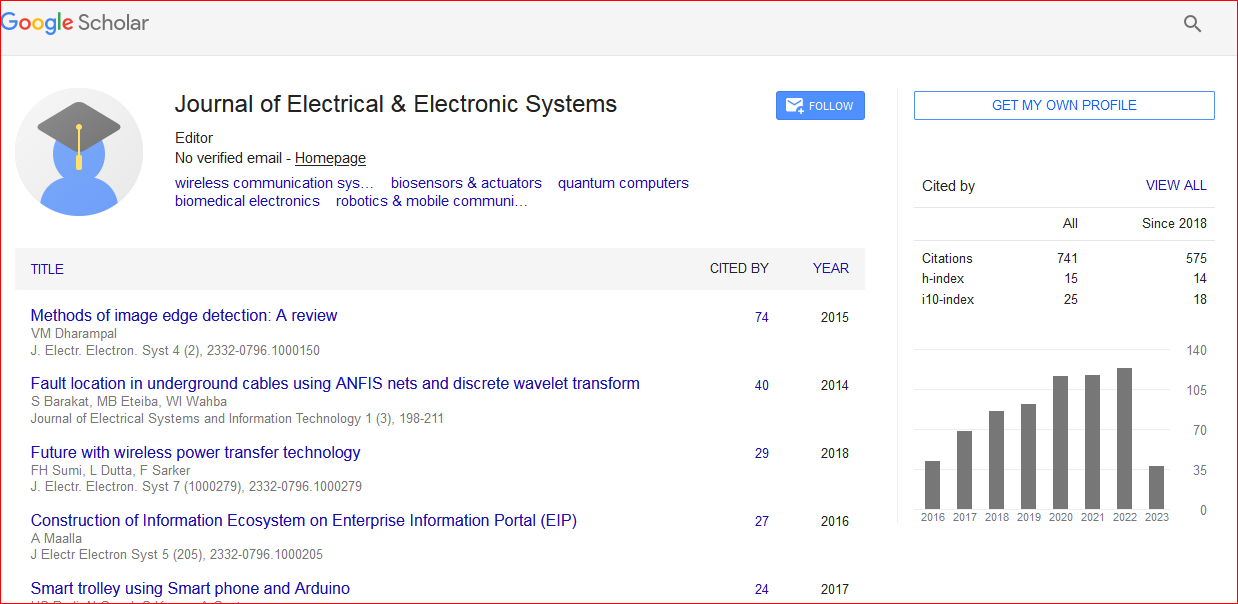
Journal of Electrical & Electronic Systems received 733 citations as per Google Scholar report