Short Communication - (2025) Volume 16, Issue 4
Received: 01-Jul-2025, Manuscript No. jnmrt-26-186382;
Editor assigned: 03-Jul-2025, Pre QC No. P-186382;
Reviewed: 17-Jul-2025, QC No. Q-186382;
Revised: 22-Jul-2025, Manuscript No. R-186382;
Published:
29-Jul-2025
, DOI: 10.37421/2155-9619.2025.16.663
Citation: Anderson, Thomas. ”Fractionated RPT: Optimizing
Tumor Microenvironment Modulation.” J Nucl Med Radiat Ther 16 (2025):663.
Copyright: © 2025 Anderson T. This is an open-access article distributed under the terms of the Creative Commons Attribution License, which permits unrestricted use,
distribution and reproduction in any medium, provided the original author and source are credited.
Fractionated radiopharmaceutical therapy (RPT) is emerging as a significant strategy to enhance treatment efficacy while mitigating toxicity by administering the total therapeutic dose in multiple smaller fractions. This approach is particularly pertinent in the context of optimizing interactions with the tumor microenvironment (TME), a complex milieu that profoundly influences therapeutic outcomes. Modulating the TME, which encompasses stromal cells, immune cells, and the extracellular matrix, is paramount for improving RPT delivery and enhancing tumor responsiveness. Fractionated RPT holds the potential to favorably alter the TME by inducing immunogenic cell death, fostering immune cell infiltration, and modifying tumor vasculature, thereby creating a more conducive environment for subsequent treatment cycles or combination therapies [1].
The tumor microenvironment represents a dynamic ecosystem that critically impacts the effectiveness of diverse cancer therapies, including RPT. Targeting specific elements within the TME, such as tumor-associated macrophages or cancer-associated fibroblasts, can lead to synergistic enhancements of radiopharmaceutical effects. The fractionation of RPT may offer unique opportunities to sequentially target distinct TME components, thereby optimizing the therapeutic window and maximizing treatment benefit [2].
A crucial aspect of investigating fractionated RPT involves understanding its radiobiological effects on the various cell types constituting the TME. This includes elucidating how fractionated doses influence the radiosensitivity of tumor cells, the proliferation and functional status of stromal cells, and the infiltration and activation of immune cells. Such detailed knowledge is indispensable for guiding the development of meticulously optimized fractionation schedules tailored to specific tumor types and patient profiles [3].
Combining fractionated RPT with immunotherapies designed to target the TME presents a particularly promising avenue for cancer treatment. Fractionated RPT can effectively induce immunogenic cell death, leading to the release of tumor antigens and pro-inflammatory signals. These released factors can then be strategically leveraged by immune checkpoint inhibitors or other immunomodulatory agents to amplify and sustain anti-tumor immune responses, thereby overcoming immune evasion mechanisms [4].
Establishing an optimal fractionation schedule for RPT necessitates a comprehensive consideration of the radiopharmaceutical's pharmacokinetics and pharmacodynamics, alongside the intrinsic biological characteristics of the TME. Advanced modeling and simulation approaches are invaluable tools in this regard, as they can accurately predict the cumulative dose distribution and its dynamic impact on TME modulation across multiple treatment cycles, allowing for personalized dose adjustments [5].
Recent research efforts have focused on exploring the fractionated delivery of alpha-emitting radiopharmaceuticals, capitalizing on their inherently high linear energy transfer (LET) to potentially achieve more effective TME modulation. Fractionation strategies in this context could facilitate improved tumor penetration and significantly reduce off-target bystander effects on normal tissues, while concurrently optimizing TME impact to enhance overall therapeutic outcomes [6].
Understanding the temporal dynamics of TME alterations induced by fractionated RPT is of paramount importance for effective treatment planning and monitoring. Advanced imaging techniques, such as positron emission tomography/computed tomography (PET/CT), can be effectively employed to track dynamic changes in tumor vascularity, cellularity, and immune cell infiltration in response to fractionated treatment regimens. This real-time feedback is crucial for personalizing treatment strategies and adapting them as needed [7].
Preclinical studies play a vital role in unraveling the intricate mechanistic basis by which fractionated RPT exerts its effects on the TME. These investigations are essential for examining gene expression profiles, protein levels, and the complex cellular interactions within the TME following fractionated dosing. Such analyses are instrumental in identifying robust biomarkers that can predict treatment response and elucidate mechanisms of resistance, paving the way for more effective therapeutic development [8].
The successful clinical implementation of fractionated RPT hinges on the meticulous consideration of dose escalation strategies and the precise determination of inter-fraction intervals. These parameters are critical for maximizing therapeutic gain while effectively managing potential toxicities. A deep understanding of the TME's contribution to resistance mechanisms is therefore key to designing and optimizing effective fractionated RPT regimens that overcome treatment barriers [9].
Further exploration into combining fractionated RPT with other TME-modulating agents holds significant potential for advancing therapeutic strategies. Specifically, the integration of RPT with agents designed to target tumor hypoxia or specific cellular signaling pathways could lead to novel therapeutic combinations that exhibit enhanced efficacy and a reduced propensity for developing treatment resistance, offering new hope for challenging malignancies [10].
Fractionated radiopharmaceutical therapy (RPT) represents an innovative modality aimed at optimizing therapeutic efficacy and minimizing toxicity through the division of the total administered activity into several smaller doses. This fractionation strategy is especially relevant when considering the intricate interplay with the tumor microenvironment (TME), a complex system that influences treatment success. Modulating the TME, which comprises stromal cells, immune cells, and the extracellular matrix, is crucial for enhancing RPT delivery and improving tumor response. Fractionated RPT can potentially modify the TME by inducing immunogenic cell death, promoting immune cell infiltration, and altering tumor vasculature, thus creating a more favorable environment for subsequent treatment cycles or combination therapies [1].
The tumor microenvironment is a dynamic ecosystem that significantly impacts the effectiveness of various cancer therapies, including RPT. Targeting specific components of the TME, such as tumor-associated macrophages or cancer-associated fibroblasts, can synergistically enhance the effects of radiopharmaceuticals. Fractionation of RPT might provide unique opportunities to sequentially target different TME elements, thereby optimizing the therapeutic window and maximizing treatment benefit [2].
Investigating the radiobiological effects of fractionated RPT on different cell types within the TME is of critical importance. This includes understanding how fractionated doses affect the radiosensitivity of tumor cells, the proliferation and function of stromal cells, and the infiltration and activation of immune cells. Such comprehensive knowledge is essential for guiding the development of optimized fractionation schedules that are tailored to specific tumor characteristics and patient needs [3].
Combining fractionated RPT with immunotherapies that target the TME holds considerable promise. Fractionated RPT can induce immunogenic cell death, leading to the release of tumor antigens and pro-inflammatory signals. These released factors can then be leveraged by immune checkpoint inhibitors or other immunomodulatory agents to enhance anti-tumor immune responses, potentially overcoming mechanisms of immune evasion and resistance [4].
The optimal fractionation schedule for RPT must carefully consider the pharmacokinetic and pharmacodynamic properties of the radiopharmaceutical, as well as the specific biological characteristics of the TME. Sophisticated modeling and simulation approaches can play a pivotal role in predicting the cumulative dose distribution and its impact on TME modulation over multiple treatment cycles, facilitating personalized treatment planning [5].
Recent studies have explored the fractionated delivery of alpha-emitting radiopharmaceuticals to leverage their high linear energy transfer (LET) and potentially achieve more effective TME modulation. Fractionation in this context could enhance tumor penetration and reduce bystander effects on normal tissues, while still effectively impacting the TME to improve therapeutic outcomes [6].
Understanding the temporal dynamics of TME changes induced by fractionated RPT is critical for effective treatment management. Imaging techniques, such as PET/CT, can be utilized to monitor changes in tumor vascularity, cellularity, and immune cell infiltration in response to fractionated treatments, providing valuable feedback for treatment personalization and adaptation [7].
Preclinical studies are vital for exploring the mechanistic basis of how fractionated RPT impacts the TME. These studies can investigate gene expression profiles, protein levels, and cellular interactions within the TME following fractionated dosing to identify biomarkers of response and resistance, which is crucial for guiding future therapeutic development [8].
The successful implementation of fractionated RPT requires careful consideration of dose escalation strategies and inter-fraction intervals to optimize therapeutic gain and manage toxicity. A thorough understanding of the TME's role in resistance mechanisms is key to developing effective fractionated RPT regimens that can overcome treatment barriers and achieve durable responses [9].
Exploring the potential of combining fractionated RPT with other TME-modulating agents, such as those targeting hypoxia or specific cellular signaling pathways, could lead to novel therapeutic combinations. These combinations may offer enhanced efficacy and reduced resistance, representing a significant advancement in cancer treatment strategies [10].
Fractionated radiopharmaceutical therapy (RPT) is an innovative approach that divides therapeutic doses to optimize efficacy and minimize toxicity. This strategy is crucial for modulating the tumor microenvironment (TME), which significantly influences treatment outcomes. Fractionated RPT can alter the TME by inducing immunogenic cell death, enhancing immune cell infiltration, and modifying tumor vasculature. Targeting specific TME components and combining fractionated RPT with immunotherapies are promising avenues. Understanding the radiobiological effects and temporal dynamics of TME changes induced by fractionated RPT is essential for optimizing treatment schedules. Preclinical studies and advanced imaging techniques play a vital role in this process. Future research focuses on combining fractionated RPT with other TME-modulating agents to develop more effective therapeutic strategies.
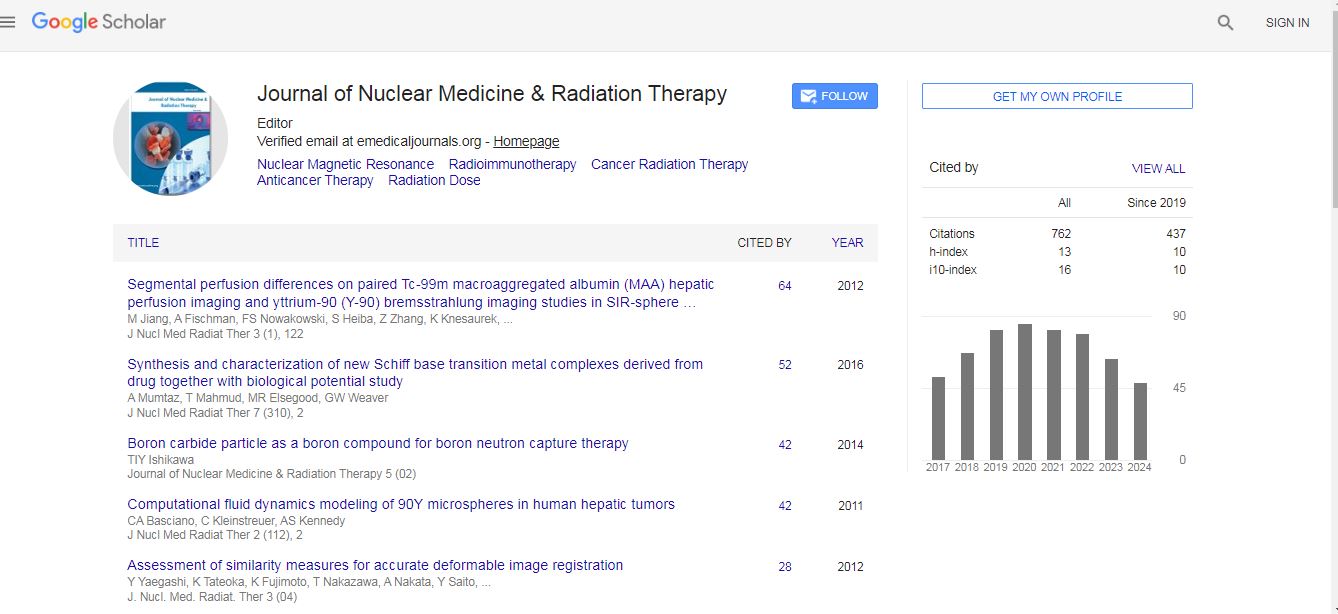
Nuclear Medicine & Radiation Therapy received 706 citations as per Google Scholar report