Perspective - (2025) Volume 11, Issue 4
Received: 01-Aug-2025, Manuscript No. jctt-26-188419;
Editor assigned: 04-Aug-2025, Pre QC No. P-188419;
Reviewed: 18-Aug-2025, QC No. Q-188419;
Revised: 22-Aug-2025, Manuscript No. R-188419;
Published:
29-Aug-2025
, DOI: 10.37421/2471-9323.2024.10.337
Citation: Smith, Oliver. ”Exploring Hair and Scalp Health: A Research Compendium.” J Cosmo Tricho 11 (2025):337.
Copyright: © 2025 Smith O. This is an open-access article distributed under the terms of the Creative Commons Attribution License, which permits unrestricted use, distribution and reproduction in any medium, provided the original author and source are credited.
The intricate relationship between scalp health and hair quality is a subject of extensive research and growing interest in both cosmetic dermatology and trichology. Understanding the complex interplay of biochemical and physiological processes governing the appearance and vitality of hair and skin is crucial for developing effective interventions and enhancing overall well-being. Advancements in cosmetology and trichology are continuously revealing new avenues for improving both hair and skin health, from deciphering the molecular underpinnings of hair growth to formulating sophisticated skincare products that promote scalp health. A strong emphasis is placed on evidence-based strategies that address common concerns such as hair thinning, various scalp conditions, and the multifaceted process of skin aging, advocating for a holistic perspective on beauty and wellness [1].
Emerging research is exploring the significant role of topical growth factors and peptides in the realm of hair regeneration and the enhancement of hair density. These compounds interact with dermal papilla cells and keratinocytes, revealing their molecular mechanisms of action and presenting promising therapeutic avenues for androgenetic alopecia and other forms of hair loss. The potential for personalized treatments, tailored to individual biological responses, is a key takeaway from these investigations [2].
Environmental stressors, including ultraviolet radiation and atmospheric pollution, have been identified as significant contributors to the aging processes of both skin and hair. Studies are elucidating the specific oxidative damage pathways initiated by these stressors and evaluating the effectiveness of antioxidant-rich formulations and protective agents in mitigating their detrimental effects. This highlights the critical importance of a proactive approach to skincare and hair care, with a focus on environmental defense, to maintain youthful vitality and structural integrity [3].
The human scalp is host to a complex and dynamic microbial ecosystem, and its influence on hair health and common scalp disorders such as dandruff and seborrheic dermatitis is becoming increasingly apparent. Research analyzing microbial diversity is identifying key bacterial and fungal species associated with both healthy and compromised scalp conditions, suggesting that modulating the scalp microbiome through targeted prebiotics and probiotics could represent a novel therapeutic strategy [4].
Innovations in hair transplantation techniques continue to advance, with follicular unit transplantation (FUT) and follicular unit extraction (FUE) remaining prominent methods, alongside the development of novel regenerative therapies. These advancements are underpinned by a deep understanding of scientific principles, refined patient selection criteria, and rigorous outcome assessments, all aimed at maximizing graft survival and achieving natural-looking aesthetic results [5].
Nutrition plays a pivotal role in maintaining the health of both hair and skin. Comprehensive reviews are examining the essential vitamins, minerals, and macronutrients vital for cell growth, repair processes, and keratin synthesis. Identifying dietary deficiencies that are commonly linked to hair loss and skin imperfections underscores the importance of a balanced diet and, where necessary, targeted supplementation for optimal health [6].
The intricate genetic architecture dictating hair characteristics is a subject of ongoing investigation, with studies delving into the genetic factors that influence hair follicle development and pigmentation. Examination of specific gene mutations associated with conditions like alopecia areata and changes in hair color is shedding light on the complex genetic underpinnings of hair disorders, pointing towards potential gene-targeted therapeutic approaches [7].
Understanding the science behind hair styling and its profound impact on hair fiber integrity is essential for hair care practices. Research is examining the detrimental effects of heat styling, chemical treatments such as coloring and perming, and mechanical stress on the hair shaft's structure and properties. This knowledge informs product formulation and application techniques designed to minimize damage and enhance hair resilience [8].
Lasers and light-based therapies are emerging as significant treatment modalities for hair loss and various dermatological conditions affecting the scalp and skin. Reviews are detailing the underlying photobiological mechanisms and accumulating clinical evidence supporting the use of low-level laser therapy (LLLT) and intense pulsed light (IPL) for a spectrum of conditions, from alopecia to skin rejuvenation [9].
Inflammatory pathways are central to many scalp disorders, and understanding these processes is critical for developing effective treatments. Comprehensive reviews discuss the roles of cytokines, chemokines, and immune cells in conditions like psoriasis and atopic dermatitis of the scalp. This insight highlights how anti-inflammatory agents and immunomodulatory therapies can significantly improve scalp health and, consequently, promote hair growth [10].
The interconnectedness of scalp health and hair quality is a focal point of contemporary research in cosmetology and trichology. This field delves into the biochemical and physiological mechanisms that dictate the appearance and vitality of both hair and skin. Significant progress in cosmetology and trichology is continuously opening new avenues for enhancing hair and skin health. This includes a deeper understanding of the molecular basis of hair growth and the development of advanced skincare formulations designed to synergize with scalp well-being. The emphasis is on evidence-based approaches to address prevalent concerns such as hair thinning, various scalp conditions, and skin aging, promoting a comprehensive view of beauty and wellness [1].
Within the scope of hair regeneration, recent research has meticulously examined the role of topical growth factors and peptides in stimulating hair follicle activity and improving hair density. The studies detail the specific molecular pathways through which these compounds interact with dermal papilla cells and keratinocytes. This exploration offers promising therapeutic strategies for androgenetic alopecia and other forms of hair loss, with a notable focus on the potential for personalized treatments guided by individual biological responses [2].
The impact of environmental aggressors, specifically UV radiation and pollution, on the aging process of skin and hair is a critical area of study. Investigations are clarifying the mechanisms of oxidative damage induced by these factors and assessing the efficacy of formulations rich in antioxidants and protective agents. The findings underscore the necessity of a proactive strategy in skincare and hair care, prioritizing environmental defense to preserve youthful appearance and structural integrity [3].
The scalp microbiome, a complex community of microorganisms, plays a vital role in hair health and is implicated in common scalp ailments like dandruff and seborrheic dermatitis. Research is focusing on analyzing microbial diversity to identify specific bacterial and fungal species associated with healthy versus compromised scalp states. These findings suggest that therapeutic interventions targeting the scalp microbiome, such as the use of prebiotics and probiotics, hold significant promise [4].
Advancements in hair transplantation techniques, including established methods like follicular unit transplantation (FUT) and follicular unit extraction (FUE), are continuously evolving alongside the emergence of regenerative therapies. These procedures are guided by a solid foundation of scientific principles, careful patient selection, and detailed outcome analysis, with the primary goals of maximizing graft survival and achieving aesthetically natural results [5].
The crucial role of nutrition in sustaining hair and skin health is highlighted in numerous reviews covering essential vitamins, minerals, and macronutrients. These components are fundamental for cellular growth, repair processes, and the synthesis of keratin. Identifying dietary deficiencies commonly linked to hair loss and skin imperfections reinforces the importance of a balanced diet and, when indicated, strategic supplementation [6].
Investigating the genetic underpinnings of hair characteristics is an active area of research, with studies focusing on genetic factors influencing hair follicle development and pigmentation. The examination of specific gene mutations associated with conditions like alopecia areata and changes in hair color is illuminating the complex genetic architecture that shapes hair traits and suggesting potential avenues for gene-targeted therapies [7].
Understanding the detrimental effects of hair styling practices on the integrity of the hair shaft is paramount. Research is evaluating the impact of thermal styling, chemical treatments (such as coloring and perming), and mechanical stress on the hair's structure and physical properties. This knowledge is instrumental in guiding the development of products and techniques aimed at minimizing damage and enhancing hair resilience [8].
Lasers and light-based therapies are increasingly recognized for their therapeutic potential in managing hair loss and various dermatological conditions affecting the scalp and skin. Reviews synthesize the underlying photobiological mechanisms and clinical evidence supporting the application of low-level laser therapy (LLLT) and intense pulsed light (IPL) for conditions ranging from alopecia to skin rejuvenation [9].
Inflammatory pathways are integral to the pathogenesis of many scalp disorders, making their understanding essential for effective treatment development. Reviews explore the roles of cytokines, chemokines, and immune cells in conditions such as scalp psoriasis and atopic dermatitis. This research highlights how anti-inflammatory and immunomodulatory therapies can substantially improve scalp health and contribute to enhanced hair growth [10].
This collection of research explores the multifaceted aspects of hair and scalp health, drawing from trichology, dermatology, and cosmetology. Key areas of investigation include the impact of scalp health on hair quality, the role of growth factors and peptides in hair regeneration, and the damaging effects of environmental stressors on skin and hair aging. The influence of the scalp microbiome, advancements in hair transplantation techniques, and the critical role of nutrition are also examined. Furthermore, research delves into the genetic factors affecting hair characteristics, the impact of styling practices on hair integrity, and the therapeutic applications of lasers and light-based therapies. Finally, the importance of understanding inflammatory pathways in scalp disorders for developing effective treatments is highlighted.
None
None
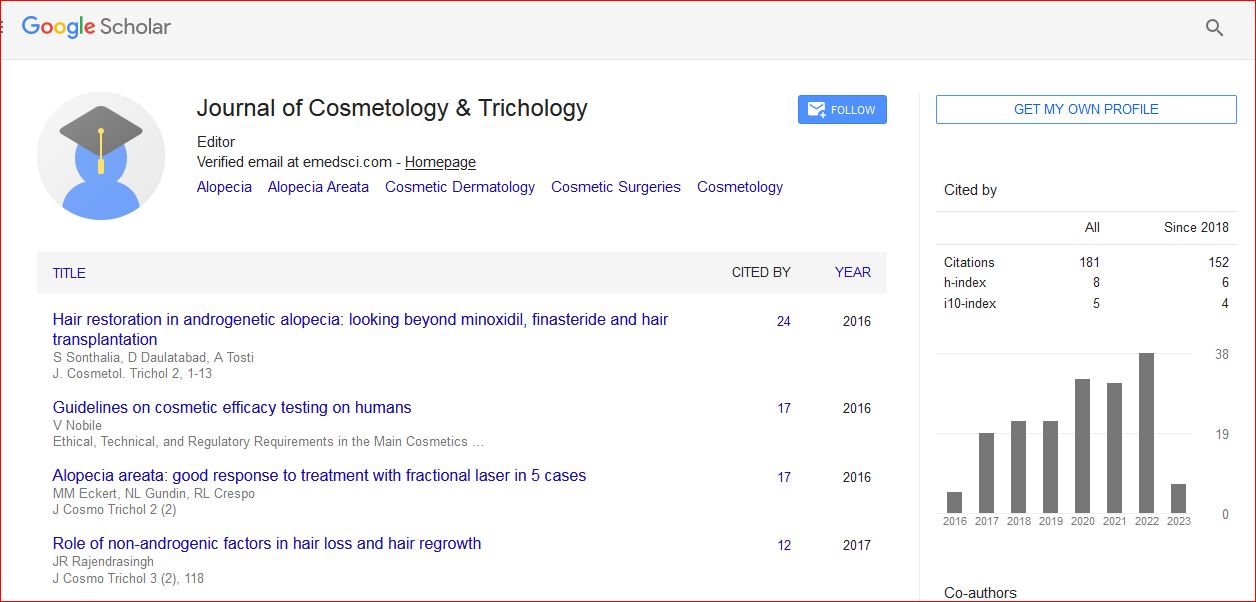
Journal of Cosmetology & Trichology received 180 citations as per Google Scholar report