Commentary - (2025) Volume 15, Issue 5
Received: 01-Oct-2025, Manuscript No. jprm-25-174464;
Editor assigned: 03-Oct-2025, Pre QC No. P-174464;
Reviewed: 17-Oct-2025, QC No. Q-174464;
Revised: 22-Oct-2025, Manuscript No. R-174464;
Published:
29-Oct-2025
, DOI: 10.37421/2161-105X.2025.15.758
Citation: Miller, Jacob. ”Evolving Role of Biomarkers in Respiratory Diseases.” J Pulm Respir Med 15 (2025):758.
Copyright: © 2025 Miller J. This is an open-access article distributed under the terms of the Creative Commons Attribution License, which permits unrestricted use, distribution and reproduction in any medium, provided the original author and source are credited.
Biomarkers are increasingly recognized as indispensable tools in modern medicine, particularly within the realm of respiratory diseases, where they offer profound insights into pathogenesis, progression, and therapeutic responses. These molecular, cellular, or physiological indicators can be objectively measured and evaluated, serving as vital guides for clinicians. Their application spans from early and accurate diagnosis to predicting disease trajectory, assessing treatment efficacy, and enabling highly personalized patient management strategies across a diverse array of pulmonary conditions. The landscape of biomarker research in respiratory health is dynamic and rapidly evolving, constantly pushing beyond traditional clinical measures to harness more precise and less invasive methods. Here's the thing, this shift is particularly crucial given the complexity and varied nature of lung diseases, which often present with overlapping symptoms and require nuanced diagnostic and therapeutic approaches. The ability to identify specific biological signals associated with disease states empowers healthcare providers to intervene more effectively, ultimately leading to improved patient outcomes and a reduction in morbidity and mortality. What this really means is that biomarkers are transforming how we understand and manage chronic and acute respiratory illnesses, moving towards a future of precision medicine where treatments are tailored to the individual's unique biological profile. For example, in asthma, research now explores the evolving landscape of biomarkers, focusing on emerging tools for diagnosis, disease severity assessment, and personalized treatment strategies. This work highlights the potential of molecular biomarkers found in exhaled breath, sputum, and blood to guide therapeutic choices and predict responses [1].
Similarly, Chronic Obstructive Pulmonary Disease (COPD) benefits from a survey of various biomarkers, discussing their utility in early diagnosis, predicting disease progression, and informing therapeutic interventions. This includes both established and novel biomarkers related to inflammation, oxidative stress, and lung tissue remodeling, emphasizing their role in precision medicine approaches for COPD [2].
In severe conditions like Idiopathic Pulmonary Fibrosis (IPF), an update on recent advances discusses how various circulating and tissue-based biomarkers can aid in diagnosis, prognostication, and monitoring treatment response. Such insights help refine patient management strategies and identify individuals at higher risk of disease progression [3].
The significance of various biomarkers in Acute Respiratory Distress Syndrome (ARDS), a critical lung injury, is also under examination. Research delves into their application for early diagnosis, stratifying patient risk, and predicting outcomes, covering inflammatory mediators, cellular markers, and markers of lung epithelial and endothelial injury, aiming to improve ARDS patient care [4].
Furthermore, for COVID-19-associated Acute Respiratory Distress Syndrome (CARDS), specific investigations focus on biomarkers for diagnosing the condition and predicting its severity. This highlights how inflammatory and coagulation markers, alongside other specific indicators, can help clinicians identify patients at high risk of severe outcomes and tailor interventions effectively [5].
In lung cancer, circulating biomarkers, including liquid biopsy components like circulating tumor DNA (ctDNA), circulating tumor cells (CTCs), and exosomes, are discussed for their potential. They offer pathways for non-invasive early diagnosis, monitoring disease progression, predicting treatment response, and identifying drug resistance, thus driving personalized oncology approaches [6].
A systematic review synthesizes current evidence on biomarkers for acute exacerbations of bronchiectasis, identifying key inflammatory and infectious markers. These markers can help in diagnosing exacerbations, assessing their severity, and guiding antimicrobial therapy, ultimately improving management strategies and patient outcomes for this chronic respiratory condition [7].
The utility of exhaled breath condensate (EBC) biomarkers in chronic respiratory diseases is another important area. This non-invasive collection method and the potential of various molecules found in EBC serve as diagnostic, prognostic, and monitoring tools for conditions like asthma, COPD, and cystic fibrosis, offering insights into airway inflammation and oxidative stress [8].
For Cystic Fibrosis (CF), a genetic disorder affecting multiple organs, including the lungs, an overview examines the current and future roles of biomarkers. It covers markers for early diagnosis, monitoring disease progression, assessing response to novel therapies, and predicting exacerbations, emphasizing the need for sensitive and specific indicators to improve CF patient management [9].
Finally, immunological biomarkers for Tuberculosis (TB), a major global respiratory infectious disease, are explored. This discussion covers the utility of various immune markers in diagnosing active TB, distinguishing between latent and active infection, predicting disease progression, and monitoring the efficacy of anti-TB treatment, which is crucial for controlling the spread of the disease [10].
Collectively, this body of work underscores a transformative shift in respiratory medicine, where biomarkers are not just research tools but integral components of clinical practice, promising more precise diagnostics and personalized therapeutic strategies.
Biomarkers have fundamentally reshaped the landscape of respiratory medicine, providing critical tools for a more nuanced understanding and management of various lung conditions. Their utility extends across the entire spectrum of disease, from initial diagnosis and severity assessment to predicting prognosis and guiding highly individualized treatment regimens. This advancement is particularly significant given the multifaceted nature of respiratory illnesses, where traditional clinical evaluations often benefit from objective molecular or physiological insights.
A significant focus within biomarker research addresses prevalent chronic obstructive conditions. For asthma, the evolving field highlights molecular biomarkers found in exhaled breath, sputum, and blood as key indicators for diagnosis, disease severity, and personalized treatment strategies. These markers are essential for moving beyond conventional clinical metrics towards more precise therapeutic choices [1]. Similarly, in Chronic Obstructive Pulmonary Disease (COPD), a comprehensive review discusses both established and novel biomarkers, including those linked to inflammation, oxidative stress, and lung tissue remodeling. These are crucial for early diagnosis, tracking disease progression, and informing therapeutic interventions, ultimately fostering precision medicine approaches for COPD patients [2].
Beyond chronic conditions, biomarkers play an indispensable role in severe and acute pulmonary disorders. Idiopathic Pulmonary Fibrosis (IPF), a severe lung condition, benefits from advances in circulating and tissue-based biomarkers that aid in diagnosis, prognostication, and monitoring treatment response. These developments are refining patient management and identifying individuals at higher risk of progression [3]. Acute Respiratory Distress Syndrome (ARDS), a critical lung injury, also sees extensive application of biomarkers for early diagnosis, patient risk stratification, and outcome prediction. This includes a range of inflammatory mediators, cellular markers, and indicators of lung epithelial and endothelial injury, all aimed at improving ARDS care [4]. A specialized application involves COVID-19-associated Acute Respiratory Distress Syndrome (CARDS), where specific inflammatory and coagulation markers are vital for diagnosis and predicting severity, allowing clinicians to identify high-risk patients and tailor interventions effectively [5].
Oncology has also seen a revolution through biomarker application in respiratory disease. Circulating biomarkers in lung cancer, often collected through liquid biopsies, represent a groundbreaking non-invasive approach. Components like circulating tumor DNA (ctDNA), circulating tumor cells (CTCs), and exosomes offer substantial potential for early diagnosis, monitoring disease progression, predicting treatment response, and identifying mechanisms of drug resistance, thereby propelling personalized oncology forward [6].
Furthermore, biomarkers are crucial in managing acute exacerbations of chronic respiratory illnesses and infectious diseases. For bronchiectasis, a systematic review identifies key inflammatory and infectious markers valuable for diagnosing exacerbations, assessing their severity, and guiding antimicrobial therapy, thus improving management strategies [7]. The non-invasive collection method of exhaled breath condensate (EBC) provides a promising avenue, with various molecules in EBC serving as diagnostic, prognostic, and monitoring tools for conditions like asthma, COPD, and cystic fibrosis, offering insights into airway inflammation and oxidative stress [8]. In Cystic Fibrosis (CF), biomarkers are being explored for early diagnosis, monitoring disease progression, assessing novel therapy responses, and predicting exacerbations, highlighting the need for highly sensitive and specific indicators [9]. Lastly, immunological biomarkers are pivotal in Tuberculosis (TB) for diagnosing active TB, differentiating latent from active infection, predicting progression, and monitoring anti-TB treatment efficacy, which is critical for disease control [10].
This collective body of research underscores the dynamic and indispensable nature of biomarkers in contemporary respiratory medicine, offering enhanced diagnostic capabilities, precise prognostic indicators, and guiding principles for highly personalized and effective therapeutic interventions across a broad spectrum of lung diseases.
The compiled research thoroughly examines the critical and evolving role of biomarkers across a wide range of respiratory diseases. Studies highlight their significance in asthma, where molecular biomarkers in breath, sputum, and blood offer new avenues for diagnosis, assessing severity, and tailoring treatment strategies [1]. Similarly, for Chronic Obstructive Pulmonary Disease (COPD), both established and novel biomarkers related to inflammation, oxidative stress, and lung remodeling are crucial for early diagnosis, predicting disease progression, and informing therapeutic decisions within precision medicine frameworks [2]. In severe conditions like Idiopathic Pulmonary Fibrosis (IPF) and Acute Respiratory Distress Syndrome (ARDS), biomarkers are proving invaluable for early diagnosis, prognostication, and monitoring treatment responses. This includes inflammatory mediators and cellular markers vital for risk stratification and predicting patient outcomes in general ARDS, as well as specific inflammatory and coagulation markers for COVID-19-associated ARDS (CARDS) [3, 4, 5]. For lung cancer, the development of circulating biomarkersâ??such as ctDNA, CTCs, and exosomesâ??represents a significant leap in non-invasive early diagnosis, monitoring progression, predicting treatment efficacy, and identifying drug resistance, thereby advancing personalized oncology [6]. Beyond these, the utility of various markers extends to acute exacerbations of bronchiectasis, where inflammatory and infectious indicators guide diagnosis, severity assessment, and antimicrobial therapy [7]. Exhaled breath condensate (EBC) biomarkers emerge as non-invasive tools for diagnosing and monitoring chronic respiratory diseases like asthma, COPD, and cystic fibrosis, by reflecting airway inflammation and oxidative stress [8]. Finally, immunological biomarkers play a key role in managing Cystic Fibrosis and Tuberculosis, aiding in early diagnosis, disease progression monitoring, therapeutic response assessment, and distinguishing active from latent infections [9, 10]. This collective body of work underscores the transformative potential of biomarkers in enhancing patient management across the spectrum of respiratory illnesses.
None
None
1. Zixia L, Tian G, Jian S. "Biomarkers for asthma: recent advances and future directions".Chin Med J (Engl) 136 (2023):1640-1647.
Indexed at, Google Scholar, Crossref
2. Meng S, Tong L, Yan H. "Current and Emerging Biomarkers in Chronic Obstructive Pulmonary Disease: Diagnostic, Prognostic, and Therapeutic Implications".Int J Chron Obstruct Pulmon Dis 17 (2022):3051-3069.
Indexed at, Google Scholar, Crossref
3. Declan NO, David W, David M. "Biomarkers in Idiopathic Pulmonary Fibrosis: An Update on Recent Advances".Chest 158 (2020):2516-2527.
Indexed at, Google Scholar, Crossref
4. Peng G, Wei S, Yue L. "Role of Biomarkers in Diagnosis and Management of Acute Respiratory Distress Syndrome".Biomolecules 13 (2023):367.
Indexed at, Google Scholar, Crossref
5. Vaibhav S, Akhilesh KS, Sudha M. "Biomarkers for the diagnosis and prediction of severity in COVID-19-associated acute respiratory distress syndrome".Int J Biol Macromol 247 (2023):125867.
Indexed at, Google Scholar, Crossref
6. Wenbo H, Shuai M, Ruixin Z. "Circulating Biomarkers in Lung Cancer: Emerging Roles in Diagnosis, Prognosis, and Treatment".J Clin Med 11 (2022):4016.
Indexed at, Google Scholar, Crossref
7. Stefano A, Simon M, Marisa B. "Biomarkers of Acute Exacerbations of Bronchiectasis: A Systematic Review".J Clin Med 11 (2022):581.
Indexed at, Google Scholar, Crossref
8. Hongli Z, Xiaojing W, Zhibin S. "The role of exhaled breath condensate biomarkers in the diagnosis and monitoring of chronic respiratory diseases".Front Med (Lausanne) 9 (2022):994017.
Indexed at, Google Scholar, Crossref
9. Raúl DC, Rafael O, Juan L. "Biomarkers in Cystic Fibrosis: An Overview and Future Perspectives".Biomolecules 11 (2021):981.
Indexed at, Google Scholar, Crossref
10. Domenica G, Emilia P, Sabine AJ. "Immunological Biomarkers for Diagnosis, Prognosis, and Treatment Response in Tuberculosis".Microbiol Spectr 11 (2023):e0283022.
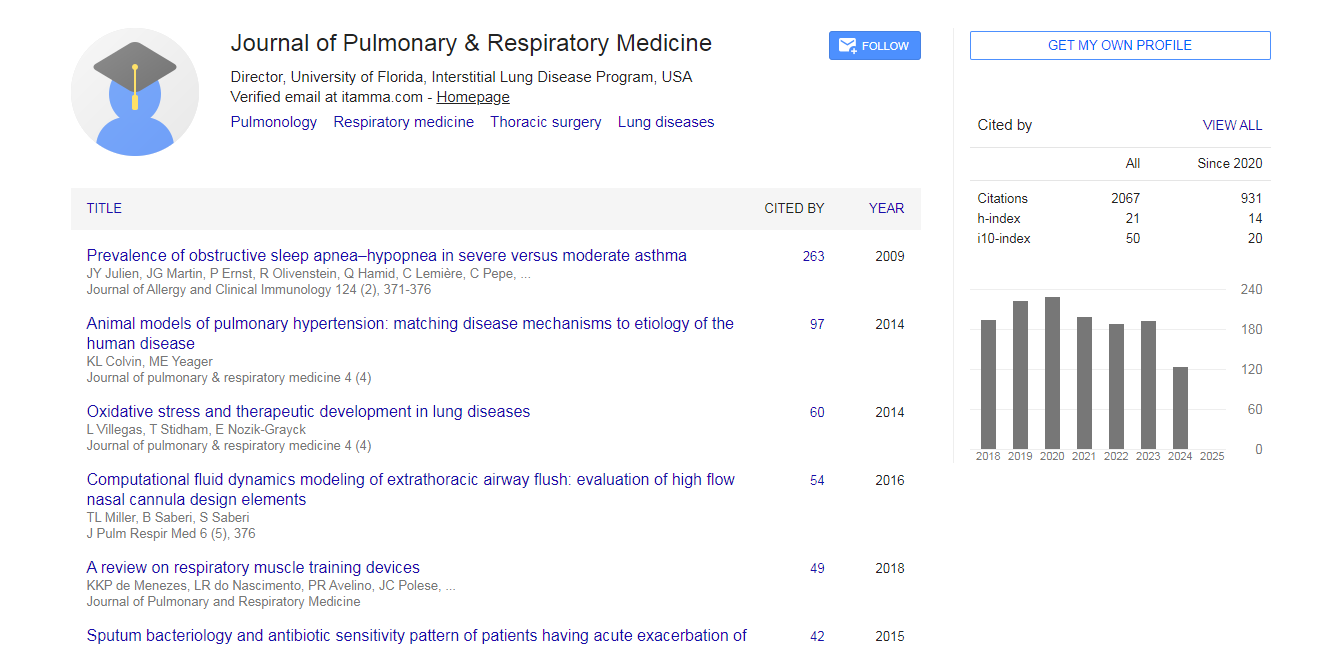
Pulmonary & Respiratory Medicine received 1690 citations as per Google Scholar report