Brief Report - (2025) Volume 17, Issue 6
Received: 01-Dec-2025, Manuscript No. jbabm-26-182365;
Editor assigned: 03-Dec-2025, Pre QC No. P-182365;
Reviewed: 17-Dec-2025, QC No. Q-182365;
Revised: 22-Dec-2025, Manuscript No. R-182365;
Published:
29-Dec-2025
, DOI: 10.37421/1948-593X.2025.17.523
Citation: Rodriguez, Maya T.. ”Epigenetics: Biomarkers, Therapy, and Precision Medicine.” J Bioanal Biomed 17 (2025):523.
Copyright: © 2025 Rodriguez T. Maya This is an open-access article distributed under the terms of the Creative Commons Attribution License, which permits unrestricted use, distribution and reproduction in any medium, provided the original author and source are credited.
Epigenetic modifications, encompassing processes like DNA methylation and histone alterations, are fundamental to gene expression regulation without altering the underlying genetic sequence [1].
Understanding these epigenetic mechanisms in human health is crucial for the diagnosis and treatment of a wide spectrum of diseases, including various cancers, neurodegenerative conditions, and metabolic disorders [1].
This article aims to provide a comprehensive overview of recent advancements in bioanalytical techniques specifically designed for the detection and quantification of these critical epigenetic marks [1].
These advancements hold significant promise for enhancing diagnostic capabilities and informing therapeutic strategies across numerous disease areas [1].
Research has specifically explored the intricate role of DNA methylation patterns in the progression of Alzheimer's disease, identifying key differentially methylated regions correlated with cognitive decline [2].
These findings suggest that specific methylation patterns could serve as valuable early diagnostic biomarkers, aiding in the timely intervention for Alzheimer's disease [2].
Histone acetylation dynamics are also being investigated for their profound impact on immune cell function, particularly during viral infections, influencing pro-inflammatory cytokine expression and disease severity [3].
This area of research highlights the potential of targeting the epigenetic machinery for effective immunomodulation strategies [3].
The technical challenges and recent breakthroughs in quantifying non-coding RNA-associated epigenetic modifications, such as microRNAs, are also under active investigation, utilizing advanced bioanalytical tools for profiling complex regulatory networks [4].
Such profiling is essential for understanding diverse human diseases where these epigenetic mechanisms play a role [4].
Epigenetic modifications, including DNA methylation and histone modifications, are essential for controlling gene expression without changing the DNA sequence itself [1].
The study of these modifications is vital for diagnosing and treating prevalent human diseases such as cancer, neurodegenerative disorders, and metabolic conditions [1].
This review summarizes recent progress in bioanalytical techniques used to detect and quantify these epigenetic marks, emphasizing their diagnostic and therapeutic potential [1].
Significant research has focused on DNA methylation patterns in Alzheimer's disease, identifying specific differentially methylated regions linked to synaptic plasticity and neuroinflammation, which correlate with cognitive impairment [2].
The implication of these methylation patterns is their potential to act as early diagnostic biomarkers for Alzheimer's disease [2].
Histone acetylation, a critical epigenetic mechanism, is being examined for its influence on immune cell function during viral infections, affecting the expression of pro-inflammatory cytokines and potentially disease outcomes [3].
This work underscores the importance of targeting epigenetic machinery for therapeutic immunomodulation [3].
Technical hurdles and recent advancements in quantifying epigenetic modifications related to non-coding RNAs, particularly microRNAs, are being addressed using sophisticated bioanalytical tools like next-generation sequencing and mass spectrometry [4].
These advanced methods are crucial for profiling intricate regulatory networks relevant to various human diseases [4].
The epigenetic landscape of type 2 diabetes (T2D) is also being investigated, revealing specific DNA methylation signatures in adipose tissue and peripheral blood mononuclear cells associated with insulin resistance, suggesting novel therapeutic targets for T2D management [5].
Epigenetic modifications are crucial for regulating gene expression and play a significant role in various human diseases, including cancer, neurodegenerative disorders, and metabolic diseases. Recent advancements in bioanalytical techniques have enabled more accurate detection and quantification of these epigenetic marks, improving diagnostic capabilities and informing therapeutic interventions. Studies highlight the importance of DNA methylation patterns in Alzheimer's disease and type 2 diabetes, suggesting their potential as early biomarkers. Research also explores the role of histone acetylation in immune responses during viral infections and investigates non-coding RNA epigenetics. Liquid biopsy is emerging as a non-invasive tool for cancer detection, utilizing cfDNA methylation patterns. Furthermore, epigenetic alterations are linked to environmental exposures impacting respiratory health and to neurodevelopmental disorders like fragile X syndrome. Targeting epigenetic modifiers, such as HDAC inhibitors, shows promise in treating hematological malignancies. Circular RNAs are also recognized as novel epigenetic regulators in cardiovascular disease. Overall, the field of epigenetics, coupled with advanced bioanalytical methods, offers promising avenues for precision medicine.
None
None
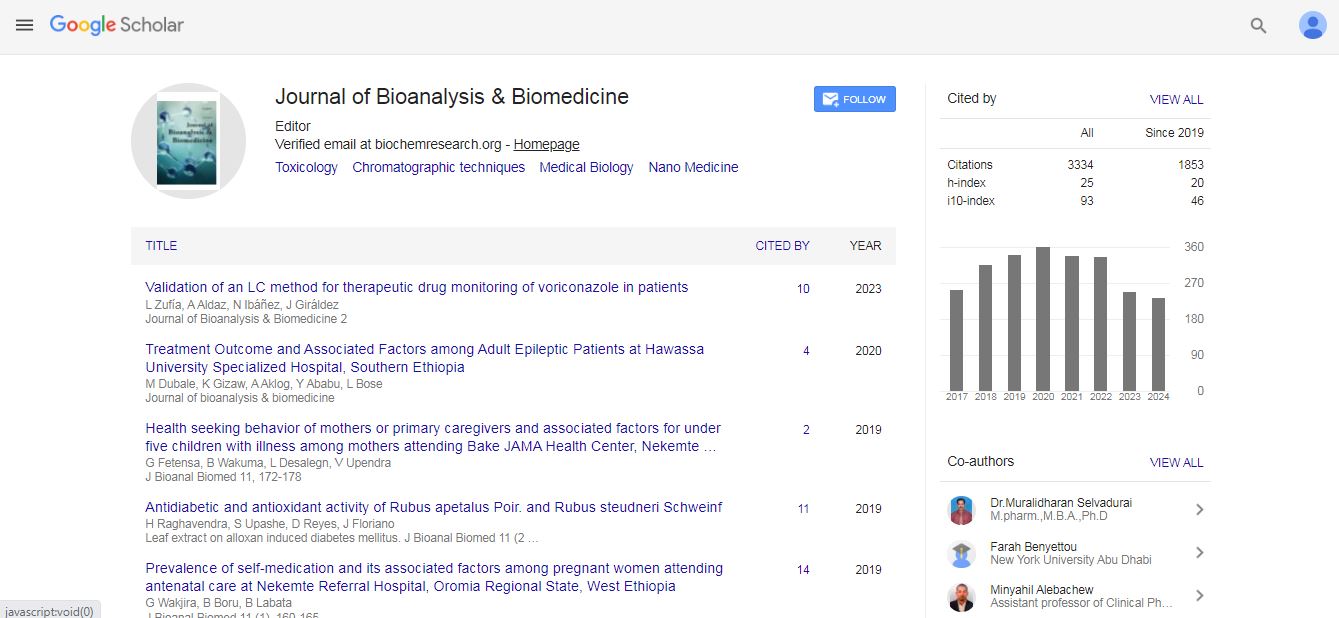
Journal of Bioanalysis & Biomedicine received 3099 citations as per Google Scholar report