Commentary - (127) Volume 15, Issue 5
Received: 01-Sep-2025, Manuscript No. jnt-26-178965;
Editor assigned: 03-Sep-2025, Pre QC No. P-178965;
Reviewed: 17-Sep-2025, QC No. Q-178965;
Revised: 22-Sep-2025, Manuscript No. R-178965;
Published:
29-Sep-2025
, DOI: 10.37421/2161-0959.2025.15.586
Citation: Kulkarni, Ananya. ”Endothelial Dysfunction: A Key Driver of Kidney Disease.” J Nephrol Ther 15 (2025):586.
Copyright: © 2025 Kulkarni A. This is an open-access article distributed under the terms of the Creative Commons Attribution License, which permits unrestricted use, distribution and reproduction in any medium, provided the original author and source are credited.
Endothelial dysfunction stands as a pivotal factor in the development of a spectrum of renal ailments, notably encompassing chronic kidney disease (CKD) and diabetic nephropathy. This pathological state is fundamentally characterized by a disruption in the delicate equilibrium between factors that promote vasodilation and those that induce vasoconstriction. Furthermore, it involves an elevation in inflammatory processes and a deficit in the bioavailability of nitric oxide, ultimately culminating in damage to the glomeruli, the onset of fibrosis, and a decline in overall kidney function. [1] The endothelium, far from being a mere passive barrier, actively engages in the regulation of vascular tone, the modulation of inflammatory responses, and the control of coagulation. Within the context of renal diseases, any damage inflicted upon this vital cellular layer initiates a complex chain of events that serves to exacerbate existing kidney injury. [2] Oxidative stress, a widely recognized hallmark of endothelial dysfunction, significantly contributes to the progression of renal fibrosis. This occurs through its potent ability to stimulate inflammatory pathways and disrupt crucial cellular signaling mechanisms. Consequently, therapeutic interventions aimed at targeting these oxidative stress pathways hold considerable promise for ameliorating renal pathology. [3] Inflammation plays a central and indispensable role in mediating the development and perpetuation of endothelial dysfunction observed in various renal diseases. Pro-inflammatory cytokines, in particular, possess the capacity to directly inflict damage upon endothelial cells, augment vascular permeability, and orchestrate the recruitment of immune cells, thereby intensifying the ongoing kidney injury. [4] A marked impairment in nitric oxide (NO) bioavailability is a defining characteristic of endothelial dysfunction in the setting of kidney disease. The reduction in NO levels triggers a cascade of detrimental effects, including enhanced vasoconstriction, increased platelet aggregation, and heightened inflammation, all of which are profoundly deleterious to renal health. [5] The renin-angiotensin-aldosterone system (RAAS) is demonstrably implicated in exacerbating endothelial dysfunction within the confines of renal diseases. Its deleterious effects are primarily mediated through its capacity to foster both oxidative stress and inflammation, thereby contributing to the overall pathological process. [6] Endothelial dysfunction emerges as an early and critical event in the natural progression of hypertensive nephropathy. This dysfunction is primarily defined by a reduction in the capacity for vasodilation and a significant increase in vascular stiffness, both of which directly contribute to the cumulative damage sustained by the kidneys. [7] Advanced glycation end products (AGEs) represent another significant contributor to endothelial dysfunction, particularly within the context of diabetic kidney disease. AGEs exert their detrimental effects by activating pro-inflammatory signaling cascades and exacerbating the burden of oxidative stress within the endothelium. [8] Certain therapeutic strategies designed to address endothelial dysfunction, such as the administration of statins and angiotensin-converting enzyme (ACE) inhibitors, have demonstrated considerable efficacy in mitigating renal damage across a variety of kidney diseases. These agents achieve this by improving endothelial function and concurrently reducing inflammatory burden. [9] The phenomenon of podocyte injury, which is a defining feature of many glomerular diseases, exhibits a strong and intricate connection with endothelial dysfunction. This highlights the complex and interdependent relationship between these critical vascular components in the maintenance of overall kidney health. [10]
The endothelium serves a multifaceted role in maintaining vascular integrity and function, extending well beyond its established barrier properties. It actively participates in the intricate regulation of vascular tone, acting as a key mediator in controlling blood vessel diameter. Furthermore, it plays a crucial role in orchestrating inflammatory responses, influencing the recruitment and activation of immune cells. The endothelium also exerts significant control over the coagulation cascade, ensuring appropriate hemostasis while preventing pathological thrombosis. In the context of renal diseases, damage or dysfunction of this vital endothelial layer initiates a cascade of pathological events that invariably exacerbate and perpetuate kidney injury, underscoring its central importance in renal health. [1] The endothelium's function as a gatekeeper of vascular health is paramount, extending to its active participation in regulating vascular tone, inflammation, and coagulation. Within the complex environment of renal diseases, the integrity of this endothelial lining is frequently compromised. Damage to this critical layer triggers a cascade of events that significantly worsen kidney injury, highlighting the endothelium's indispensable role in preserving renal function and preventing disease progression. [2] Oxidative stress, a pervasive consequence and hallmark of endothelial dysfunction, contributes substantially to the fibrotic processes that afflict the kidneys. This detrimental contribution arises from its capacity to amplify inflammatory signaling pathways and disrupt essential cellular communication networks. Consequently, the exploration and development of therapeutic strategies that specifically target and mitigate oxidative stress pathways are of considerable interest for their potential to yield significant clinical benefits in managing renal fibrosis. [3] Inflammation is a fundamental driver and central orchestrator of endothelial dysfunction observed in the pathological landscape of renal diseases. The presence and action of pro-inflammatory cytokines can directly inflict structural and functional damage on endothelial cells, lead to an increase in vascular permeability, and promote the influx of inflammatory cells into the renal tissue. This intricate interplay of inflammatory mediators and endothelial cells further perpetuates and amplifies the ongoing kidney injury. [4] A critical manifestation of endothelial dysfunction in kidney disease is the significant impairment of nitric oxide (NO) bioavailability. This reduction in NO availability leads to a predictable set of adverse vascular consequences, including excessive vasoconstriction, an increased propensity for platelet aggregation, and a chronic inflammatory state. Collectively, these phenomena exert a profoundly detrimental impact on the overall health and functional capacity of the kidneys. [5] The renin-angiotensin-aldosterone system (RAAS) emerges as a significant contributor to the development and exacerbation of endothelial dysfunction observed in various renal diseases. Its pathological influence is exerted through its ability to promote the generation of reactive oxygen species, thereby inducing oxidative stress, and by activating inflammatory pathways within the vasculature, further compromising endothelial function. [6] Endothelial dysfunction represents an early and critical pathophysiological event in the progressive development of hypertensive nephropathy. This dysfunction is clinically characterized by a diminished capacity for vasodilation, the ability of blood vessels to widen, and a marked increase in vascular stiffness, indicating a loss of elasticity. These vascular abnormalities directly contribute to the cumulative damage and functional decline of the kidneys over time. [7] Advanced glycation end products (AGEs), which accumulate under conditions of hyperglycemia, play a significant role in the pathogenesis of endothelial dysfunction, particularly in the context of diabetic kidney disease. AGEs contribute to this dysfunction by initiating and sustaining inflammatory signaling cascades and by promoting an elevated state of oxidative stress within the endothelial cells. [8] Several therapeutic strategies aimed at directly addressing endothelial dysfunction have shown considerable promise in ameliorating renal damage associated with diverse kidney diseases. Prominent among these are statins, which modulate lipid metabolism and possess anti-inflammatory properties, and ACE inhibitors, which interfere with the RAAS. These agents work by improving endothelial function and concurrently reducing the inflammatory milieu, thereby offering a protective effect on the kidneys. [9] Podocyte injury, a hallmark feature of various glomerular diseases, is intricately linked to the presence and severity of endothelial dysfunction. This interconnectedness highlights the complex and delicate interplay between the podocytes, the specialized cells of the glomerular filtration barrier, and the vascular endothelial cells in maintaining the overall structural and functional integrity of the kidney. [10]
Endothelial dysfunction is a critical factor in the pathogenesis of various renal diseases, including chronic kidney disease and diabetic nephropathy. It involves an imbalance of vasodilating and vasoconstricting factors, increased inflammation, and impaired nitric oxide bioavailability, leading to glomerular damage and reduced kidney function. The endothelium's role extends to regulating vascular tone, inflammation, and coagulation, and its damage exacerbates kidney injury. Oxidative stress and inflammation are key contributors to renal fibrosis and endothelial dysfunction, often driven by factors like advanced glycation end products and the renin-angiotensin-aldosterone system. Impaired nitric oxide bioavailability further compromises renal health. Therapeutic strategies targeting endothelial dysfunction, such as statins and ACE inhibitors, show promise in mitigating renal damage by improving endothelial function and reducing inflammation. The interplay between podocyte injury and endothelial dysfunction is significant in glomerular diseases.
None
None
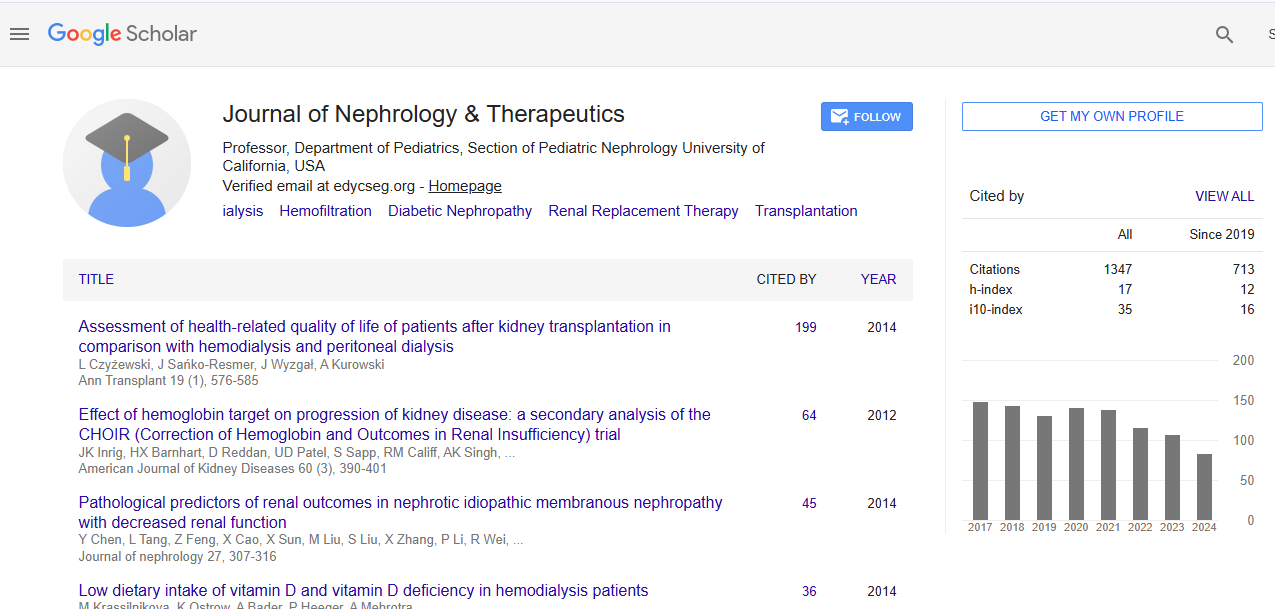
Journal of Nephrology & Therapeutics received 784 citations as per Google Scholar report