Brief Report - (2025) Volume 16, Issue 2
Received: 01-Apr-2025, Manuscript No. jbsbe-26-183286;
Editor assigned: 03-Apr-2025, Pre QC No. P-183286;
Reviewed: 17-Apr-2025, QC No. Q-183286;
Revised: 22-Apr-2025, Manuscript No. R-183286;
Published:
29-Apr-2025
, DOI: 10.37421/2165-6210.2025.16.492
Citation: Lee, Marcus. ”Electrochemical Biosensors: Revolutionizing Clinical Diagnostics and Disease Detection.” J Biosens Bioelectron 16 (2025):492.
Copyright: © 2025 Lee M. This is an open-access article distributed under the terms of the Creative Commons Attribution License, which permits unrestricted use, distribution and reproduction in any medium, provided the original author and source are credited.
Electrochemical biosensors represent a significant advancement in the field of clinical diagnostics, offering a powerful platform for rapid and sensitive detection of disease biomarkers. Their inherent ability to convert biological recognition events into measurable electrical signals makes them exceptionally well-suited for identifying specific indicators of illness with high precision. Recent research has focused on refining the core components of these biosensors, including innovative electrode materials, diverse biorecognition elements, and sophisticated signal transduction strategies. These advancements are driving applications in crucial areas such as the detection of infectious diseases, the screening of various cancers, and the development of point-of-care testing devices, all aimed at enhancing diagnostic capabilities. The ongoing pursuit of improved sensitivity, greater selectivity, and significantly reduced detection limits for vital clinical analytes underscores the dynamic evolution of this technology. Specifically, significant progress has been made in developing advanced electrochemical biosensing platforms for a wide array of diagnostic needs. One area of intense focus is the utilization of nanomaterials to amplify signal transduction and increase surface area for enhanced analyte capture and detection. This has led to biosensors with unprecedented sensitivity and lower detection limits, crucial for early disease diagnosis and monitoring. The integration of sophisticated recognition elements, such as antibodies, aptamers, and enzymes, further refines the specificity of these devices, ensuring accurate identification of target biomarkers even in complex biological matrices. The development of novel electrode modifications, including the use of graphene, carbon nanotubes, and noble metal nanoparticles, has been instrumental in improving the electrochemical performance and stability of these biosensors. These materials offer excellent electrical conductivity and a high surface-to-volume ratio, facilitating efficient electron transfer and enhancing the overall sensing performance. Furthermore, research is exploring the potential of these biosensors for detecting genetic mutations associated with inherited diseases, enabling personalized medicine approaches through rapid genetic screening. The continuous refinement of biosensor design and fabrication methodologies is paving the way for the widespread adoption of these technologies in routine clinical practice, offering faster, more accurate, and more accessible diagnostic solutions. The adaptability of electrochemical biosensors to detect a broad spectrum of analytes, from small molecules to large biomolecules and even pathogens, highlights their versatility and immense potential in modern healthcare. The focus on miniaturization and integration is also leading to the development of portable and user-friendly devices, facilitating point-of-care diagnostics and remote patient monitoring. The ability to perform multiplexed detection, simultaneously analyzing multiple biomarkers from a single sample, represents another significant leap forward, improving diagnostic efficiency for complex diseases. The ongoing exploration of molecularly imprinted polymers (MIPs) as robust recognition elements further expands the utility of electrochemical sensors, offering cost-effective and selective detection of specific molecules in biological samples. The development of electrochemical biosensors with enhanced stability and antifouling properties is crucial for their long-term use in continuous monitoring applications, such as glucose monitoring for diabetes management. The rapid detection of viral and bacterial pathogens is also a critical application area, with biosensors showing promise for early diagnosis and outbreak management. The potential for non-invasive diagnostic tools for neurodegenerative diseases, such as Alzheimer's, is also being realized through the development of highly sensitive electrochemical immunosensors for key biomarkers. The overarching goal is to translate these laboratory-based advancements into practical, scalable, and affordable diagnostic tools that can benefit patients globally. The continuous innovation in electrode materials, biorecognition strategies, and signal processing techniques is steadily pushing the boundaries of what is achievable in electrochemical biosensing for healthcare applications. The integration of advanced computational methods for data analysis and interpretation is also becoming increasingly important, enabling more sophisticated diagnostic capabilities. The exploration of novel transduction mechanisms beyond simple amperometric or potentiometric measurements is further expanding the repertoire of electrochemical sensing. The development of robust and reproducible fabrication methods is essential for the commercialization and widespread adoption of these promising diagnostic technologies. The increasing demand for rapid and accurate diagnostics, especially in the context of emerging infectious diseases and chronic conditions, fuels the ongoing research and development in this field. The ability to detect biomarkers at extremely low concentrations is paramount for early disease intervention and improved patient outcomes. The development of self-calibrating and user-friendly electrochemical biosensors will further enhance their accessibility and utility in diverse clinical settings. The synergistic integration of electrochemical techniques with other analytical methodologies is also an area of active research, promising even more powerful diagnostic tools. The drive towards sustainable and eco-friendly biosensing platforms is also gaining momentum, with a focus on reducing waste and energy consumption. The ethical considerations and regulatory pathways for novel diagnostic devices are also being actively addressed to ensure their safe and effective implementation in healthcare. The ultimate aim is to democratize advanced diagnostic capabilities, making them accessible to a wider population and improving global health outcomes. The ongoing evolution of electrochemical biosensors promises a future where diseases are detected earlier, managed more effectively, and treated more precisely, revolutionizing the landscape of clinical diagnostics. [1], [2], [3], [4], [5], [6], [7], [8], [9], [10]
Electrochemical biosensors have emerged as a cornerstone in the advancement of clinical diagnostics, offering a versatile and sensitive platform for the rapid identification of disease-related biomarkers. Their fundamental principle involves the transduction of biological interactions into measurable electrical signals, enabling high specificity in detecting indicators of various health conditions. The ongoing development in this field encompasses innovative electrode materials, sophisticated biorecognition elements, and refined signal transduction mechanisms. These advancements are crucial for applications spanning infectious disease detection, cancer screening, and point-of-care testing, with a continuous drive towards enhanced sensitivity, selectivity, and lowered detection limits for critical clinical analytes. Significant strides have been made in harnessing nanomaterials to augment the performance of electrochemical biosensors. For instance, the integration of graphene oxide and gold nanoparticles on screen-printed electrodes has demonstrably enhanced sensor surface area and conductivity, leading to improved sensitivity and reduced limits of detection for specific cancer biomarkers. Such enhancements are critical for early diagnosis and intervention strategies. The engineering of highly sensitive electrochemical immunosensors has also seen notable progress, particularly for the rapid detection of inflammatory markers. By employing unique antibody immobilization strategies on modified electrode surfaces, these sensors ensure high binding affinity and stability, showing promise for real-time monitoring of inflammatory conditions. The development of electrochemical DNA biosensors represents another significant area of innovation, particularly for identifying specific genetic mutations linked to inherited diseases. These sensors utilize hybridization assays on functionalized electrode surfaces to achieve high specificity and sensitivity for target DNA sequences, supporting rapid genetic screening and the advancement of personalized medicine. Molecularly imprinted polymer (MIP) based electrochemical sensors are also gaining traction for their selective detection of drug metabolites in biological fluids. The MIP film acts as a robust recognition element, offering a cost-effective and reliable method for therapeutic drug monitoring and pharmacokinetic studies. In the realm of infectious disease diagnostics, advanced electrochemical biosensors are being developed for the rapid detection of viral pathogens. By employing novel immobilization techniques for antibodies on modified electrodes, these sensors achieve enhanced sensitivity and rapid response times for viral antigen detection, highlighting their potential for point-of-care diagnostics during outbreaks. The management of chronic conditions like diabetes is also benefiting from advancements in electrochemical glucose biosensors. Novel electrode modification strategies are improving the long-term stability and antifouling properties of these sensors, leading to more reliable and user-friendly glucose monitoring devices with excellent linearity and accuracy. The rapid detection of bacterial infections is another critical application, with aptamer-functionalized electrochemical biosensors showing promise. Utilizing specific aptamers and nanomaterials, these sensors achieve high sensitivity and specificity in identifying bacterial DNA, delivering results within minutes for urgent clinical settings. The early diagnosis of neurodegenerative diseases, such as Alzheimer's, is being facilitated by electrochemical immunosensors designed to detect key biomarkers like amyloid-beta peptides. These platforms demonstrate high sensitivity and selectivity, contributing to the development of non-invasive diagnostic tools for conditions affecting the brain. Finally, the development of multiplexed electrochemical biosensing systems allows for the simultaneous detection of multiple biomarkers from a single sample. This innovation significantly improves diagnostic efficiency, particularly for complex diseases where multiple indicators are relevant, by integrating diverse recognition elements and electrode designs. The collective impact of these diverse applications points towards a future where electrochemical biosensors play an indispensable role in proactive, personalized, and accessible healthcare. [1], [2], [3], [4], [5], [6], [7], [8], [9], [10]
Electrochemical biosensors are revolutionizing clinical diagnostics with their high sensitivity and rapid detection capabilities for disease biomarkers. Recent advancements focus on enhancing electrode materials, biorecognition elements, and signal transduction to improve sensitivity, selectivity, and reduce detection limits. Key applications include infectious disease detection, cancer screening, genetic mutation identification, inflammatory marker monitoring, therapeutic drug monitoring, viral and bacterial pathogen detection, glucose monitoring for diabetes, and early diagnosis of neurodegenerative diseases. Innovations such as the use of nanomaterials, molecularly imprinted polymers, and aptamers are driving these improvements. Multiplexed systems capable of detecting multiple biomarkers simultaneously are also enhancing diagnostic efficiency for complex diseases. The overall trend is towards more accurate, accessible, and point-of-care diagnostic solutions.
None
None
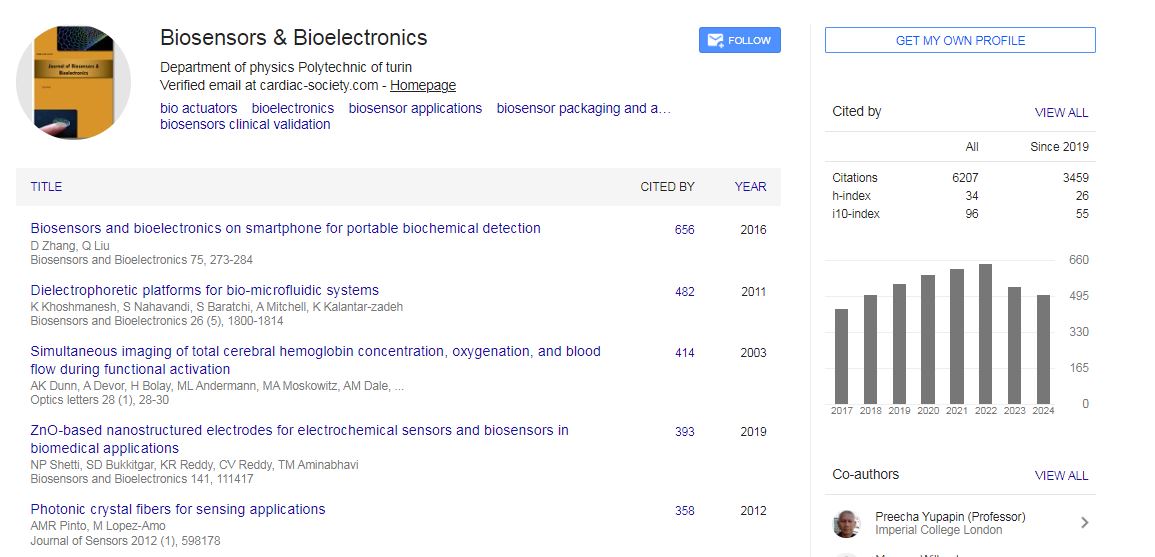
Biosensors & Bioelectronics received 6207 citations as per Google Scholar report