Commentary - (2025) Volume 15, Issue 3
Received: 01-Sep-2025, Manuscript No. jttr-25-175418;
Editor assigned: 03-Dec-2025, Pre QC No. P-175418;
Reviewed: 17-Dec-2025, QC No. Q-175418;
Revised: 22-Sep-2025, Manuscript No. R-175418;
Published:
29-Sep-2025
, DOI: 10.37421/2161-0991.2025.15.310
Citation: Petrova, Natalia. ”Dynamic Organ Preservation: Expanding Life-Saving Transplants.” J Transplant Technol Res 15 (2025):310.
Copyright: © 2025 Petrova N. This is an open-access article distributed under the terms of the Creative Commons Attribution License, which permits unrestricted use, distribution and reproduction in any medium, provided the original author and source are credited.
Machine perfusion is a game-changer in kidney transplantation, offering better organ preservation and more accurate viability assessment. It helps reduce cold ischemia time and improve outcomes, especially for marginal kidneys. What this really means is that by continuously perfusing the organ, we get real-time metabolic and functional data, helping clinicians decide if a kidney is truly suitable for transplant, ultimately expanding the donor pool and enhancing patient success [1].
Assessing liver viability during machine perfusion is crucial for successful transplantation. This approach allows for a dynamic evaluation of donor livers, especially those considered marginal, by monitoring metabolic activity and physiological parameters. This better identifies livers that will perform well post-transplant, leading to reduced rates of primary non-function and graft failure, ultimately improving patient survival and quality of life [2].
Ex vivo lung perfusion (EVLP) has transformed how we assess and recondition marginal donor lungs. Itâ??s not just about keeping the organ alive; it's about actively improving its function outside the body. This technique allows for a comprehensive viability assessment, including gas exchange and pulmonary mechanics, which helps to mitigate ischemia-reperfusion injury and expand the pool of usable lungs, ultimately saving more lives [3].
Assessing pancreas viability for transplantation is incredibly complex due to its susceptibility to ischemia-reperfusion injury. Current methods focus on static cold storage, but innovations in machine perfusion and biomarker analysis are pushing boundaries. The goal here is to accurately predict post-transplant function, reducing complications like graft pancreatitis and ensuring better outcomes for patients with diabetes requiring a pancreas transplant [4].
Biomarkers measured during normothermic machine perfusion are proving invaluable for assessing kidney transplant viability. These markers, like lactate, glucose consumption, and specific enzyme levels, offer real-time insights into metabolic health and injury. Clinicians can make more informed decisions about accepting a donor kidney, potentially reducing rates of delayed graft function and improving long-term graft survival [5].
Ex vivo heart perfusion (EVHP) is making strides in assessing and reconditioning donor hearts, especially those from extended criteria donors. This technique allows for a dynamic evaluation of cardiac function and metabolic status outside the body. The real benefit here is the potential to expand the donor heart pool by safely utilizing hearts that might otherwise be discarded, ultimately offering more opportunities for life-saving heart transplants [6].
Organ preservation technologies are constantly evolving, moving beyond simple static cold storage to more sophisticated perfusion methods. These advancements, coupled with improved viability assessment tools, are crucial for increasing the number of transplantable organs. We're talking about better outcomes, reduced discard rates, and essentially, saving more lives by getting the most out of every donated organ [7].
Ischemia-reperfusion injury (IRI) remains a significant challenge in organ transplantation, directly impacting graft viability and long-term function. Understanding its pathophysiology is key to developing strategies that minimize damage during preservation and reperfusion. The goal here is to find ways to protect organs from this injury, ensuring better outcomes and expanding the criteria for transplantable organs, ultimately benefiting more patients [8].
Advanced imaging techniques are revolutionizing how we assess organ viability before transplantation. Tools like magnetic resonance imaging, computed tomography, and optical imaging can provide non-invasive, detailed structural and functional insights. What this means is that we can get a clearer picture of an organ's health, identify subtle damage, and make more accurate predictions about its post-transplant performance, leading to better selection and patient outcomes [9].
Artificial Intelligence (AI) is rapidly emerging as a powerful tool in organ transplantation, particularly for viability assessment. By analyzing vast datasets from donor characteristics, perfusion parameters, and imaging, AI algorithms can predict graft outcomes with impressive accuracy. The potential here is huge: more objective decision-making, reduced human error, and optimized allocation, which translates to more successful transplants and improved patient lives [10].
Modern organ transplantation continually seeks to improve outcomes, and a significant part of that effort focuses on advanced organ preservation and viability assessment. Technologies are moving beyond basic static cold storage to sophisticated perfusion methods, which are crucial for increasing the number of transplantable organs available. This evolution means better outcomes, reduced discard rates, and more lives saved by maximizing the potential of every donated organ [7].
For kidneys, machine perfusion is a game-changer. It ensures better organ preservation and more accurate viability assessments by reducing cold ischemia time and improving outcomes, especially for marginal kidneys. This continuous perfusion provides real-time metabolic and functional data, helping clinicians confidently determine if a kidney is suitable for transplant [1]. Similarly, in liver transplantation, machine perfusion allows for dynamic evaluation of donor livers. By monitoring metabolic activity and physiological parameters, especially in marginal organs, this method helps identify livers that will perform well, thereby reducing primary non-function and graft failure rates [2]. Biomarkers like lactate, glucose consumption, and specific enzyme levels, measured during normothermic machine perfusion, provide real-time insights into kidney metabolic health and injury, further aiding informed decisions and potentially improving long-term graft survival [5].
Beyond kidneys and livers, specialized perfusion techniques are transforming the assessment of other vital organs. Ex Vivo Lung Perfusion (EVLP) is crucial for reconditioning and assessing marginal donor lungs. This technique actively improves lung function outside the body, offering a comprehensive viability assessment that includes gas exchange and pulmonary mechanics. It effectively mitigates ischemia-reperfusion injury, expanding the pool of usable lungs [3]. For hearts, Ex Vivo Heart Perfusion (EVHP) is advancing the assessment and reconditioning of donor hearts, particularly those from extended criteria donors. This dynamic evaluation of cardiac function and metabolic status outside the body expands the donor heart pool by safely utilizing hearts that might otherwise be discarded [6]. Pancreas viability assessment remains complex, largely due to its susceptibility to ischemia-reperfusion injury, but machine perfusion and biomarker analysis are making strides in predicting post-transplant function and reducing complications [4].
Ischemia-reperfusion injury (IRI) remains a significant challenge across all organ transplantations, directly impacting graft viability and long-term function. Understanding its pathophysiology is essential for developing protective strategies during preservation and reperfusion, ensuring better outcomes and broadening the criteria for transplantable organs [8]. Advanced imaging techniques, including magnetic resonance imaging, computed tomography, and optical imaging, are also revolutionizing viability assessment. These non-invasive tools offer detailed structural and functional insights, providing a clearer picture of an organ's health, identifying subtle damage, and improving predictions of post-transplant performance [9].
The integration of Artificial Intelligence (AI) is rapidly emerging as a powerful tool in this field. By analyzing vast datasets, including donor characteristics, perfusion parameters, and imaging results, AI algorithms can predict graft outcomes with impressive accuracy. This technology offers the potential for more objective decision-making, reduced human error, and optimized organ allocation, leading to more successful transplants and improved patient lives [10]. Collectively, these innovations in perfusion, biomarker analysis, imaging, and AI are significantly advancing the field of organ transplantation, promising better results for recipients worldwide.
The field of organ transplantation is undergoing a transformative shift, moving from traditional static cold storage to advanced perfusion technologies and dynamic viability assessment methods. This evolution is crucial for expanding the donor pool and significantly improving patient outcomes across various organs. Machine perfusion for kidneys, for instance, offers real-time metabolic data, enabling better preservation and reducing cold ischemia time. Similarly, for livers, it provides dynamic evaluation, monitoring metabolic activity to predict post-transplant performance and reduce graft failure. Techniques like Ex Vivo Lung Perfusion (EVLP) actively recondition marginal lungs, mitigating ischemia-reperfusion injury, while Ex Vivo Heart Perfusion (EVHP) assesses and revitalizes hearts from extended criteria donors, expanding life-saving opportunities. Pancreas transplantation, though complex due to ischemia-reperfusion susceptibility, also benefits from evolving perfusion and biomarker analysis. Biomarkers during normothermic machine perfusion for kidneys offer crucial insights into organ health, aiding clinical decisions and improving long-term graft survival. Overcoming ischemia-reperfusion injury remains a central challenge, addressed by these advanced preservation strategies. Further enhancing assessment are advanced imaging techniques that provide non-invasive structural and functional insights. Artificial Intelligence (AI) is also emerging as a pivotal tool, analyzing extensive data to predict graft outcomes, optimize allocation, and ensure more objective decision-making. Together, these innovations are ensuring more transplantable organs, reducing discard rates, and ultimately saving more lives through improved graft function and patient success.
None
None
Mojtaba G, Asmaa R, Alaa G. "Machine Perfusion in Kidney Transplantation: A Comprehensive Review".Transplant Proc 55 (2023):145-151.
Indexed at, Google Scholar, Crossref
Hao C, Haibing Z, Xiaolong L. "Organ viability assessment of donor livers using machine perfusion: A systematic review and meta-analysis".Front Surg 10 (2023):1240294.
Indexed at, Google Scholar, Crossref
Tilen K, Rexhep J, Primož K. "Advancements in Ex Vivo Lung Perfusion for Marginal Donor Lungs".J Clin Med 12 (2023):1632.
Indexed at, Google Scholar, Crossref
Philipp T, Raphael M, Verena B. "Current Status of Pancreas Preservation and Viability Assessment".J Clin Med 12 (2023):6855.
Indexed at, Google Scholar, Crossref
Judith S, Virginia S, Jaume T. "Biomarkers in Normothermic Machine Perfusion for Kidney Transplant Viability Assessment: A Systematic Review".J Clin Med 12 (2023):2659.
Indexed at, Google Scholar, Crossref
Rolf T, Alessandro C, Roberto C. "Ex Vivo Heart Perfusion in Clinical Practice and Research: Current State and Future Perspectives".J Clin Med 12 (2023):6749.
Indexed at, Google Scholar, Crossref
Anne R, Barbara S, H. MH. "Organ Preservation Technologies and Viability Assessment: An Overview".Transpl Int 36 (2023):11413.
Indexed at, Google Scholar, Crossref
Jiaxin L, Yan L, Shaohua G. "Ischemia-Reperfusion Injury in Organ Transplantation: Pathophysiology and Potential Therapeutic Strategies".Front Immunol 12 (2021):656919.
Indexed at, Google Scholar, Crossref
Carolina G, Silvia C, Cristina S. "Advanced Imaging Techniques for Organ Viability Assessment in Transplantation".J Clin Med 9 (2020):2201.
Indexed at, Google Scholar, Crossref
Vikram S, Anupam PS, Deepti S. "Artificial Intelligence in Organ Transplantation: An Overview".Cureus 15 (2023):e44026.
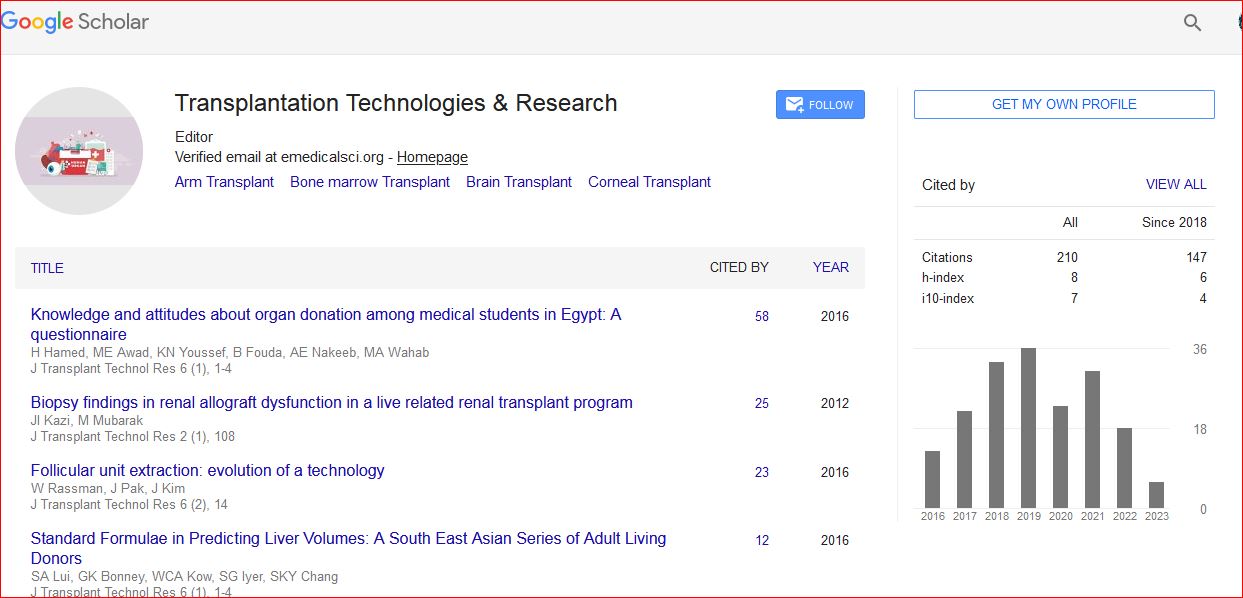
Transplantation Technologies & Research received 223 citations as per Google Scholar report