Opinion - (2025) Volume 11, Issue 3
Received: 02-Jun-2025, Manuscript No. jctt-26-188407;
Editor assigned: 04-Jun-2025, Pre QC No. P-188407;
Reviewed: 18-Jun-2025, QC No. Q-188407;
Revised: 23-Jun-2025, Manuscript No. R-188407;
Published:
30-Jun-2025
, DOI: 10.37421/2471-9323.2024.10.325
Citation: Lin, Mei. ”Advancements In Skin And Hair Health Therapies.” J Cosmo Tricho 11 (2025):325.
Copyright: © 2025 Lin M. This is an open-access article distributed under the terms of the Creative Commons Attribution License, which permits unrestricted use, distribution and reproduction in any medium, provided the original author and source are credited.
The field of cosmetic dermatology and trichology has seen remarkable advancements, driven by a deeper understanding of skin and hair biology and the development of sophisticated ingredients and technologies. The pursuit of enhanced skin health and robust hair growth is increasingly reliant on targeted, scientifically validated approaches. Novel bioactive peptides and plant-derived exosomes are emerging as key players in skin rejuvenation, working synergistically to promote cellular regeneration and combat signs of aging [1].
Concurrently, the complex ecosystem of the scalp microbiome is being recognized for its profound influence on hair health. Dysbiosis, or an imbalance in this microbial community, is linked to various hair disorders, prompting the development of therapies aimed at restoring equilibrium through prebiotics and probiotics for improved hair strength and reduced inflammation [2].
Protection against environmental damage is another critical area of focus, particularly concerning oxidative stress induced by pollutants and UV radiation. Advanced antioxidants, delivered via innovative systems like nanoemulsions, are being developed to enhance skin barrier function and mitigate the visible signs of aging, emphasizing the importance of photoprotection [3].
For individuals experiencing hair loss, particularly androgenetic alopecia, low-level laser therapy (LLLT) is demonstrating efficacy. This non-invasive treatment stimulates hair regrowth by increasing ATP production in follicles and extending the hair growth cycle, offering a promising therapeutic option [4].
In the realm of skin aging, retinoids continue to be a cornerstone of treatment. Their ability to modulate gene expression, boost collagen synthesis, and accelerate epidermal turnover makes them invaluable for reducing wrinkles and improving skin texture, though management of side effects remains important [5].
Environmental stressors, such as UV radiation and air pollution, also significantly impact hair fiber integrity and scalp health. Research is exploring how oxidative damage affects hair structure, leading to brittleness and breakage, and is informing the development of protective haircare formulations [6].
Beyond established ingredients, novel peptide complexes are showing significant promise in enhancing skin elasticity and firmness. Studies confirm their capacity to stimulate collagen production, offering potential for advanced anti-aging topical treatments [7].
A comprehensive understanding of the hair growth cycle, influenced by hormones and genetics, is crucial for addressing alopecia. Current therapeutic strategies, including minoxidil, finasteride, and platelet-rich plasma, are being evaluated for their efficacy and safety, highlighting the need for multifaceted treatment approaches [8].
The skin barrier's integrity is fundamental to maintaining skin health, especially for dry and sensitive conditions. Ceramides play a vital role in this protective function, and topical formulations containing them are proving effective in restoring barrier function, improving hydration, and reducing irritation [9].
Finally, the impact of diet and nutrition on hair quality and growth cannot be overstated. Essential vitamins, minerals, and proteins are critical for follicle health, and understanding nutritional deficiencies can guide effective dietary interventions and supplementation strategies for various types of alopecia [10].
Advanced cosmetic ingredients are revolutionizing skin and hair care by targeting fundamental biological processes. Novel formulations incorporating synergistic combinations of natural extracts and synthetic peptides are demonstrating remarkable efficacy in enhancing cellular regeneration and hydration, leading to significant improvements in skin health and combating the visible signs of aging. These innovative approaches also extend to promoting scalp microcirculation, fostering robust hair growth [1].
The scalp's microbiome is a critical frontier in dermatological research, with its balance directly influencing hair health. Disruptions in this delicate ecosystem, known as dysbiosis, are strongly implicated in common hair issues such as dandruff and alopecia. Consequently, therapeutic strategies focusing on restoring microbial balance through prebiotics and probiotics are gaining traction, promising enhanced hair strength and reduced scalp inflammation [2].
Protecting the skin from environmental aggressors is paramount, especially in urban settings where pollution and UV radiation can induce significant oxidative stress. Cutting-edge research is focused on developing advanced antioxidants and novel delivery systems, such as nanoemulsions, to enhance their penetration and bioavailability. This leads to improved skin barrier function and a noticeable reduction in aging signs [3].
For individuals affected by hair loss, particularly androgenetic alopecia, low-level laser therapy (LLLT) presents a viable non-invasive treatment option. Clinical trials have confirmed its ability to stimulate hair regrowth by boosting energy production within hair follicles and positively influencing the hair growth cycle, making it a significant development in trichology [4].
Topical retinoids remain a gold standard in the treatment of skin aging, owing to their profound effects on cellular processes. They effectively modulate gene expression, stimulate collagen production, and accelerate skin cell turnover, resulting in a reduction of wrinkles, enhanced skin texture, and a more youthful appearance, with ongoing efforts to manage potential side effects [5].
Environmental factors like UV exposure and air pollution pose significant threats to hair integrity and scalp health. Studies are investigating how oxidative damage compromises the hair cuticle and cortex, leading to issues such as brittleness and breakage. This research informs the development of specialized haircare products designed to neutralize free radicals and fortify the hair shaft [6].
A promising area of research involves novel peptide complexes that have shown a remarkable ability to stimulate collagen synthesis and improve skin elasticity. Both in vitro and in vivo studies have validated their effectiveness in enhancing skin firmness and reducing the appearance of fine lines, positioning them as valuable agents in anti-aging formulations [7].
Understanding the intricate hair growth cycle and the factors that regulate it, including hormonal and genetic influences, is fundamental to addressing hair loss conditions. A review of current therapeutic interventions for alopecia, encompassing established treatments and emerging options like platelet-rich plasma, underscores the importance of a comprehensive and personalized treatment strategy [8].
The critical role of ceramides in maintaining a healthy skin barrier is well-established, particularly for managing dry and sensitive skin. Deficiencies in ceramides can impair the skin's protective capabilities, leading to increased water loss. Topical ceramide formulations are thus crucial for restoring skin barrier integrity, improving hydration, and alleviating irritation [9].
Diet and nutrition play a fundamental role in the health and growth of hair. An adequate intake of essential vitamins, minerals, and proteins is vital for maintaining the vitality of hair follicles and the structural integrity of the hair shaft. Nutritional deficiencies can contribute to various forms of alopecia, making evidence-based dietary recommendations and supplementation important therapeutic considerations [10].
This collection of research highlights advancements in cosmetic dermatology and trichology. It explores novel bioactive peptides and exosomes for skin rejuvenation, the role of the scalp microbiome and targeted therapies for hair health, and the protective effects of antioxidants delivered via nanoemulsions against environmental damage. The efficacy of low-level laser therapy for hair regrowth and the established benefits of retinoids and ceramides for skin aging and barrier function are discussed. Furthermore, the impact of environmental stressors on hair integrity, the potential of new peptide complexes for skin elasticity, the understanding of hair growth cycles and alopecia treatments, and the significance of diet and nutrition for hair health are examined.
None
None
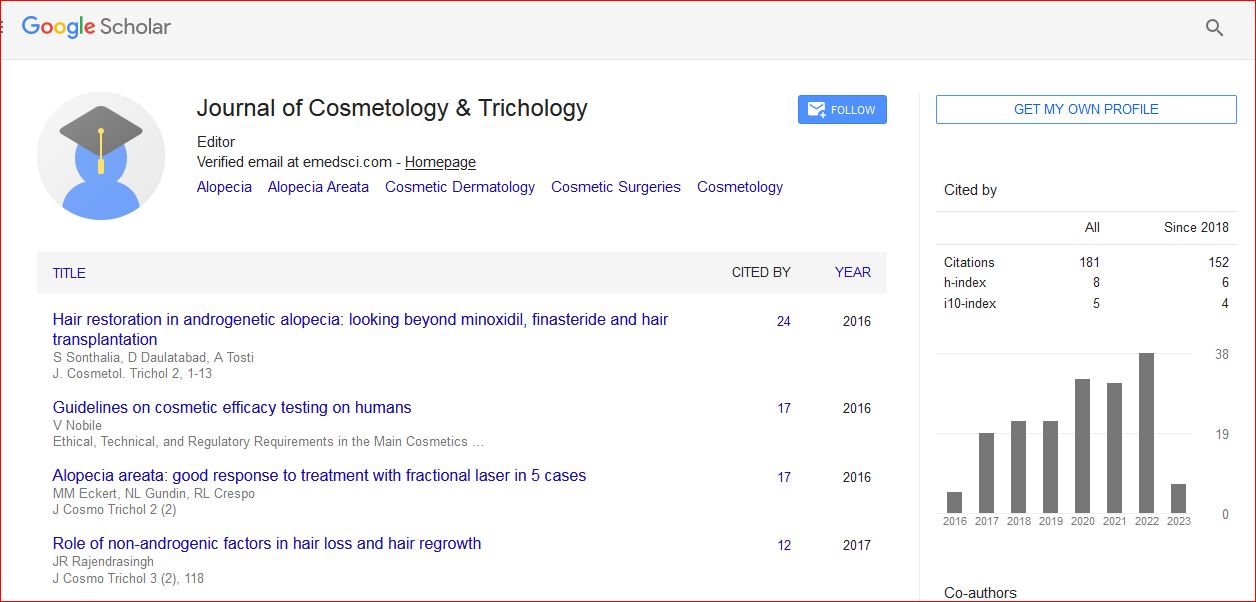
Journal of Cosmetology & Trichology received 180 citations as per Google Scholar report