Commentary - (2025) Volume 9, Issue 5
Received: 01-Oct-2025, Manuscript No. jid-26-188343;
Editor assigned: 03-Oct-2025, Pre QC No. P-188343;
Reviewed: 17-Oct-2025, QC No. Q-188343;
Revised: 22-Oct-2025, Manuscript No. R-188343;
Published:
29-Oct-2025
, DOI: 10.37421/2684-4559.2025.9.346
Citation: Al-Faraj, Omar. "Cryptococcus Neoformans in HIV: Diversity, Resistance, Epidemiology." Clin Infect Dis 13 (2025):346.
Copyright: © 2025 Al-Faraj O. This is an open-access article distributed under the terms of the Creative Commons Attribution License, which permits unrestricted use, distribution and reproduction in any medium, provided the original author and source are credited.
The investigation into the genetic diversity and antifungal resistance profiles of *Cryptococcus neoformans* isolates among HIV-positive patients is a critical area of research, crucial for the development of effective targeted therapies and the enhancement of patient outcomes within this particularly vulnerable demographic. This understanding is paramount for addressing the significant burden of cryptococcosis in individuals with compromised immune systems, a challenge that continues to persist despite advancements in HIV management [1].
Furthermore, a deep dive into the molecular mechanisms underlying *Cryptococcus neoformans* pathogenesis, especially within the context of HIV coinfection, is essential for identifying key virulence factors and potential therapeutic targets. This research endeavors to elucidate how a weakened immune system critically influences the progression and severity of cryptococcosis, a serious opportunistic infection [2].
The detailed genotypic characterization of both *Cryptococcus neoformans* and *Cryptococcus gattii* strains, particularly those isolated from a cohort of HIV-positive patients, significantly contributes to a more profound understanding of the prevailing epidemiological landscape and the prevalence of specific strains. This knowledge is fundamental for public health strategies and clinical management [3].
Another significant focus lies in the prevalence of specific *Cryptococcus neoformans* molecular types and their direct association with clinical outcomes in HIV-positive individuals. Such studies provide invaluable insights into potential genotype-phenotype correlations, aiding in predicting disease severity and response to treatment [4].
Exploring the genomic epidemiology of *Cryptococcus neoformans* serves the vital purpose of identifying novel virulence determinants and antifungal resistance mechanisms that are particularly relevant to HIV-positive patients. The ultimate aim is to inform and improve both diagnostic and therapeutic strategies employed in the clinical setting [5].
The molecular basis of azole resistance in *Cryptococcus neoformans* isolates originating from HIV-positive patients is a subject of paramount importance. This is due to the widespread and frequent use of azole antifungals for both the treatment and prophylaxis of cryptococcosis, making resistance a significant clinical concern [6].
Investigating the epidemiological trends of cryptococcal meningitis specifically within HIV-positive patient populations, coupled with an analysis of the molecular subtypes of *Cryptococcus neoformans*, offers crucial insights into transmission dynamics and the intricate host-pathogen interactions at play. This information is vital for effective disease control [7].
The identification of circulating lineages of *Cryptococcus neoformans* within HIV-positive patient populations, alongside an assessment of their associated antifungal susceptibility patterns, provides indispensable data for the formulation and implementation of targeted public health interventions. Such data can guide resource allocation and treatment guidelines [8].
Understanding the genetic relatedness of *Cryptococcus neoformans* isolates obtained from HIV-positive patients, often achieved through methods like multilocus sequence typing (MLST), is key to deciphering clonal expansion and transmission routes. This aids in tracing the origins and spread of infections [9].
Finally, assessing the impact of antiretroviral therapy (ART) on the prevalence and molecular characteristics of *Cryptococcus neoformans* in HIV-positive patients offers critical insights into the complex interplay between immune reconstitution and the susceptibility to fungal infections. This area of research is vital for optimizing HIV care and preventing opportunistic infections [10].
The study meticulously investigates the genetic diversity and antifungal resistance profiles of *Cryptococcus neoformans* isolates specifically sourced from HIV-positive patients. Such an in-depth understanding is deemed essential for the strategic development of targeted therapeutic interventions and the overall improvement of patient outcomes within this particularly vulnerable population. This forms a cornerstone for effective clinical management [1].
Further research examines the intricate molecular mechanisms responsible for *Cryptococcus neoformans* pathogenesis, with a particular emphasis on the context of HIV coinfection. This analysis highlights crucial virulence factors and identifies potential targets for novel therapeutic agents. The research aims to illuminate how a compromised immune system significantly influences the clinical course of cryptococcosis [2].
This paper provides a comprehensive account of the genotypic characterization of both *Cryptococcus neoformans* and *Cryptococcus gattii* strains. These isolates were obtained from a distinct cohort of HIV-positive patients, thereby contributing significantly to a more profound comprehension of the prevailing epidemiological landscape and the specific strain prevalence within healthcare settings [3].
Central to another study is the focused examination of the prevalence of specific molecular types of *Cryptococcus neoformans*. The research also investigates their correlation with clinical outcomes observed in HIV-positive individuals, offering critical insights into potential genotype-phenotype relationships that can guide clinical decision-making [4].
This research delves into the genomic epidemiology of *Cryptococcus neoformans*, with the overarching goal of identifying novel virulence determinants and understanding the mechanisms of antifungal resistance. These findings are particularly relevant to the management of HIV-positive patients and are intended to inform diagnostic and therapeutic strategies [5].
The study critically investigates the molecular underpinnings of azole resistance observed in *Cryptococcus neoformans* isolates derived from HIV-positive patients. This area is of immense significance given the widespread utilization of azole antifungals for both the treatment and prophylactic management of cryptococcosis [6].
This publication addresses the evolving epidemiological trends associated with cryptococcal meningitis in HIV-positive patients. By analyzing the molecular subtypes of *Cryptococcus neoformans*, the study aims to provide a clearer picture of transmission dynamics and the complex host-pathogen interactions involved in the disease process [7].
The research is dedicated to identifying the various circulating lineages of *Cryptococcus neoformans* within the HIV-positive patient population. Concurrently, it assesses their antifungal susceptibility patterns, thereby generating vital data crucial for the implementation of effective public health interventions and treatment protocols [8].
This paper meticulously explores the genetic relatedness among *Cryptococcus neoformans* isolates that were obtained from HIV-positive patients. The study employs advanced techniques such as multilocus sequence typing (MLST) to gain a deeper understanding of clonal expansion and the patterns of transmission within this patient group [9].
Lastly, this research evaluates the multifaceted impact of antiretroviral therapy (ART) on both the prevalence and the molecular characteristics of *Cryptococcus neoformans* infections in HIV-positive patients. The findings offer valuable insights into the dynamic interplay between immune reconstitution and the susceptibility to fungal infections [10].
This collection of research focuses on *Cryptococcus neoformans* infections in HIV-positive patients, investigating genetic diversity, antifungal resistance, and molecular epidemiology. Studies explore virulence factors, genotype-phenotype correlations, and the impact of antiretroviral therapy. Key areas include understanding azole resistance mechanisms and identifying circulating fungal lineages. The research aims to improve diagnostic and therapeutic strategies for cryptococcosis in this vulnerable population, providing crucial data for public health interventions and better patient outcomes.
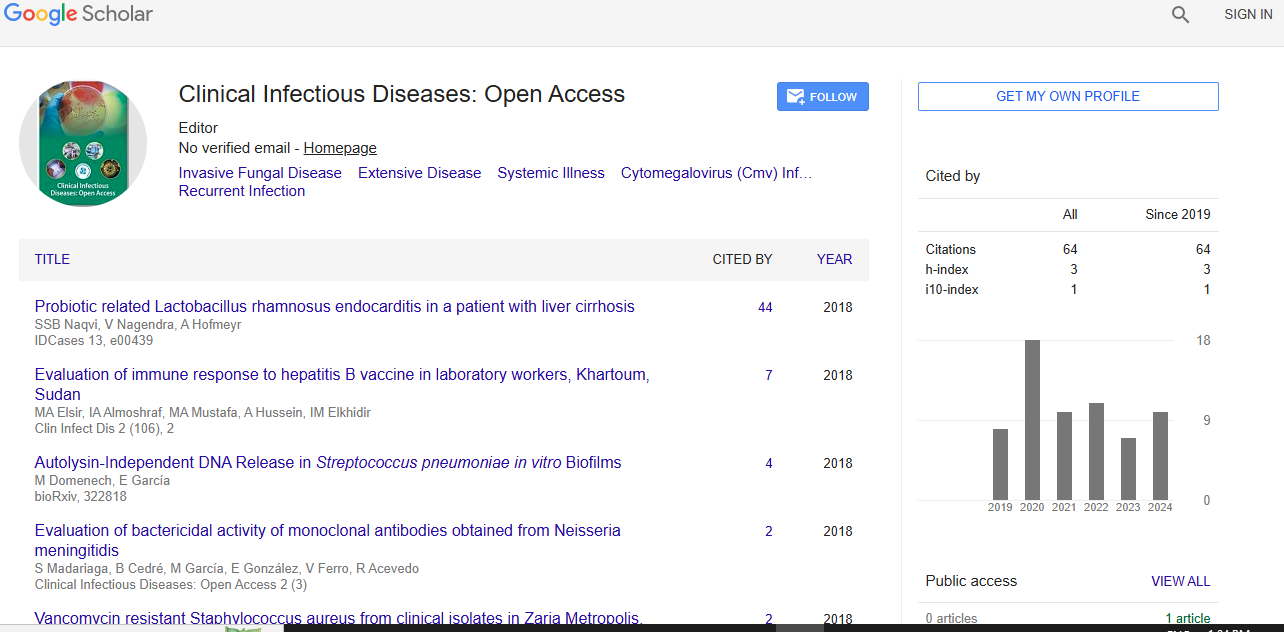
Clinical Infectious Diseases: Open Access received 1149 citations as per Google Scholar report