Short Communication - (2025) Volume 15, Issue 4
Received: 01-Dec-2025, Manuscript No. jttr-25-175460;
Editor assigned: 03-Dec-2025, Pre QC No. P-175460;
Reviewed: 17-Dec-2025, QC No. Q-175460;
Revised: 22-Dec-2025, Manuscript No. R-175460;
Published:
29-Dec-2025
, DOI: 10.37421/2161-0991.2025.15.324
Citation: Dupont, Claire H.. ”Contemporary Liver Transplant: Progress and Challenges.” J Transplant Technol Res 15 (2025):324.
Copyright: © 2025 Dupont H. Claire This is an open-access article distributed under the terms of the Creative Commons Attribution License, which permits unrestricted use, distribution and reproduction in any medium, provided the original author and source are credited.
Liver transplantation remains a life-saving procedure for end-stage liver disease, with continuous advancements shaping its practice. A core aspect of successful transplantation involves the careful management of immunosuppression strategies. Clinicians aim to strike a delicate balance between preventing organ rejection and minimizing adverse side effects, utilizing established regimens like calcineurin inhibitors, antimetabolites, and steroids, while also exploring newer agents and personalized approaches to optimize patient outcomes.[1] The ongoing challenge of organ scarcity has elevated the importance of living donor liver transplantation. This vital option requires a comprehensive understanding of its current role, associated surgical techniques, and expected outcomes. Emphasis is placed on evolving indications, robust donor safety protocols, and innovative strategies designed to improve results for both recipients and donors.[2] Organ preservation technology has also seen significant innovation, with machine perfusion emerging as a transformative method. This approach involves various modalities, including hypothermic and normothermic perfusion, which effectively enhance organ preservation, enable more accurate viability assessment, and critically, expand the donor pool by making previously marginal organs suitable for transplant. This ultimately leads to improved post-transplant outcomes.[3] The landscape of liver transplantation for hepatocellular carcinoma (HCC) is another area of active research. Recent studies offer population-based insights into patient selection criteria and post-transplant survival rates. These analyses highlight the evolving standards and the considerable impact that different treatment strategies have on the long-term outcomes for HCC patients undergoing liver transplants.[4] Closely related is the complex issue of HCC recurrence after liver transplantation, which demands careful attention. Comprehensive reviews meticulously identify various risk factors, ranging from specific tumor characteristics to the nuances of post-transplant immunosuppression. These studies also outline current prevention and treatment strategies, all geared towards improving recurrence-free survival rates for patients.[5] Beyond surgical and oncological considerations, patient assessment plays a crucial role. Frailty assessment in liver transplantation has gained recognition as a key indicator of patient resilience and potential post-operative risks. Current methods for measuring frailty are explored, along with their profound impact on transplant outcomes. This area of research also suggests future directions for integrating frailty assessments systematically into clinical practice, thereby optimizing patient selection and enhancing overall care.[6] Looking ahead, Artificial Intelligence (AI) is increasingly making its mark in liver transplantation. A systematic review of this emerging role reveals how AI technologies are being applied across multiple stages of the transplant process. This includes sophisticated donor-recipient matching, more accurate prediction of graft survival, fine-tuning immunosuppression protocols, and early detection of potential complications. Such applications demonstrate AI's substantial potential to revolutionize clinical decision-making and elevate the standard of patient care.[7] Specific populations also present unique considerations. Recent advancements in pediatric liver transplantation, for instance, highlight significant improvements in surgical techniques, tailored immunosuppressive regimens, and enhanced management of both pre-operative and post-operative complications. These developments are directly leading to better outcomes and an improved quality of life for young recipients, effectively addressing the distinct challenges inherent to the pediatric population.[8] Furthermore, understanding the long-term trajectory of transplant patients is vital. A detailed evaluation of long-term outcomes for liver transplantation performed for various etiologies over several decades provides invaluable insights into patient and graft survival. Such single-center experiences shed light on how diverse underlying liver diseases influence long-term prognosis and underscore the evolving success of transplantation over time.[9] Despite these many successes, managing post-transplant complications remains a critical aspect of ongoing care. Updates on common complications, including their diagnosis and effective management strategies, cover a broad spectrum of issues from immunological rejection and infections to cardiovascular and renal complications. This guidance is crucial for ensuring optimal patient recovery and long-term well-being after a liver transplant.[10]
Liver transplantation involves complex strategies for patient care, focusing heavily on managing the immune system. Current approaches to immunosuppression carefully balance preventing rejection with minimizing drug-related side effects, employing both established treatments and newer, personalized regimens to enhance patient survival and quality of life [1]. Simultaneously, the challenge of organ availability has made living donor liver transplantation a more prominent and vital option. This involves evaluating evolving indications, refining surgical techniques, and prioritizing donor safety to improve outcomes for both the donor and the recipient [2]. Advances in organ preservation technology, particularly machine perfusion, have also been instrumental. Using modalities like hypothermic and normothermic perfusion allows for improved organ viability assessment, extends preservation times, and crucially, expands the pool of usable donor organs, ultimately contributing to better post-transplant success rates [3].
For patients with hepatocellular carcinoma (HCC), liver transplantation offers a curative path, but specific considerations are paramount. Recent population-based studies provide insights into patient selection criteria and factors influencing post-transplant survival for HCC patients. These studies underscore the dynamic nature of selection guidelines and the significant impact of treatment choices on long-term patient outcomes [4]. A related and critical concern is the recurrence of HCC following transplantation. Comprehensive reviews identify various risk factors, from tumor characteristics to the specifics of post-transplant immunosuppressive therapy, and outline strategies for prevention and treatment aimed at extending recurrence-free survival [5].
Patient assessment goes beyond clinical markers to include overall resilience. Frailty assessment has emerged as an important indicator in liver transplantation, helping to gauge a patient's capacity to withstand the stress of surgery and recovery. Research explores current methods for measuring frailty and its direct influence on transplant outcomes, suggesting future directions for its integration into clinical practice to optimize patient selection and personalize care [6].
Technological innovation, specifically Artificial Intelligence (AI), is beginning to revolutionize the field. AI technologies are finding applications across various stages of liver transplantation, including optimizing donor-recipient matching, predicting graft survival, fine-tuning immunosuppression regimens, and facilitating early detection of complications. This integration holds considerable potential for enhancing clinical decision-making and improving patient care pathways [7]. Furthermore, advancements in pediatric liver transplantation address the unique needs of younger patients. Recent developments have improved surgical techniques, refined immunosuppressive protocols, and enhanced the management of both pre- and post-operative complications, leading to better outcomes and an improved quality of life for pediatric recipients [8].
Understanding the long-term success of liver transplantation for different underlying conditions is key to continuous improvement. A three-decade single-center study, for example, offers valuable insights into the long-term patient and graft survival across various etiologies. This kind of extensive data illuminates how different liver diseases affect long-term prognosis and showcases the ongoing evolution in transplant success over time [9]. Despite these successes, managing post-transplant complications remains a significant part of patient care. Current updates detail the diagnosis and management of common issues, ranging from immunological rejection and infections to cardiovascular and renal complications. This guidance is essential for ensuring optimal patient recovery and sustained well-being after liver transplantation [10].
The provided data highlights a range of critical topics in liver transplantation, reflecting contemporary challenges and advancements. One significant area is the strategic management of immunosuppression, which involves carefully balancing the prevention of organ rejection against the need to mitigate side effects. This involves evaluating established regimens alongside newer agents and personalized approaches to improve patient outcomes. Addressing the persistent issue of organ scarcity, living donor liver transplantation is presented as a vital option. The discussions cover its evolving indications, surgical techniques, and outcomes, with a strong emphasis on ensuring donor safety and enhancing results for both recipients and donors. Organ preservation has also seen advancements, particularly through machine perfusion, which includes hypothermic and normothermic modalities. This technology is crucial for enhancing organ viability, allowing for better assessment, and expanding the donor pool by making marginal organs usable, ultimately leading to better post-transplant outcomes. For hepatocellular carcinoma (HCC), the data explores recent trends in transplantation, including patient selection criteria and post-transplant survival, while also detailing risk factors, prevention, and treatment strategies for HCC recurrence. Patient assessment tools are evolving, with frailty assessment emerging as a key indicator for post-operative risk and resilience, helping to optimize patient selection and care. Furthermore, technology like Artificial Intelligence (AI) is transforming clinical decision-making across various stages of transplantation, from matching donors and recipients to predicting graft survival and managing complications. Unique considerations in pediatric liver transplantation are also covered, focusing on surgical and immunosuppressive advancements. Finally, the collection provides insights into long-term outcomes across different liver disease etiologies and updates on diagnosing and managing common post-transplant complications.
None
None
Michael RL, David AA, Robert JF. "Immunosuppression in Liver Transplantation: An Update on Current Practices and Emerging Trends".Semin Liver Dis 42 (2022):78-95.
Indexed at, Google Scholar, Crossref
Minoru K, Yoichi M, Eiji M. "Living donor liver transplantation: An overview of current practice and future perspectives".World J Gastroenterol 29 (2023):2135-2148.
Indexed at, Google Scholar, Crossref
Giacomo C, Michele C, Giulia R. "Machine Perfusion in Liver Transplantation: A Comprehensive Review of Current Evidence and Future Directions".Medicina (Kaunas) 59 (2023):180.
Indexed at, Google Scholar, Crossref
Jianan L, Qiang L, Longjun L. "Trends in liver transplantation for hepatocellular carcinoma: A population-based study".Front Oncol 12 (2022):969046.
Indexed at, Google Scholar, Crossref
Zhiyuan D, Wenhao W, Yuanfang W. "Recurrence of hepatocellular carcinoma after liver transplantation: Risk factors, prevention, and treatment strategies".World J Clin Cases 10 (2022):3004-3019.
Indexed at, Google Scholar, Crossref
Stephanie HK, Elliot BT, Jennifer CL. "Frailty Assessment in Liver Transplantation: A Review of Current Practices and Future Directions".Curr Hepatol Rep 21 (2022):133-144.
Indexed at, Google Scholar, Crossref
Yizhou W, Yingying Z, Guosheng L. "Artificial intelligence in liver transplantation: A systematic review and future perspectives".World J Gastroenterol 29 (2023):5410-5421.
Indexed at, Google Scholar, Crossref
Benjamin DS, John CB, R. PW. "Recent Advances in Pediatric Liver Transplantation".Curr Gastroenterol Rep 25 (2023):1-10.
Indexed at, Google Scholar, Crossref
Haixia D, Zhaohua Z, Xiaochun Z. "Long-term outcomes of liver transplantation for various etiologies: A single-center experience over three decades".J Int Med Res 49 (2021):03000605211022238.
Indexed at, Google Scholar, Crossref
Sara H, Mona HA, Rawan A. "Post-liver transplant complications: An update on diagnosis and management".World J Gastroenterol 29 (2023):5937-5953.
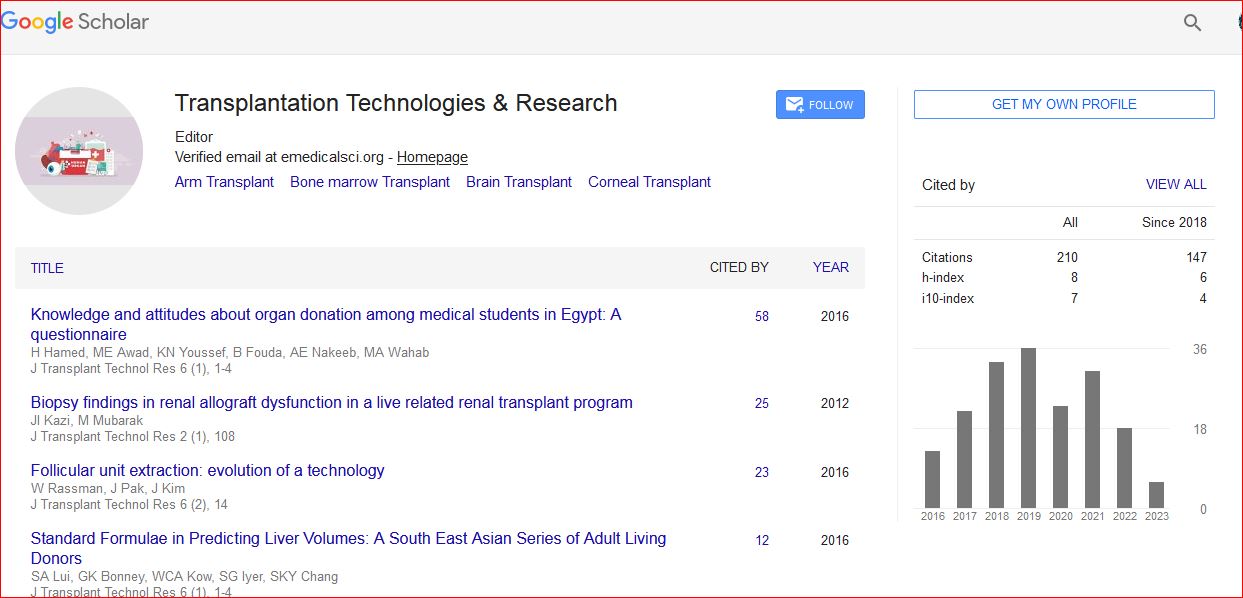
Transplantation Technologies & Research received 223 citations as per Google Scholar report