Opinion - (2025) Volume 17, Issue 3
Received: 01-May-2025, Manuscript No. jcst-25-172460;
Editor assigned: 05-May-2025, Pre QC No. P-172460;
Reviewed: 19-May-2025, QC No. Q-172460;
Revised: 22-May-2025, Manuscript No. R-172460;
Published:
29-May-2025
, DOI: 10.37421/1948-5956.2025.17.706
Citation: Fernandez, Maria. ”Cell Signaling: Life, Disease, Therapeutic
Promise.” J Cancer Sci Ther 17 (2025):706.
Copyright: © 2025 Fernandez M. This is an open-access article distributed under the terms of the Creative Commons Attribution License, which permits unrestricted use,
distribution and reproduction in any medium, provided the original author and source are credited.
Targeting specific cell signaling pathways offers a novel therapeutic approach for cancer, particularly by focusing on cancer stem cells. It highlights the potential for new drug development that inhibits the self-renewal and survival of these resilient cells, crucial for tumor initiation, metastasis, and recurrence. The authors delve into various pathways implicated in cancer stem cell biology, offering insights into how their manipulation could lead to more effective and less toxic cancer treatments [1].
Various cell signaling pathways play critical roles in the pathogenesis and progression of neurodegenerative diseases. This review discusses how dysregulation within these pathways contributes to neuronal damage, protein aggregation, and inflammation, common hallmarks of conditions like Alzheimer's and Parkinson's disease. The insights here pave the way for identifying new therapeutic targets and developing interventions that can modulate these pathways to slow or halt neurodegeneration [2].
The intricate relationship between metabolic regulation and cell signaling pathways within immune cells is a key area of study. This article highlights how cellular metabolism doesn't just provide energy but also actively shapes immune responses by influencing signaling cascades. Understanding this crosstalk is crucial for developing therapies that can fine-tune immune cell functions, offering new strategies for treating autoimmune diseases, infections, and cancer [3].
Key cell signaling pathways govern the development and differentiation of pluripotent stem cells. This paper elucidates how precise control over these pathways, such as Wnt, Notch, and BMP, is essential for maintaining pluripotency or directing stem cells towards specific lineages. The insights gained are fundamental for regenerative medicine, enabling better control over stem cell fate for therapeutic applications [4].
Strategies for drug discovery often target specific cell signaling pathways involved in inflammatory diseases. This review discusses how modulating pathways like NF-κB, MAPK, and JAK/STAT can dampen excessive inflammatory responses, offering therapeutic potential for conditions such as rheumatoid arthritis, inflammatory bowel disease, and psoriasis. The article underscores the importance of pathway-specific approaches to develop more effective and targeted anti-inflammatory drugs [5].
The intricate interplay between cell signaling pathways and immune responses during viral infections is a complex field of study. This paper details how viruses often hijack or manipulate host signaling pathways to facilitate their replication and evade immune surveillance, while the host immune system activates its own pathways to combat the infection. Understanding these interactions is vital for developing antiviral therapies and vaccines that can bolster host defenses [6].
Dysregulation of cell signaling pathways stands out as a key contributor to aging and age-related diseases. This article highlights how changes in pathways such as mTOR, AMPK, and sirtuins influence cellular senescence, oxidative stress, and inflammation, which are central to the aging process. Modulating these pathways offers promising avenues for anti-aging interventions and treatments for age-related conditions [7].
Various cell signaling pathways regulate plant growth and development, particularly under diverse stress conditions. This study explains how plants activate specific signaling cascades, involving hormones like auxin and abscisic acid, and pathways like MAPK, to adapt and survive environmental challenges. Understanding these mechanisms is crucial for developing stress-tolerant crops and improving agricultural productivity [8].
The intricate crosstalk between cell signaling pathways and epigenetic mechanisms significantly impacts disease progression. This article illustrates how changes in DNA methylation, histone modifications, and non-coding RNAs are often intertwined with signaling cascades like Wnt, Notch, and Hedgehog, collectively driving various pathological conditions, including cancer and developmental disorders. Unraveling these connections offers new targets for therapeutic intervention [9].
Novel cell signaling pathways play crucial roles in orchestrating tissue repair and regeneration. This paper discusses how complex networks involving growth factors, cytokines, and extracellular matrix interactions drive cellular processes like proliferation, migration, and differentiation, essential for restoring damaged tissues. Identifying and manipulating these pathways holds immense promise for advancing regenerative medicine and treating various injuries and degenerative conditions [10].
Cell signaling pathways form intricate communication networks within and between cells, orchestrating diverse biological functions vital for health and disease. Their importance spans various biological systems and pathological conditions, from cellular development to immune responses, offering fundamental insights and pathways for therapeutic innovation.
Targeting specific cell signaling pathways offers a novel therapeutic approach for cancer, focusing on inhibiting cancer stem cells crucial for tumor initiation, metastasis, and recurrence. This aims to develop more effective and less toxic cancer treatments [1]. In neurodegenerative diseases, dysregulation in various cell signaling pathways leads to neuronal damage, protein aggregation, and inflammation, hallmarks of conditions like Alzheimer's and Parkinson's. Identifying therapeutic targets here could slow or halt neurodegeneration [2].
The immune system is heavily influenced by cell signaling, notably through the intricate relationship between metabolic regulation and immune cell function. Cellular metabolism actively shapes immune responses by influencing signaling cascades. This crosstalk is crucial for developing therapies that fine-tune immune cell functions, offering new strategies for autoimmune diseases, infections, and cancer [3]. Furthermore, specific cell signaling pathways are targeted for drug discovery in inflammatory diseases. Modulating pathways like NF-κB, MAPK, and JAK/STAT can dampen excessive inflammatory responses, providing therapeutic potential for conditions such as rheumatoid arthritis, inflammatory bowel disease, and psoriasis. This highlights the value of pathway-specific approaches for effective anti-inflammatory drugs [5].
Fundamental biological processes like development, aging, and responses to viral threats are deeply rooted in cell signaling. Key pathways, including Wnt, Notch, and BMP, govern pluripotent stem cell development and differentiation. Precise control over these is essential for maintaining pluripotency or directing stem cells towards specific lineages, vital for regenerative medicine [4]. During viral infections, viruses often hijack host signaling pathways for replication, while the host immune system activates its own. Understanding these interactions is crucial for developing antiviral therapies and vaccines [6]. Additionally, dysregulation of cell signaling pathways is a key contributor to aging and age-related diseases. Changes in pathways like mTOR, AMPK, and sirtuins impact cellular senescence, oxidative stress, and inflammation, opening promising avenues for anti-aging interventions [7].
Cell signalingâ??s reach extends to plant biology, where pathways regulate growth and development, especially under stress. Plants activate specific cascades involving hormones like auxin and abscisic acid, and pathways like MAPK, to adapt and survive environmental challenges, crucial for developing stress-tolerant crops [8]. At a deeper molecular level, the crosstalk between cell signaling pathways and epigenetic mechanisms is integral to disease. Changes in DNA methylation and histone modifications intertwine with signaling cascades like Wnt, Notch, and Hedgehog, driving various pathological conditions, including cancer and developmental disorders [9]. Finally, novel cell signaling pathways play crucial roles in orchestrating tissue repair and regeneration. Complex networks involving growth factors, cytokines, and extracellular matrix interactions drive essential cellular processes, holding immense promise for advancing regenerative medicine and treating injuries [10].
Cell signaling pathways are fundamental to life, governing everything from cellular function to organismal development and disease. Research emphasizes their critical role across a spectrum of biological contexts. For instance, new therapeutic approaches for cancer focus on targeting specific cell signaling pathways to inhibit the self-renewal and survival of cancer stem cells, crucial for preventing tumor initiation, metastasis, and recurrence. This work provides insight into developing more effective and less toxic cancer treatments. In neurodegenerative diseases like Alzheimer's and Parkinson's, dysregulation within these pathways drives neuronal damage, protein aggregation, and inflammation. Understanding these mechanisms is vital for identifying novel therapeutic targets to slow or halt neurodegeneration. Beyond disease, metabolic regulation intricately influences cell signaling within immune cells, shaping immune responses and offering new strategies to treat autoimmune conditions, infections, and cancer. The development and differentiation of pluripotent stem cells are precisely controlled by key signaling pathways such as Wnt, Notch, and BMP. Manipulating these pathways is essential for regenerative medicine, allowing better control over stem cell fate for therapeutic applications. Similarly, drug discovery efforts for inflammatory diseases, including rheumatoid arthritis and psoriasis, center on modulating pathways like NF-κB, MAPK, and JAK/STAT to dampen excessive inflammatory responses. Cell signaling also plays a significant role in infectious diseases; viruses often hijack host pathways for replication, while the immune system activates its own defenses. Understanding this interplay helps develop antiviral therapies and vaccines. Moreover, the dysregulation of these pathways contributes to aging and age-related diseases, with changes in mTOR, AMPK, and sirtuins impacting cellular senescence and oxidative stress, suggesting new anti-aging interventions. Even in plants, specific signaling cascades involving hormones like auxin and abscisic acid enable adaptation to environmental stress, crucial for agricultural productivity. Finally, the intricate crosstalk between cell signaling and epigenetic mechanisms is a major factor in various diseases, including cancer. Changes in DNA methylation and histone modifications are often intertwined with signaling cascades, presenting new therapeutic targets. Additionally, novel signaling pathways orchestrate tissue repair and regeneration, involving growth factors and cytokines, offering immense promise for regenerative medicine to restore damaged tissues. Collectively, these studies underscore the pervasive and profound impact of cell signaling pathways on health and disease, driving innovative research in therapeutics and basic biology.
Indexed at, Google Scholar, Crossref
Indexed at, Google Scholar, Crossref
Indexed at, Google Scholar, Crossref
Indexed at, Google Scholar, Crossref
Indexed at, Google Scholar, Crossref
Indexed at, Google Scholar, Crossref
Indexed at, Google Scholar, Crossref
Indexed at, Google Scholar, Crossref
Indexed at, Google Scholar, Crossref
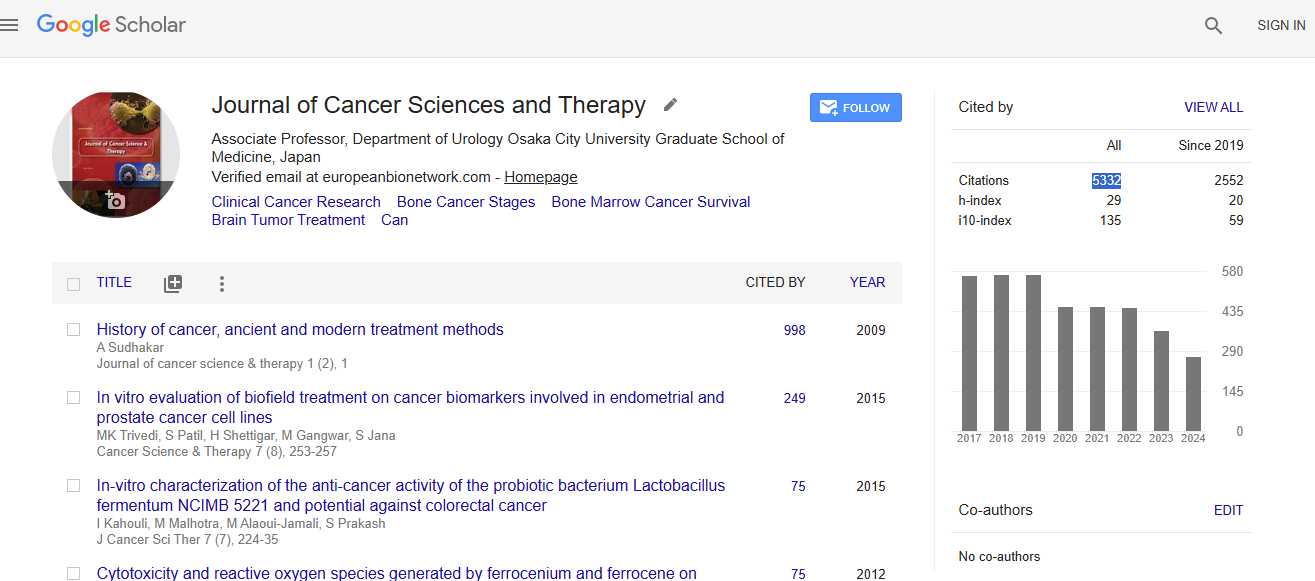
Cancer Science & Therapy received 5332 citations as per Google Scholar report