Commentary - (2025) Volume 16, Issue 5
Received: 01-Oct-2025, Manuscript No. jbsbe-26-183320;
Editor assigned: 03-Oct-2025, Pre QC No. P-183320;
Reviewed: 17-Oct-2025, QC No. Q-183320;
Revised: 22-Oct-2025, Manuscript No. R-183320;
Published:
29-Oct-2025
, DOI: 10.37421/2165-6210.2025.16.526
Citation: Haddad, Noura. ”Biosensors Drive Precision Medicine Through Real-Time Monitoring.” J Biosens Bioelectron 16 (2025):526.
Copyright: © 2025 Haddad N. This is an open-access article distributed under the terms of the Creative Commons Attribution License, which permits unrestricted use, distribution and reproduction in any medium, provided the original author and source are credited.
Biosensors are revolutionizing the field of personalized medicine by enabling unprecedented levels of individualized health monitoring and treatment. The core of this advancement lies in the ability of biosensors to detect specific biological molecules, or biomarkers, within the body, providing real-time data that can inform clinical decisions. This personalized approach moves away from a one-size-fits-all model towards therapies tailored to the unique physiological profile of each patient. The integration of advanced technologies within biosensor design is continuously enhancing their capabilities, making them more sensitive, specific, and accessible for widespread clinical use. This review aims to consolidate current knowledge and future directions in biosensor applications for personalized medicine, highlighting key innovations and their impact on patient care. The pivotal role of biosensors in advancing personalized medicine is explored, emphasizing their capacity for real-time, on-demand monitoring of biomarkers, which facilitates tailored treatment strategies and early disease detection. Key innovations include the integration of microfluidics, nanomaterials, and advanced signal processing to enhance sensitivity, specificity, and portability, with a focus on translating these technologies from laboratory to clinical practice for improved patient outcomes [1].
Significant strides have been made in the development of wearable biosensors, marking a crucial step towards continuous, non-invasive health monitoring essential for personalized medicine. These advancements in electrochemical and optical sensing modalities allow for the detection of analytes like glucose, lactate, and electrolytes in biofluids such as sweat and interstitial fluid, addressing challenges in long-term stability, calibration, and data interpretation for personalized health management [2].
The design of biosensors is being profoundly reshaped by nanomaterials, which offer enhanced surface area and unique electrical or optical properties critical for sensitive biomarker detection in personalized medicine. This includes the application of nanoparticles, nanowires, and graphene-based materials to create highly selective and sensitive biosensing platforms for diverse applications, ranging from cancer diagnostics to infectious disease monitoring [3].
Point-of-care testing (POCT) powered by biosensors is indispensable for personalized medicine, enabling rapid diagnostics directly at the patient's bedside. Novel microfluidic electrochemical biosensors are being developed for the simultaneous detection of multiple biomarkers, demonstrating high sensitivity and specificity with potential for rapid diagnosis in emergency settings, thereby facilitating timely and personalized therapeutic interventions [4].
The convergence of artificial intelligence (AI) with biosensor technology is unlocking new frontiers in personalized medicine. AI algorithms are adept at analyzing complex biosensor data to identify subtle disease patterns, predict treatment responses, and personalize drug dosages, with machine learning models improving diagnostic accuracy and optimizing therapeutic regimens based on individual physiological profiles [5].
Optical biosensors are emerging as powerful tools, particularly for sensitive detection of circulating tumor DNA (ctDNA) as part of liquid biopsy strategies for cancer management. Techniques like surface plasmon resonance imaging achieve high sensitivity and specificity, promising early cancer detection and monitoring of treatment efficacy, which is vital for personalized cancer therapy [6].
Aptasensors, known for their high specificity and stability, are rapidly gaining traction in personalized medicine. The development of electrochemical aptasensors for detecting key inflammatory biomarkers shows excellent performance, offering a promising platform for personalized diagnosis and monitoring of inflammatory diseases, leading to targeted treatment strategies [7].
Cell-based biosensors are being explored for their potential in personalized drug screening and toxicity assessment. By using living cells as sensing elements, these biosensors can mimic in vivo responses to therapeutic agents, enabling the prediction of individual patient responses and the optimization of drug regimens, though challenges in cell viability and standardization persist [8].
Implantable biosensors are critical for long-term monitoring of chronic diseases, a fundamental aspect of personalized medicine. Advancements in biocompatible materials and miniaturized sensor designs are enabling continuous glucose monitoring and other long-term health assessments, focusing on stable and reliable performance within the body to guide personalized treatment adjustments [9].
Multiplexed biosensor arrays represent a significant advancement for personalized health. These platforms integrate microfluidics and electrochemical detection for the simultaneous analysis of multiple disease biomarkers, vital for comprehensive health assessments and the early identification of complex disease risks, particularly for cardiovascular and metabolic disorders [10].
The exploration into biosensors for personalized medicine highlights a paradigm shift towards individualized healthcare strategies. This field leverages sophisticated sensing technologies to glean detailed insights into an individual's biological state, enabling interventions that are precisely matched to their unique needs. The foundational concept involves the detection of specific biomarkers, which are indicators of physiological processes or disease states. By continuously or on-demand monitoring these biomarkers, healthcare providers can gain a dynamic understanding of a patient's health trajectory, allowing for proactive and responsive medical management. The continuous evolution of biosensor technology, encompassing advancements in materials science, microfabrication, and signal processing, is central to realizing the full potential of personalized medicine. These developments aim to overcome previous limitations in sensitivity, specificity, and practicality, making advanced diagnostics more accessible and user-friendly. The ultimate goal is to bridge the gap between laboratory innovations and routine clinical application, thereby enhancing patient outcomes through more effective and targeted therapeutic approaches [1].
Wearable biosensors represent a transformative leap towards achieving continuous and non-invasive health monitoring, a cornerstone of personalized medicine. This technology allows for the seamless collection of physiological data throughout the day, providing a rich dataset that reflects an individual's health status in their natural environment. By employing advanced electrochemical and optical sensing methods, these devices can track a variety of analytes present in biofluids like sweat and interstitial fluid. Addressing the inherent challenges of maintaining sensor accuracy and reliability over extended periods, along with effective data interpretation for actionable health insights, remains a key focus for widespread adoption in personalized health management [2].
Nanomaterials are proving to be revolutionary in the development of biosensors, offering enhanced surface properties that are crucial for achieving high sensitivity and specificity in biomarker detection. Their unique electrical and optical characteristics can be harnessed to create biosensing platforms that are significantly more responsive to even minute concentrations of target molecules. This has direct implications for personalized medicine, enabling earlier and more accurate diagnoses for a wide spectrum of conditions, from various forms of cancer to emerging infectious diseases. The precise engineering of nanomaterials allows for the tailored design of biosensors optimized for specific diagnostic applications [3].
Point-of-care testing (POCT) is profoundly impacted by biosensor technology, extending diagnostic capabilities directly to the patient's vicinity, which is critical for timely personalized medical interventions. The development of integrated microfluidic and biosensor systems allows for rapid, on-site analysis of biological samples. For instance, a microfluidic electrochemical biosensor designed for the simultaneous detection of cardiac biomarkers exemplifies this potential, offering high sensitivity and specificity for swift diagnoses in acute situations like myocardial infarction. This immediate diagnostic feedback loop is essential for initiating personalized treatment promptly, thereby improving patient prognosis [4].
The synergistic integration of artificial intelligence (AI) with biosensor technology is a powerful catalyst for progress in personalized medicine. AI algorithms excel at processing and interpreting the complex, high-dimensional data generated by biosensors. This analytical prowess allows for the identification of subtle disease signatures that might otherwise go unnoticed, enabling more accurate predictions of treatment efficacy and the precise tailoring of drug dosages. Machine learning, in particular, plays a vital role in refining diagnostic accuracy and optimizing individual treatment plans based on a comprehensive understanding of a patient's unique biological profile [5].
Optical biosensors are carving out a significant niche in personalized medicine, particularly through their application in liquid biopsy for cancer management. By employing advanced optical detection principles, such as surface plasmon resonance imaging, these sensors can achieve exceptional sensitivity and specificity in detecting circulating tumor DNA (ctDNA). This capability is paramount for early cancer detection, non-invasive monitoring of treatment response, and the dynamic adjustment of therapeutic strategies, ultimately contributing to more personalized and effective cancer care [6].
Aptasensors, characterized by their remarkable specificity and robustness, are increasingly vital in the realm of personalized medicine. These sensors utilize aptamers, which are short nucleic acid sequences, as recognition elements. The development of electrochemical aptasensors for detecting specific inflammatory biomarkers demonstrates their potential for sensitive and reliable diagnostics. Such advancements are paving the way for personalized strategies in diagnosing and managing inflammatory conditions, allowing for treatments tailored to the individual's inflammatory profile [7].
Cell-based biosensors offer a unique advantage in personalized medicine by employing living cells as the core sensing component. This approach allows for the assessment of a biological agent's effect on cellular function, closely mimicking in vivo responses. This capability is particularly valuable for personalized drug screening and toxicity assessment, enabling predictions of how an individual might respond to a particular medication. While challenges related to maintaining cell viability, standardizing protocols, and enabling high-throughput screening need to be addressed, the potential for predicting patient responses and optimizing drug regimens is immense [8].
Implantable biosensors are integral to the long-term management of chronic diseases, a critical aspect of personalized medicine that requires continuous physiological monitoring. Innovations in biocompatible materials and miniaturized sensor designs are crucial for the development of devices that can reliably function within the body for extended periods. Continuous glucose monitoring in diabetic patients serves as a prime example, where stable and accurate readings are essential for making personalized adjustments to insulin therapy and lifestyle choices, thereby improving disease control and quality of life [9].
The development of multiplexed biosensor arrays signifies a leap forward in comprehensive personalized health assessment. These advanced platforms are capable of simultaneously detecting a panel of biomarkers related to various diseases, such as cardiovascular and metabolic disorders. By integrating technologies like microfluidics and electrochemical detection, these arrays offer high throughput and sensitivity, providing a more holistic view of an individual's health status and enabling the early identification of complex disease risks that might be missed by single-analyte tests [10].
Biosensors are driving personalized medicine through real-time biomarker monitoring, enabling tailored treatments and early disease detection. Innovations in microfluidics, nanomaterials, and AI are enhancing sensor sensitivity, specificity, and portability. Wearable and implantable biosensors offer continuous health tracking, while point-of-care testing facilitates rapid diagnostics. Aptasensors and cell-based biosensors provide highly specific detection and personalized drug screening. Multiplexed biosensor arrays offer comprehensive health assessments. These advancements are transforming healthcare by allowing for precise, individualized medical interventions.
None
None
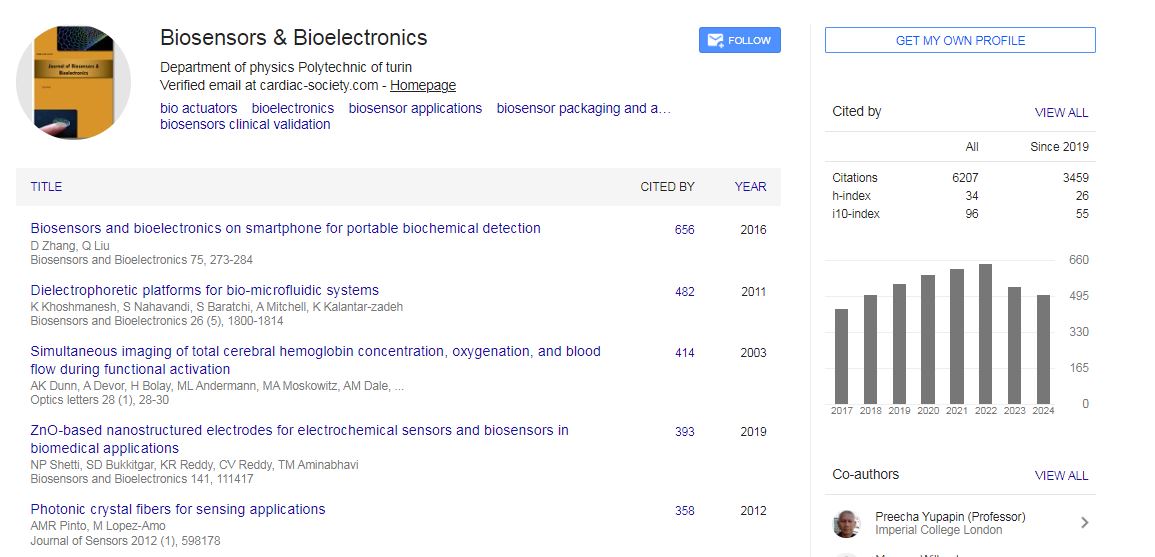
Biosensors & Bioelectronics received 6207 citations as per Google Scholar report