Opinion - (2025) Volume 11, Issue 5
Received: 02-Oct-2025, Manuscript No. icoa-25-173606;
Editor assigned: 06-Oct-2025, Pre QC No. P-173606;
Reviewed: 20-Oct-2025, QC No. Q-173606;
Revised: 23-Oct-2025, Manuscript No. R-173606;
Published:
30-Oct-2025
, DOI: 10.37421/2469-9756.2025.11.321
Citation: Garcia, Sofia L.. ”Biomedical Research: Diagnostics, Therapies, Public Health.” Immunochem Immunopathol 11 (2025):321.
Copyright: © 2025 Garcia L. Sofia This is an open-access article distributed under the terms of the Creative Commons Attribution License, which permits unrestricted use,
distribution and reproduction in any medium, provided the original author and source are credited.
This research highlights a new strategy for treating glioma, a type of brain cancer. It shows that by targeting the PRMT5-RNF168 axis, a specific pathway involved in DNA repair, we can make cancer cells more vulnerable to existing therapies. Essentially, blocking this pathway interferes with the cancer's ability to fix its DNA, leading to a better response to treatment. This is a promising approach for improving outcomes in glioma patients [1].
Beyond cancer treatment, here's the thing: human brain organoids, essentially miniature lab-grown brains, are proving to be incredibly valuable tools. They are helping scientists model complex neurodevelopmental and neurodegenerative diseases, giving us a clearer window into how these conditions start and progress. What this really means is we have a better system for studying the human brain's intricate processes, leading to new insights for treatment and understanding [2].
Public health surveillance also plays a critical role, as seen in the vital update on HIV drug resistance across the United States and Canada from 2018 to 2021. By analyzing genomic data, researchers are tracking how the virus is evolving and becoming resistant to certain medications. This surveillance is critical for public health, ensuring that treatment guidelines remain effective and helping clinicians choose the right therapies for patients [3].
Similarly, targeted public health efforts are making a difference in occupational safety. For example, research looks at an intervention designed to make nail salons in California safer for workers. It investigated whether specific practices could improve health and safety conditions, like reducing exposure to harmful chemicals. What this really means is that such efforts can create healthier work environments, addressing occupational hazards and protecting vulnerable populations [4].
Moving into genetic influences, this study delves into the genetic factors that influence the peptidomeâ??the collection of peptides in our bloodstreamâ??and how these relate to cardiometabolic diseases. It pinpoints specific genetic determinants that could predispose individuals to conditions like heart disease and diabetes. Understanding these genetic links can open doors for earlier detection and more personalized preventive strategies [5].
In the realm of medical imaging, a new deep learning framework significantly speeds up high-resolution whole-brain diffusion Magnetic Resonance Imaging (MRI). It uses self-supervised denoising to improve image quality while reducing scan time. This is a big deal because it means clinicians and researchers can get clearer, more detailed brain images faster, potentially improving diagnosis and research capabilities without compromising data integrity [6].
Our understanding of disease also extends to psychosocial factors. This research unpacks the relationship between psychosocial stress and cardiovascular disease, specifically focusing on adults with type 2 diabetes and looking for sex differences. It highlights how stress impacts heart health differently between men and women in this patient group. Understanding these nuances is crucial for developing more tailored prevention and management strategies for cardiovascular disease [7].
Furthermore, novel drug targets are emerging for inflammatory conditions. This article investigates targeting the E3 ubiquitin ligase TRIM25 as a way to control inflammatory responses. It identifies TRIM25 as a key player in inflammation pathways, and the potential to modulate its activity could lead to new therapeutic strategies for inflammatory diseases. What this really means is we might have a novel drug target for conditions driven by excessive inflammation [8].
Addressing health disparities, a systematic review and meta-analysis examines the risk of metabolic dysfunction-associated steatotic liver disease (MASLD) and advanced fibrosis in Asian Americans. It synthesizes existing evidence to provide a comprehensive picture of this health disparity. The findings are important for clinicians, helping them better screen and manage liver disease risks in this specific population [9].
Finally, magnetic resonance imaging (MRI) continues to be indispensable in oncology. This paper reviews its current role in diagnosing and monitoring hepatocellular carcinoma (HCC), a common liver cancer. It details how MRI is used for detection, staging, and tracking treatment response. This information is vital for radiologists and oncologists to make informed decisions about patient care and surveillance strategies for HCC [10].
Here's the thing: new research highlights a new strategy for treating glioma, a type of brain cancer. It shows that by targeting the PRMT5-RNF168 axis, a specific pathway involved in DNA repair, we can make cancer cells more vulnerable to existing therapies. Blocking this pathway essentially interferes with the cancer's ability to fix its DNA, leading to a better response to treatment. This is a promising approach for improving outcomes in glioma patients [1]. Separately, scientists are exploring how human brain organoids, which are essentially miniature, lab-grown brains, are becoming incredibly valuable tools. They are helping scientists model complex neurodevelopmental and neurodegenerative diseases, giving a clearer window into how these conditions start and progress. This means a better system for studying the human brain's intricate processes, ultimately leading to new insights for treatment and understanding [2].
A vital update from a recent study provides information on HIV drug resistance across the United States and Canada from 2018 to 2021. Genomic data analysis allows researchers to track how the virus evolves and becomes resistant to certain medications. This surveillance is critical for public health, ensuring that treatment guidelines remain effective and helping clinicians choose the right therapies for patients [3]. In public health, an intervention in California's nail salons aims to enhance worker safety. It investigated whether specific practices could improve health and safety conditions, like reducing exposure to harmful chemicals. What this really means is targeted public health efforts can foster healthier work environments, tackle occupational hazards, and protect vulnerable populations [4].
Another study delves into the genetic factors that influence the peptidome, which is the collection of peptides in our bloodstream, and how these relate to cardiometabolic diseases. It pinpoints specific genetic determinants that could predispose individuals to conditions like heart disease and diabetes. Understanding these genetic links can pave the way for earlier detection and more personalized preventive strategies [5]. Meanwhile, a new deep learning framework significantly speeds up high-resolution whole-brain diffusion Magnetic Resonance Imaging (MRI). It uses self-supervised denoising to improve image quality while reducing scan time. This is a big deal because it means clinicians and researchers can obtain clearer, more detailed brain images faster, potentially improving diagnosis and research capabilities without compromising data integrity [6].
Research unpacks the link between psychosocial stress and cardiovascular disease, specifically focusing on adults with type 2 diabetes and looking for sex differences. It highlights how stress impacts heart health differently between men and women in this patient group. Understanding these nuances proves crucial for developing tailored prevention and management strategies for cardiovascular disease [7]. Furthermore, an article investigates targeting the E3 ubiquitin ligase TRIM25 as a way to control inflammatory responses. It identifies TRIM25 as a key player in inflammation pathways, and the potential to modulate its activity could lead to new therapeutic strategies for inflammatory diseases. What this really means is a potential novel drug target for conditions driven by excessive inflammation might be on the horizon [8].
A systematic review and meta-analysis examines the risk of Metabolic Dysfunction-Associated Steatotic Liver Disease (MASLD) and advanced fibrosis in Asian Americans. It synthesizes existing evidence to provide a comprehensive picture of this health disparity. The findings are important for clinicians, aiding them in better screening and managing liver disease risks within this specific population [9]. Lastly, a paper reviews the current role of Magnetic Resonance Imaging (MRI) in diagnosing and monitoring Hepatocellular Carcinoma (HCC), a common liver cancer. It details how MRI is used for detection, staging, and tracking treatment response. This information is vital for radiologists and oncologists to make informed decisions regarding patient care and surveillance strategies for Hepatocellular Carcinoma (HCC) [10].
This collection of research spans diverse biomedical fields, offering insights into advanced diagnostic techniques, therapeutic strategies, and public health interventions. One promising approach targets the PRMT5-RNF168 axis to enhance glioma treatment by disrupting DNA repair mechanisms. Another area of focus involves human brain organoids, which serve as crucial models for understanding neurodevelopmental and neurodegenerative diseases. Public health initiatives include genomic surveillance of HIV drug resistance in North America, vital for effective treatment guidelines, and interventions to improve health and safety for workers in California's nail salons, highlighting the importance of occupational hazard protection. Genetic research is also advancing, with studies identifying determinants of the circulating peptidome linked to cardiometabolic diseases, paving the way for personalized preventive strategies. In medical imaging, new deep learning frameworks are accelerating high-resolution whole-brain diffusion MRI, promising faster and clearer diagnoses. The impact of psychosocial stress on cardiovascular disease in type 2 diabetes patients, with a focus on sex differences, reveals critical nuances for tailored prevention. Moreover, novel therapeutic targets are emerging, such as modulating the E3 ubiquitin ligase TRIM25 to control inflammatory responses. Addressing health disparities, a systematic review analyzes the risk of Metabolic Dysfunction-Associated Steatotic Liver Disease (MASLD) and advanced fibrosis in Asian Americans, informing better clinical management. Finally, the role of Magnetic Resonance Imaging (MRI) in diagnosing and monitoring Hepatocellular Carcinoma (HCC) underscores its continued importance in oncology for patient care decisions. Together, these studies represent significant strides in understanding and treating complex health challenges.
None
None
1. Hong Y, Chunjun C, Rui G. "Targeting the PRMT5-RNF168 axis blocks DNA damage repair and promotes therapeutic response in glioma".Signal Transduct Target Ther 8 (2023):257.
Indexed at, Google Scholar, Crossref
2. Sangmin L, Na-Kyoung K, Jae-Seong S. "Human Brain Organoids: Models of Neurodevelopmental and Neurodegenerative Diseases".Int J Mol Sci 23 (2022):7626.
Indexed at, Google Scholar, Crossref
3. Soo-Yon R, Walter JF, Timothy JL. "Genomic Surveillance of HIV Drug Resistance in the United States and Canada: 2018-2021".Viruses 14 (2022):2811.
Indexed at, Google Scholar, Crossref
4. Julia P, Jennifer W, Bonnie A. "Effectiveness of an Intervention to Improve Health and Safety Practices for Workers in Nail Salons in California".Environ Health Perspect 128 (2020):127003.
Indexed at, Google Scholar, Crossref
5. Xiangbo L, Hualin H, Jian'an O. "Genetic determinants of the circulating peptidome and relationship to cardiometabolic disease".Genome Med 15 (2023):11.
Indexed at, Google Scholar, Crossref
6. Cong C, Xinrui W, Xiang H. "A deep learning-based framework for accelerating high-resolution whole-brain diffusion MRI with self-supervised denoising".Magn Reson Med 90 (2023):2683-2696.
Indexed at, Google Scholar, Crossref
7. Annette Y, Min L, Jing M. "Sex differences in the association of psychosocial stress with cardiovascular disease in adults with type 2 diabetes".Sci Rep 13 (2023):22384.
Indexed at, Google Scholar, Crossref
8. Wenbo T, Chao X, Xue Y. "Targeting the E3 ubiquitin ligase TRIM25 to control inflammatory responses".J Mol Med (Berl) 101 (2023):1567-1580.
Indexed at, Google Scholar, Crossref
9. Jinjin L, Angela D, Jihong Y. "Metabolic Dysfunction-Associated Steatotic Liver Disease and Advanced Fibrosis Risk in Asian Americans: A Systematic Review and Meta-Analysis".J Clin Gastroenterol 58 (2024):e44-e51.
Indexed at, Google Scholar, Crossref
10. Zhihong L, Tingting L, Qi W. "Magnetic resonance imaging for diagnosis and surveillance of hepatocellular carcinoma".J Hepatobiliary Pancreat Sci 30 (2023):1359-1367.
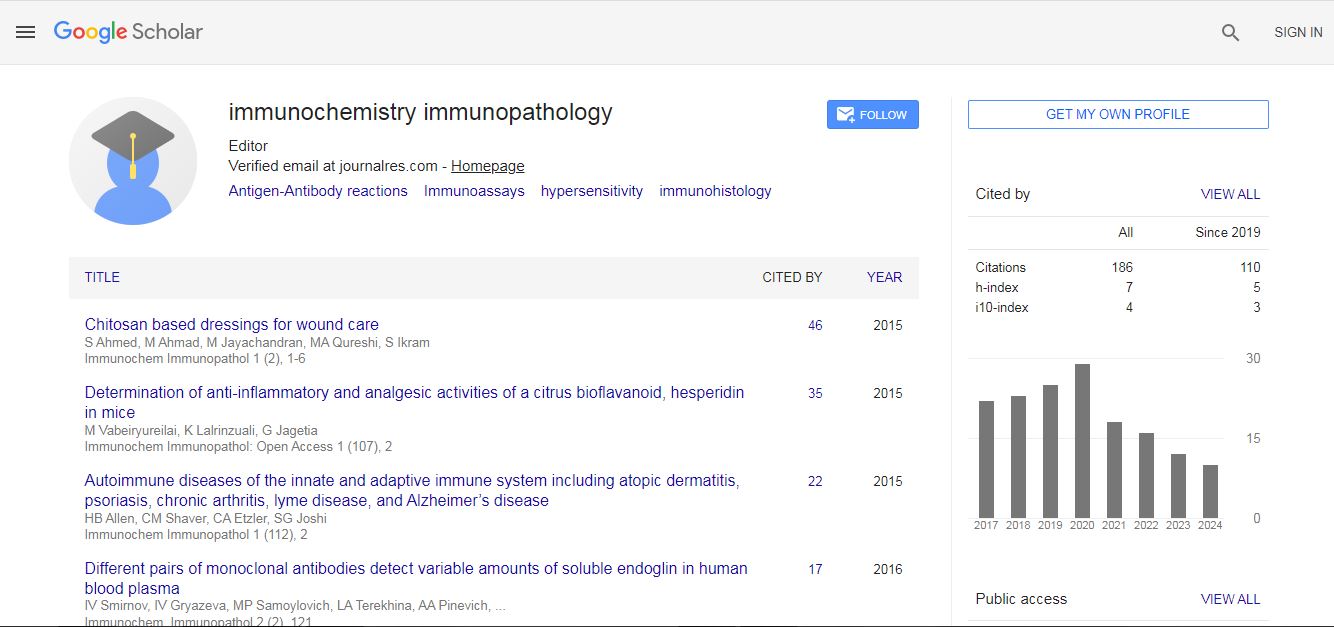
Immunochemistry & Immunopathology received 174 citations as per Google Scholar report