Opinion - (2025) Volume 16, Issue 6
Received: 01-Dec-2025, Manuscript No. jmbd-26-179555;
Editor assigned: 03-Dec-2025, Pre QC No. P-179555;
Reviewed: 15-Dec-2025, QC No. Q-179555;
Revised: 22-Dec-2025, Manuscript No. R-179555;
Published:
29-Dec-2025
, DOI: 10.37421/2155-9929.2025.16.732
Citation: Hassan, Laila. ”Biomarkers Revolutionize Disease Diagnostics With Multi-Omics.” J Mol Biomark Diagn 16 (2025):732.
Copyright: © 2025 Hassan L. This is an open-access article distributed under the terms of the Creative Commons Attribution License, which permits unrestricted use,
distribution and reproduction in any medium, provided the original author and source are credited.
Protein and RNA biomarkers are emerging as powerful tools in the diagnosis of various human diseases, offering sensitive and specific indicators for early detection, prognosis, and treatment monitoring. Their ability to reflect cellular states and disease processes makes them invaluable in the realm of personalized medicine, driving advancements in identifying and validating these crucial markers [1].
The field of molecular diagnostics is being revolutionized by proteomics and transcriptomics, which are providing unprecedented insights into disease mechanisms. This study, for instance, investigates specific protein and RNA signatures in sepsis, demonstrating their utility in differentiating bacterial from viral infections and predicting patient outcomes, highlighting the translational power of these approaches [2].
Circulating microRNAs (miRNAs) represent a particularly promising frontier for the early detection of cancers. Research has identified panels of circulating miRNAs with high diagnostic accuracy for colorectal cancer, capable of distinguishing it from benign conditions, and the minimally invasive nature of sample collection makes this an attractive strategy for widespread screening [3].
In the domain of neurodegenerative diseases, the landscape of protein biomarkers is rapidly evolving. Novel extracellular vesicle-derived proteins are being explored as potential diagnostic and prognostic markers for Alzheimer's disease, showing significant promise in differentiating affected individuals from healthy controls and tracking disease progression [4].
RNA sequencing offers an unbiased and comprehensive approach to discovering novel diagnostic markers. A recent paper presents a unique RNA signature derived from peripheral blood that effectively distinguishes between active and latent tuberculosis infections, paving the way for improved diagnostic strategies for this global health challenge [5].
Liquid biopsies are fundamentally transforming cancer diagnostics by enabling non-invasive molecular analysis. This review consolidates current understanding of circulating tumor DNA (ctDNA) and RNA as key biomarkers for various cancers, detailing their applications in early detection, monitoring treatment response, and identifying minimal residual disease, thereby enhancing patient management [6].
The utility of urinary protein biomarkers for the diagnosis and monitoring of kidney disease is substantial and continues to grow. Novel protein profiles identified through mass spectrometry can predict the progression of chronic kidney disease, providing a non-invasive diagnostic window into renal health and disease progression [7].
Exosomal RNA, encompassing both mRNA and miRNA, carries significant diagnostic information. This study explores exosomal RNA content in plasma samples from patients with acute myocardial infarction, identifying specific RNA species that correlate with infarct size and hold potential as early diagnostic markers for this critical cardiovascular event [8].
Single-cell RNA sequencing (scRNA-seq) provides unparalleled resolution for identifying cell-type-specific biomarkers. Applying scRNA-seq to immune cells in patients with rheumatoid arthritis has uncovered distinct transcriptional signatures in specific immune cell subsets, offering potential targets for diagnosis or therapeutic intervention in this autoimmune disease [9].
The integration of multi-omics data, particularly proteomics and transcriptomics, significantly enhances diagnostic power. This study combined protein and RNA expression data from tumor biopsies to develop a more accurate predictive model for treatment response in lung cancer patients, demonstrating the synergistic value of integrated molecular profiling [10].
Protein and RNA biomarkers possess considerable diagnostic potential across a spectrum of human ailments. Their capacity to reflect cellular states and disease progression provides sensitive and specific indicators for early detection, prognosis, and the monitoring of treatment efficacy. This review comprehensively examines advancements in the identification and validation of these biomarkers, with a particular emphasis on their role in the advancement of personalized medicine [1].
Proteomics and transcriptomics are at the forefront of revolutionizing disease diagnostics. This particular investigation delves into specific protein and RNA signatures within sepsis, illustrating their efficacy in distinguishing between bacterial and viral infections and predicting patient outcomes. The findings strongly underscore the practical translational power inherent in these sophisticated molecular approaches [2].
Circulating microRNAs (miRNAs) are rapidly emerging as highly promising biomarkers for the early detection of various cancers. This research successfully identifies a specific panel of circulating miRNAs that exhibit high diagnostic accuracy for colorectal cancer, effectively differentiating it from benign conditions. The inherent advantage of minimally invasive sample collection makes this approach exceptionally attractive for widespread screening initiatives [3].
The landscape of protein biomarkers relevant to neurodegenerative diseases is undergoing rapid and continuous evolution. This particular study centers its investigation on novel extracellular vesicle-derived proteins, exploring their potential as both diagnostic and prognostic markers for Alzheimer's disease. The findings show considerable promise in distinguishing AD patients from healthy controls and in tracking the progression of the disease [4].
RNA sequencing methodologies provide an unbiased and systematic approach to the discovery of new diagnostic markers. This paper details the presentation of a novel RNA signature derived from peripheral blood that has demonstrated an effective ability to differentiate between patients experiencing active tuberculosis and those with latent infection, thereby paving the way for significantly improved diagnostic strategies [5].
Liquid biopsies represent a transformative technology in the field of cancer diagnostics. This review serves to consolidate the current understanding of circulating tumor DNA (ctDNA) and RNA as key non-invasive biomarkers for a wide range of cancers. It discusses their multifaceted applications in early detection, the monitoring of treatment response, and the detection of minimal residual disease [6].
The clinical utility of urinary protein biomarkers for the diagnosis and ongoing monitoring of kidney disease is substantial and growing. This research highlights the identification of novel protein profiles through advanced mass spectrometry techniques that are capable of predicting the progression of chronic kidney disease, offering a crucial non-invasive diagnostic window into renal health [7].
Exosomal RNA, encompassing both messenger RNA (mRNA) and microRNA (miRNA), carries valuable diagnostic information within its molecular composition. This study investigated the exosomal RNA content found in the plasma of patients diagnosed with acute myocardial infarction, identifying specific RNA species that correlate with infarct size and could potentially serve as early diagnostic markers [8].
Single-cell RNA sequencing (scRNA-seq) offers an unprecedented level of resolution for the precise identification of cell-type-specific biomarkers. This paper details the application of scRNA-seq to immune cells derived from patients with rheumatoid arthritis, uncovering distinct transcriptional signatures within specific immune cell subsets that could potentially be targeted for diagnostic or therapeutic purposes [9].
The integration of multi-omics data, including both proteomics and transcriptomics, serves to significantly enhance diagnostic power and accuracy. This study successfully combined protein and RNA expression data obtained from tumor biopsies to develop a more precise predictive model for treatment response in patients diagnosed with lung cancer [10].
Protein and RNA biomarkers are revolutionizing disease diagnostics by providing sensitive indicators for early detection, prognosis, and treatment monitoring. Advances in proteomics and transcriptomics, including the analysis of circulating microRNAs, extracellular vesicle proteins, and exosomal RNA, are enabling new strategies for diagnosing conditions such as sepsis, colorectal cancer, Alzheimer's disease, and tuberculosis. Liquid biopsies using circulating tumor DNA and RNA offer non-invasive cancer detection and management. Urinary protein signatures show promise for kidney disease prediction, while single-cell RNA sequencing identifies specific cell-type biomarkers in diseases like rheumatoid arthritis. Integrating multi-omics data further improves diagnostic accuracy, particularly in complex diseases like lung cancer.
None
None
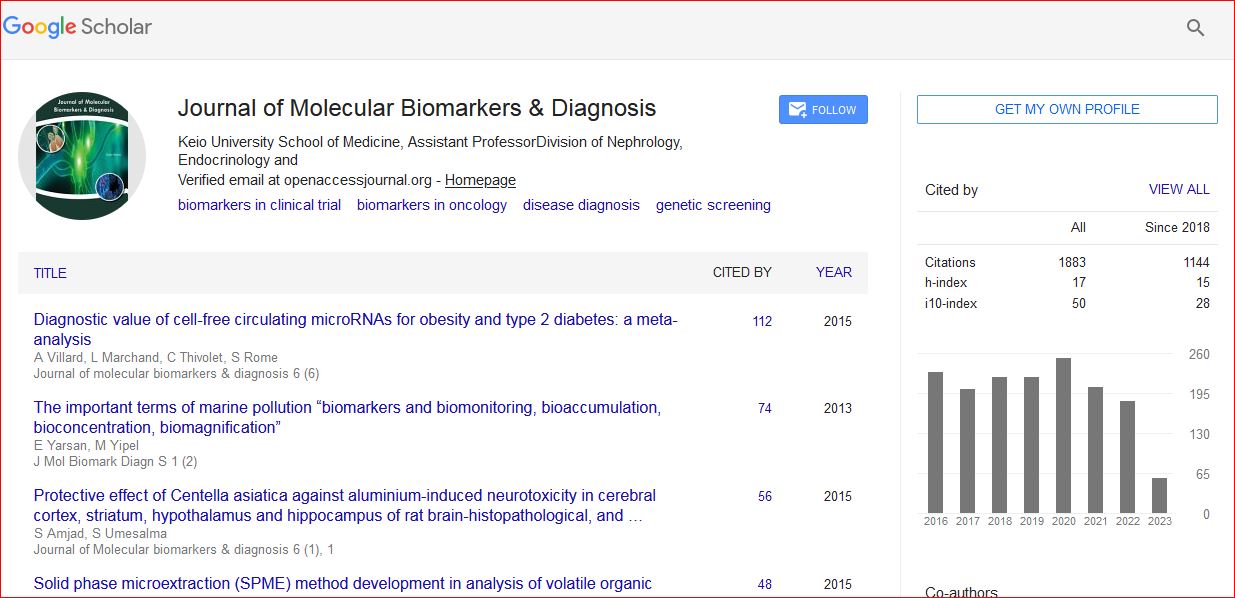
Journal of Molecular Biomarkers & Diagnosis received 2054 citations as per Google Scholar report