Perspective - (2025) Volume 17, Issue 2
Received: 01-Apr-2025, Manuscript No. jbabm-26-182329;
Editor assigned: 03-Apr-2025, Pre QC No. P-182329;
Reviewed: 17-Apr-2025, QC No. Q-182329;
Revised: 22-Apr-2025, Manuscript No. R-182329;
Published:
29-Apr-2025
, DOI: 10.37421/1948-593X.2025.17.487
Citation: Martins, David L.. ”Bioanalysis of Therapeutic Proteins and Monoclonal Antibodies.” J Bioanal Biomed 17 (2025):487.
Copyright: © 2025 Martins L. David This is an open-access article distributed under the terms of the Creative Commons Attribution License, which permits unrestricted use, distribution and reproduction in any medium, provided the original author and source are credited.
The landscape of biopharmaceutical development has seen remarkable advancements, particularly in the realm of therapeutic proteins and monoclonal antibodies (mAbs). The accurate and reliable bioanalysis of these complex molecules is paramount for ensuring their safety, efficacy, and regulatory compliance throughout the drug development lifecycle. This field is characterized by a continuous evolution of analytical methodologies aimed at addressing the inherent complexities of these biologics, from their initial characterization to their monitoring in clinical settings. The meticulous quantification of drug concentrations, elucidation of pharmacokinetic profiles, and assessment of immunogenicity are critical aspects that underpin successful therapeutic protein and mAb development. These processes demand sensitive, specific, and robust bioanalytical assays that can accurately reflect the behavior of the drug in biological matrices. The application of various bioanalytical techniques, including but not limited to enzyme-linked immunosorbent assays (ELISA), liquid chromatography-tandem mass spectrometry (LC-MS/MS), and cell-based assays (CBAs), forms the backbone of this field. Each technique offers unique advantages and addresses specific analytical challenges, contributing to a comprehensive understanding of the drug's behavior. The judicious selection and implementation of these methods are crucial for generating reliable data that supports critical decision-making during drug development and clinical trials. Furthermore, the regulatory scrutiny surrounding biologics necessitates a rigorous approach to assay development and validation, ensuring that the data generated meets the highest standards of scientific integrity and patient safety. Ligand-binding assays (LBAs), particularly ELISA, have emerged as workhorses in the bioanalysis of therapeutic mAbs. Their ability to provide sensitive and specific quantification in complex biological fluids makes them indispensable for therapeutic drug monitoring and pharmacokinetic studies. The intricacies of LBA development, from antibody selection to assay optimization and validation, require careful consideration of potential pitfalls such as matrix effects and cross-reactivity. Strategies to enhance sensitivity and robustness are continuously being explored to meet the demands of detecting low drug concentrations and characterizing intricate pharmacokinetic profiles. Complementing LBAs, mass spectrometry-based bioanalysis, especially LC-MS/MS, offers an alternative approach with inherent specificity and sensitivity for protein and mAb quantification. The evolution of LC-MS/MS techniques, encompassing both targeted and untargeted approaches, has significantly expanded its utility. Addressing challenges related to sample preparation, peptide selection, and matrix complexity is essential for achieving accurate absolute quantification. The ongoing development of advanced MS technologies, such as ion mobility and high-resolution MS, promises even more comprehensive protein characterization and detailed analysis of post-translational modifications. A critical facet of therapeutic protein and mAb development is the assessment of immunogenicity, which directly impacts patient safety and therapeutic outcomes. Regulatory agencies have established guidelines for immunogenicity testing, often employing a tiered approach that integrates in vitro and in vivo assays. Predicting immunogenicity remains a challenge, underscoring the importance of specialized assays designed to characterize the type and functional impact of anti-drug antibodies (ADAs), providing essential information for risk assessment and mitigation. Ensuring the reliability and integrity of bioanalytical data is fundamentally dependent on robust method validation. Regulatory guidelines provide a framework for validating assays, encompassing parameters such as accuracy, precision, selectivity, sensitivity, and stability. Understanding and adhering to these guidelines is crucial for generating data that is acceptable to regulatory authorities. Common challenges encountered during validation, such as method robustness and the potential for matrix effects, require careful planning and execution of validation studies. The development and characterization of biosimilars introduce unique bioanalytical considerations. Demonstrating similarity to the reference product requires a strategic application of bioanalytical methods. Orthogonal approaches and comprehensive characterization of critical quality attributes are essential for supporting comparability studies, a key requirement for biosimilar approval. Robust bioanalysis plays a pivotal role in establishing the scientific basis for biosimilarity. The assessment of protein binding to plasma proteins or other circulating molecules is often vital for understanding the pharmacokinetics and pharmacodynamics of therapeutic proteins and mAbs. Protein binding can significantly influence a drug's efficacy and safety profile. Bioanalytical methods designed to measure both free and total drug concentrations, such as equilibrium dialysis and ultrafiltration, are employed to elucidate these binding characteristics and their implications. The integration of biomarkers and pharmacodynamic endpoints into the development of therapeutic proteins and mAbs offers valuable insights into drug activity and patient response. These endpoints complement traditional pharmacokinetic measurements by providing direct evidence of the drug's biological effect. The selection and validation of relevant biomarkers, coupled with the analysis of clinical outcomes, are crucial for optimizing dosing strategies and assessing therapeutic benefit, reflecting a shift towards more comprehensive drug characterization. Emerging therapeutic modalities, including antibody-drug conjugates (ADCs) and bispecific antibodies, present novel and complex bioanalytical challenges. These multi-component therapeutics require sophisticated assays capable of quantifying various analytes, such as the parent antibody, released payload, and antibody fragments, while also assessing linker stability and payload distribution. Innovative bioanalytical strategies are continuously being developed to support the advancement of these sophisticated biologics.
The accurate bioanalysis of therapeutic proteins and monoclonal antibodies (mAbs) is a critical component of their development and clinical application. This process involves a suite of sophisticated analytical techniques designed to quantify drug concentrations, understand pharmacokinetic profiles, and assess immunogenicity, all while adhering to stringent regulatory requirements. The complexity of these biologics necessitates the development of highly sensitive and specific bioanalytical assays that can reliably function within diverse biological matrices. The continuous advancement in bioanalytical methodologies is driven by the need to provide robust data that underpins critical decisions in drug discovery and development, ultimately ensuring patient safety and therapeutic efficacy. Among the widely employed bioanalytical techniques for therapeutic proteins and mAbs, ligand-binding assays (LBAs), particularly ELISA, hold a prominent position. These assays are instrumental in the quantification of mAbs in biological fluids, facilitating therapeutic drug monitoring and the characterization of pharmacokinetic parameters. The development of effective LBAs involves meticulous optimization of assay conditions, careful selection of critical reagents, and rigorous validation to mitigate challenges such as matrix effects and potential cross-reactivity. Enhancing assay sensitivity and robustness remains a key focus for researchers to accurately measure low drug concentrations and complex pharmacokinetic profiles. Liquid chromatography-tandem mass spectrometry (LC-MS/MS) represents another powerful bioanalytical platform for therapeutic protein and mAb quantification, offering high specificity and sensitivity. The evolution of LC-MS/MS methodologies, including targeted and untargeted approaches, has significantly broadened its applicability in protein bioanalysis. Critical aspects of LC-MS/MS method development involve optimized sample preparation techniques, strategic peptide selection for quantification, and thorough validation to address challenges posed by complex biological matrices. The integration of advanced MS technologies, such as high-resolution mass spectrometry and ion mobility, further enhances the capability for comprehensive protein characterization. Immunogenicity assessment is a crucial aspect of therapeutic protein and mAb development, directly impacting patient safety and therapeutic efficacy. Regulatory guidelines outline comprehensive strategies for immunogenicity testing, often employing a tiered approach that includes screening assays, confirmatory assays, and functional assays. Predicting immunogenicity remains a complex challenge, highlighting the importance of specialized assays designed to identify and characterize anti-drug antibodies (ADAs) and their potential functional consequences. This ensures a thorough understanding of the immune response to the therapeutic agent. The validation of bioanalytical methods is a cornerstone of regulatory compliance in the development of therapeutic proteins and mAbs. Comprehensive validation ensures that the assays used are accurate, precise, specific, sensitive, and stable, providing reliable data for regulatory submissions. Key validation parameters, such as selectivity, linearity, range, and recovery, are meticulously assessed to meet stringent regulatory expectations. Addressing common pitfalls and challenges during validation is essential for generating high-quality bioanalytical data that supports drug development. The bioanalytical characterization of biosimilars presents unique challenges, requiring the demonstration of similarity to the reference product. This involves the strategic application of orthogonal bioanalytical methods to comprehensively assess critical quality attributes and establish comparability. Robust bioanalytical strategies are fundamental to supporting the extensive comparability studies necessary for the regulatory approval of biosimilars. The precision and accuracy of these methods are vital in confirming the similarity in quality, safety, and efficacy. Understanding the extent of protein binding to plasma proteins and other circulating molecules is often crucial for interpreting the pharmacokinetic and pharmacodynamic behavior of therapeutic proteins and mAbs. Protein binding can significantly influence a drug's bioavailability, distribution, and therapeutic effect. Bioanalytical methods, including equilibrium dialysis, ultrafiltration, and LC-MS/MS, are employed to accurately quantify both free and total drug concentrations, providing essential insights into drug-target interactions and overall drug disposition. The utilization of biomarkers and pharmacodynamic endpoints in the development of therapeutic proteins and mAbs provides valuable information regarding drug activity and patient response. These endpoints offer a direct measure of the drug's biological effect, complementing pharmacokinetic data. The selection and validation of relevant biomarkers, along with their integration with clinical outcomes, are essential for optimizing dosing strategies and demonstrating therapeutic benefit. This approach signifies a move towards a more holistic understanding of drug efficacy. Novel therapeutic modalities such as antibody-drug conjugates (ADCs) and bispecific antibodies introduce new complexities to bioanalysis. The development of assays for these multi-component therapeutics requires the quantification of various entities, including the parent antibody, the cytotoxic payload, and potentially antibody fragments. Furthermore, assessing linker stability and payload release kinetics is critical. Innovative bioanalytical strategies are paramount to effectively support the development of these advanced biologics. Cell-based assays (CBAs) are indispensable for bioanalysis, particularly for measuring the biological activity and potency of therapeutic proteins and mAbs. These assays reflect the in vivo mechanism of action and are crucial for assessing efficacy and immunogenicity. Challenges in CBA development and validation include ensuring reproducibility, selecting appropriate cell lines, and mitigating the impact of matrix components. Strategies for enhancing the robustness of CBAs are continuously being explored to ensure their reliability in drug development.
This collection of articles explores the multifaceted field of bioanalysis for therapeutic proteins and monoclonal antibodies (mAbs). It covers the critical aspects of assay development, validation, and application across various techniques, including ligand-binding assays (LBAs), LC-MS/MS, and cell-based assays (CBAs). The content highlights the importance of accurate quantification, pharmacokinetic profiling, and immunogenicity assessment for ensuring drug safety and efficacy. Regulatory considerations and the challenges associated with novel biologics like biosimilars, ADCs, and bispecific antibodies are also discussed. The overarching theme emphasizes the need for robust, sensitive, and specific bioanalytical methods to support drug development and clinical monitoring in this rapidly evolving area.
None
None
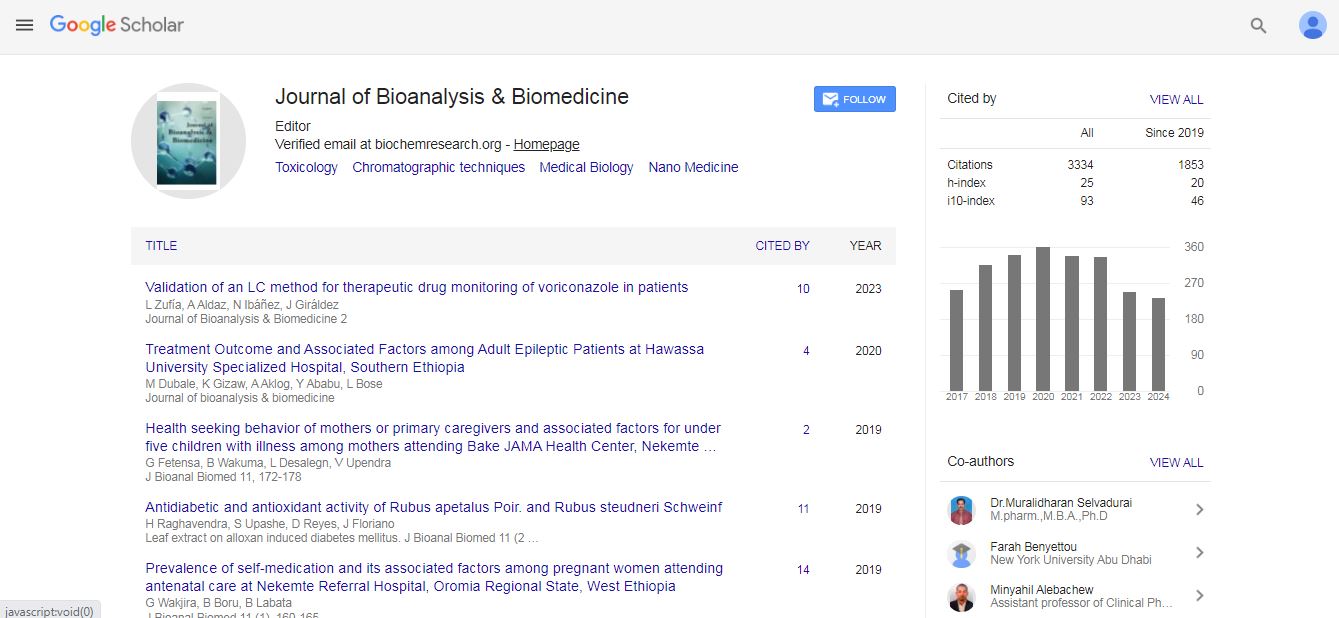
Journal of Bioanalysis & Biomedicine received 3099 citations as per Google Scholar report