Brief Report - (2025) Volume 17, Issue 2
Received: 01-Apr-2025, Manuscript No. jbabm-26-182325;
Editor assigned: 03-Apr-2025, Pre QC No. P-182325;
Reviewed: 17-Apr-2025, QC No. Q-182325;
Revised: 22-Apr-2025, Manuscript No. R-182325;
Published:
29-Apr-2025
, DOI: 10.37421/1948-593X.2025.17.483
Citation: Rodriguez, Elena. ”Bioanalysis: Driving Advances in Personalized Medicine.” J Bioanal Biomed 17 (2025):483.
Copyright: © 2025 Rodriguez E. This is an open-access article distributed under the terms of the Creative Commons Attribution License, which permits unrestricted use, distribution and reproduction in any medium, provided the original author and source are credited.
The advancement of personalized medicine hinges on the sophisticated application of bioanalytical methods for precise biomarker quantification. These techniques are fundamental to tailoring therapeutic strategies, offering a path towards improved patient outcomes and more effective treatment regimens. The ability to accurately measure a variety of biomolecules is paramount in this evolving field. This article delves into the critical role of bioanalytical methods in advancing personalized medicine. It highlights how precise quantification of biomarkers, including small molecules, proteins, and nucleic acids, in complex biological matrices is fundamental for therapeutic drug monitoring, pharmacogenomics, and the development of novel diagnostics. The discussion emphasizes the need for highly sensitive, selective, and reproducible bioanalytical techniques to guide individualized treatment strategies and improve patient outcomes. [1] The cornerstone of many bioanalytical workflows in personalized medicine is liquid chromatography-mass spectrometry (LC-MS/MS). This powerful technique enables the accurate measurement of low-abundance biomarkers, which are crucial for early disease detection and predicting treatment responses. Ongoing advancements continue to refine its application in complex biological samples. This paper examines the application of liquid chromatography-mass spectrometry (LC-MS/MS) as a cornerstone bioanalytical technique in personalized medicine. It addresses the challenges and advancements in developing and validating LC-MS/MS methods for low-abundance biomarkers, crucial for early disease detection and response prediction. The authors stress the importance of robust validation to ensure data integrity and reliable clinical decision-making. [2] Immunoassay techniques, such as ELISA and multiplex assays, offer complementary strengths for biomarker analysis in personalized medicine. Their ability to facilitate high-throughput screening of multiple protein targets simultaneously is invaluable for unraveling complex disease signatures and identifying novel diagnostic or prognostic indicators. This review focuses on immunoassay techniques, particularly ELISA and multiplex assays, and their utility in personalized medicine. It discusses how these methods enable high-throughput analysis of multiple protein biomarkers simultaneously, facilitating the identification of complex disease signatures. The text highlights the ongoing development of more sensitive and specific immunoassays to meet the demands of personalized diagnostics and prognostics. [3] Integrating genomic and transcriptomic data with bioanalytical approaches provides a more comprehensive view of an individual's health status. Technologies like next-generation sequencing (NGS) and digital PCR are essential for quantifying gene expression and identifying actionable mutations that guide drug selection and dosage adjustments. The article explores the integration of genomics and transcriptomics data with bioanalytical approaches for personalized treatment. It emphasizes the role of next-generation sequencing (NGS) and digital PCR in quantifying gene expression levels and identifying actionable mutations that inform drug selection and dosage. The authors underscore the need for sophisticated bioinformatic tools to interpret this complex data for clinical application. [4] The development of biosensors represents a significant frontier in personalized medicine, offering the potential for rapid, real-time monitoring of various analytes. These platforms can facilitate immediate therapeutic adjustments by providing immediate feedback on a patient's physiological state. This publication discusses the evolving landscape of biosensors and their potential in personalized medicine. It highlights the development of rapid, point-of-care biosensing platforms capable of detecting various analytes in real-time, enabling immediate therapeutic adjustments. The review focuses on electrochemical, optical, and piezoelectric biosensors and their translation into clinical practice. [5] Addressing matrix effects and interferences is a persistent challenge in bioanalytical method development for personalized medicine. Implementing robust sample preparation techniques and employing advanced detection methods are critical for ensuring the accuracy and reliability of measurements in diverse biological matrices. The article addresses the challenges of matrix effects and interferences in bioanalytical methods used for personalized medicine. It provides strategies for mitigating these issues, such as sample preparation techniques and advanced detection methods, to ensure the accuracy and reliability of biomarker measurements in complex biological samples like plasma, urine, and tissues. [6] The bioanalysis of circulating tumor DNA (ctDNA) has emerged as a powerful tool for personalized cancer management. Detecting and quantifying low-frequency mutations in ctDNA is essential for monitoring treatment efficacy and identifying minimal residual disease, enabling timely adjustments to therapeutic strategies. This paper focuses on the bioanalytical quantification of circulating tumor DNA (ctDNA) as a liquid biopsy marker for personalized cancer management. It discusses the sensitivity requirements and technological advancements in detecting and quantifying low-frequency mutations in ctDNA, crucial for monitoring treatment response and detecting minimal residual disease. [7] Method validation in bioanalysis for personalized medicine requires flexible and fit-for-purpose strategies. The dynamic nature of biomarker discovery and the diverse analytical needs of individualized care necessitate adaptable validation approaches to ensure data integrity and clinical utility. The article explores the challenges and opportunities in bioanalytical method validation for personalized medicine. It emphasizes the need for flexible and fit-for-purpose validation strategies that can accommodate the dynamic nature of biomarker discovery and the diverse analytical requirements in individualized patient care. [8] Pharmacogenomics plays a pivotal role in personalized therapy, guiding drug selection and dosing based on an individual's genetic makeup. Accurate and reproducible bioanalytical techniques are indispensable for analyzing genetic variations and their impact on drug metabolism and response. This review discusses the role of pharmacogenomics in personalized medicine and the bioanalytical techniques used to support it. It covers the analysis of genetic variations and their impact on drug metabolism and response, highlighting the importance of accurate and reproducible bioanalysis for guiding drug therapy. [9] The miniaturization offered by microfluidic devices presents compelling advantages for bioanalysis in personalized medicine. These platforms promise reduced sample and reagent consumption, faster analysis times, and the integration of multiple analytical steps, paving the way for point-of-care diagnostics and improved treatment monitoring. The article examines the development of microfluidic devices for bioanalysis in personalized medicine. It highlights the advantages of miniaturization, such as reduced sample and reagent consumption, faster analysis times, and integration of multiple analytical steps, making them promising tools for point-of-care diagnostics and personalized treatment monitoring. [10]
The field of personalized medicine is significantly propelled by advanced bioanalytical methods, which are crucial for the accurate and sensitive quantification of biomarkers. These methods are indispensable for understanding individual responses to therapies, optimizing drug dosages, and developing novel diagnostic tools. The precise measurement of small molecules, proteins, and nucleic acids within complex biological samples is a foundational element for successful personalized treatment strategies and improved patient outcomes. The development of highly sensitive, selective, and reproducible analytical techniques is therefore a continuous area of research and innovation. Bioanalytical Strategies for Personalized Medicine: A Perspective from Drug Development emphasizes the critical role of these methods in guiding individualized treatment. It underscores the necessity of robust bioanalytical techniques for therapeutic drug monitoring, pharmacogenomics, and the creation of new diagnostic approaches. The paper highlights how these analytical capabilities directly contribute to enhancing patient care through tailored therapeutic interventions. [1] Among the most prominent bioanalytical techniques employed is liquid chromatography-tandem mass spectrometry (LC-MS/MS), which serves as a fundamental tool for biomarker quantification in personalized medicine. Significant efforts are dedicated to developing and validating LC-MS/MS methods capable of detecting and quantifying biomarkers present at very low concentrations. Such capabilities are vital for early disease detection and for predicting a patient's response to specific treatments, ensuring the reliability of clinical decisions. Liquid Chromatography-Tandem Mass Spectrometry for Biomarker Quantification in Personalized Medicine details the application of LC-MS/MS in this context. It addresses the complexities and progress in creating and validating methods for low-abundance biomarkers. The authors stress the imperative of rigorous validation to guarantee data accuracy and foster confident clinical decision-making, thereby supporting personalized therapeutic approaches. [2] Immunoassay techniques, including ELISA and multiplex assays, offer a powerful means for high-throughput analysis of protein biomarkers, which is essential for identifying complex disease signatures. These methods allow for the simultaneous assessment of multiple analytes, thereby accelerating the discovery and validation of biomarkers relevant to personalized diagnostics and prognostics. Continuous refinement aims to enhance their sensitivity and specificity. Immunoassays for Biomarker Discovery and Validation in Personalized Medicine reviews the utility of immunoassay techniques in personalized medicine. It explains how these methods facilitate the simultaneous analysis of numerous protein biomarkers, aiding in the characterization of intricate disease patterns. The publication points to ongoing advancements in immunoassay technology to meet the evolving requirements of personalized healthcare. [3] The integration of genomic and transcriptomic data with bioanalytical approaches provides a deeper understanding of individual biological profiles for personalized treatment. Technologies such as next-generation sequencing (NGS) and digital PCR are instrumental in quantifying gene expression and pinpointing actionable mutations that inform therapeutic decisions, including drug selection and dosage. Sophisticated bioinformatic tools are necessary to interpret this data for clinical use. Genomic and Transcriptomic Profiling: Bioanalytical Foundations for Precision Oncology discusses the synergy between molecular profiling and bioanalysis. It highlights the importance of NGS and digital PCR for quantifying genetic information and identifying mutations that guide personalized treatment. The authors emphasize the need for advanced bioinformatics to translate this complex data into actionable clinical insights. [4] Biosensors represent a rapidly advancing area with immense potential for personalized medicine, particularly for real-time monitoring. These devices can offer rapid detection of analytes at the point of care, enabling immediate adjustments to treatment plans based on immediate physiological feedback. Electrochemical, optical, and piezoelectric biosensors are key technologies being translated into clinical applications. Biosensors for Real-Time Monitoring in Personalized Medicine explores the developing field of biosensors and their impact on personalized medicine. It showcases the creation of quick, point-of-care biosensing platforms for real-time analyte detection, facilitating prompt therapeutic modifications. The review concentrates on the clinical translation of various biosensor technologies. [5] Managing matrix effects and interferences is a critical consideration in the development of bioanalytical methods for personalized medicine. The complex nature of biological samples necessitates effective strategies for sample preparation and the use of advanced detection methods to ensure the accuracy and reliability of biomarker measurements. These efforts are vital for obtaining trustworthy analytical results. Overcoming Matrix Effects in Bioanalysis for Personalized Medicine Applications addresses the inherent challenges of matrix effects and interferences in bioanalytical assays. It proposes effective mitigation strategies, including optimized sample preparation and sophisticated detection techniques, to ensure the precision and dependability of biomarker quantification in diverse biological matrices such as plasma and urine. [6] The bioanalysis of circulating tumor DNA (ctDNA) is a significant development in personalized cancer management through liquid biopsies. Detecting and quantifying low-frequency mutations within ctDNA is crucial for monitoring treatment response and identifying minimal residual disease, which allows for timely therapeutic adjustments and improved patient outcomes. Bioanalysis of Circulating Tumor DNA for Personalized Cancer Therapy focuses on ctDNA analysis as a liquid biopsy marker for cancer management. It details the sensitivity demands and technological progress in identifying and quantifying low-abundance mutations in ctDNA, essential for tracking treatment effectiveness and detecting residual disease. [7] Validation of bioanalytical methods in the context of personalized medicine requires adaptable and fit-for-purpose approaches. Given the continuous evolution of biomarker discovery and the varied analytical requirements for individualized patient care, validation strategies must be flexible enough to accommodate these dynamic changes, ensuring the continued reliability of bioanalytical data. Validation of Bioanalytical Methods in the Era of Personalized Medicine examines the opportunities and challenges in validating bioanalytical methods for personalized medicine. It underscores the importance of flexible validation strategies that can adapt to evolving biomarker landscapes and the diverse analytical needs associated with personalized patient care, ensuring data integrity. [8] Pharmacogenomics is central to personalized therapy, enabling the selection of drugs and dosages based on an individual's genetic profile. The bioanalytical techniques supporting pharmacogenomics are critical for accurately assessing genetic variations and their impact on drug metabolism and patient response, thereby optimizing therapeutic efficacy. Bioanalytical Approaches to Support Pharmacogenomics in Personalized Therapy reviews the role of pharmacogenomics in personalized medicine and the associated bioanalytical methods. It covers the analysis of genetic variations influencing drug response and metabolism, emphasizing the necessity of precise and reproducible bioanalysis for guiding pharmaceutical treatments. [9] Microfluidic devices offer significant advantages for bioanalysis in personalized medicine due to their miniaturized nature. These platforms enhance efficiency by reducing sample and reagent volumes, accelerating analysis times, and integrating multiple analytical functions. This makes them highly promising for point-of-care diagnostics and continuous treatment monitoring. Microfluidic Platforms for Bioanalysis in Personalized Medicine discusses the development of microfluidic technologies for bioanalysis within personalized medicine. It highlights the benefits of miniaturization, including lower consumption of samples and reagents, faster analysis, and the integration of various analytical steps, positioning them as valuable tools for personalized diagnostics and monitoring. [10]
This collection of research highlights the pivotal role of bioanalytical methods in advancing personalized medicine. Key techniques discussed include liquid chromatography-mass spectrometry (LC-MS/MS), immunoassays (ELISA, multiplex), genomics (NGS, digital PCR), and biosensors. These methods enable precise quantification of biomarkers such as small molecules, proteins, and nucleic acids, facilitating therapeutic drug monitoring, pharmacogenomics, early disease detection, and personalized cancer management through liquid biopsies like ctDNA analysis. Challenges such as matrix effects and the need for flexible method validation are addressed. Microfluidic devices are emerging as promising platforms for point-of-care diagnostics and real-time monitoring. The overarching theme is the critical link between accurate bioanalysis and the successful implementation of individualized treatment strategies for improved patient outcomes.
None
None
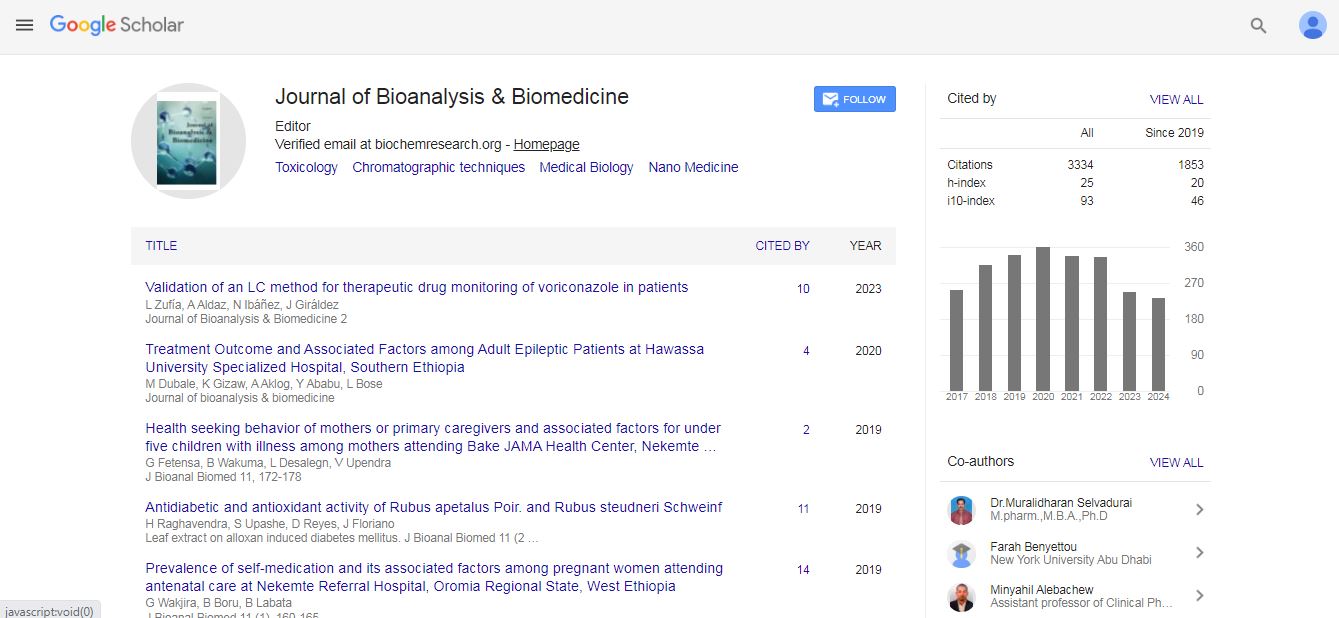
Journal of Bioanalysis & Biomedicine received 3099 citations as per Google Scholar report