Perspective - (2025) Volume 15, Issue 2
Received: 01-Mar-2025, Manuscript No. jsmds-25-174166;
Editor assigned: 03-Mar-2025, Pre QC No. P-174166;
Reviewed: 17-Mar-2025, QC No. Q-174166;
Revised: 22-Mar-2025, Manuscript No. R-174166;
Published:
29-Mar-2025
, DOI: 10.37421/2161-0673.2025.15.422
Citation: Moreau, Hugo. ”Athlete Doping: Supplements, Contamination, Education.” J Sports Med Doping Stud 15 (2025):422.
Copyright: © 2025 Moreau H. This is an open-access article distributed under the terms of the Creative Commons Attribution License, which permits unrestricted use,
distribution and reproduction in any medium, provided the original author and source are credited.
The landscape of dietary supplements and anti-doping regulations presents complex challenges for athletes across all levels of competition. Effective strategies are essential to ensure athlete health, integrity in sport, and informed decision-making regarding supplement use. Elite athletes and their support teams often grapple with the complex landscape of dietary supplements. Many supplements promise performance gains, but it's crucial for professionals to guide athletes on evidence-based choices. Understanding not just efficacy but also the critical risks of contamination and anti-doping rule violations. Informed decision-making is paramount for athlete health and integrity in sport[1].
To combat doping, educational initiatives are key. The 'Supplement 4 Performance' (S4P) project introduced a novel approach to teach elite athletes and their support staff about making smart, evidence-based decisions regarding dietary supplements. Targeted education is vital for ensuring athletes understand the lines between legitimate support and doping risks[2].
A persistent problem for athletes, both amateur and professional, is the unintended risk of doping through contaminated dietary supplements. An analytical study revealed that many supplements can contain banned substances, often without explicit labeling. It highlights the critical need for stricter quality control and for athletes to exercise extreme caution with supplement use[3].
Student-athletes often lack sufficient knowledge about banned substances, making them vulnerable to inadvertent doping. Targeted educational interventions can significantly improve their understanding. A pilot study showed that even brief, focused training can help student-athletes identify and avoid substances that could lead to anti-doping rule violations, protecting their careers and health[4].
Understanding how athletes perceive doping, supplements, and anti-doping regulations is crucial for effective prevention strategies. A qualitative study in Switzerland highlighted varied perceptions among athletes. Insights suggest that anti-doping education needs to be tailored, addressing specific beliefs and misunderstandings rather than applying a one-size-fits-all approach[5].
The intention to use doping among adolescent athletes isn't just about performance pressure; it's heavily influenced by attitudes and perceived social norms. Applying the theory of planned behavior helps us understand that if young athletes believe their peers or coaches approve of doping, they are more likely to consider it. Anti-doping efforts need to address social influences, not just individual knowledge[6].
Recreational athletes, much like their professional counterparts, use dietary supplements but often have limited awareness of the associated doping risks. The problem isn't confined to elite sports. Education must extend to all levels of athletic participation to ensure individuals understand the potential for supplement contamination and its consequences on their health and eligibility[7].
To truly foster a doping-free environment, it's essential to understand the perceptions of both athletes and their support personnel regarding doping and the anti-doping system itself. A qualitative study revealed varied insights, suggesting that trust in the system and clarity of regulations are critical. Effective anti-doping strategies must address these perceptions directly, promoting transparency and clear communication[8].
Creatine is one of the most widely used and scientifically supported performance-enhancing supplements, yet its place within anti-doping frameworks often raises questions. Current anti-doping perspectives generally consider creatine supplementation safe and permissible. Clear guidelines are needed for athletes and practitioners to differentiate between approved nutritional aids and banned substances, preventing confusion and accidental violations[9].
Interventions aimed at preventing doping in young athletes are critical, but their effectiveness needs careful examination. A study on the 'Doping-Free Sport' intervention provides insight into what works. Research helps refine educational strategies, ensuring that programs designed to promote clean sport are genuinely impactful and address the specific vulnerabilities and influences affecting young athletes[10].
Understanding these varied aspects is fundamental for developing comprehensive anti-doping education and prevention programs globally.
Elite athletes and their support teams frequently navigate the complex world of dietary supplements. Professionals must guide athletes toward evidence-based choices, considering not only efficacy but also crucial risks of contamination and anti-doping rule violations [1]. A persistent problem, for both amateur and professional athletes, is the unintended risk of doping through contaminated dietary supplements [3]. Many supplements can contain banned substances, often without explicit labeling. It highlights the critical need for stricter quality control and for athletes to exercise extreme caution with supplement use. Creatine is a widely used and scientifically supported performance-enhancing supplement; current anti-doping perspectives generally consider it safe and permissible, yet clear guidelines are needed to differentiate approved nutritional aids from banned substances to prevent confusion and accidental violations [9].
To combat doping effectively, educational initiatives are key. Projects like 'Supplement 4 Performance' (S4P) introduce novel approaches to teach elite athletes and their support staff about making smart, evidence-based decisions regarding dietary supplements [2]. Targeted education ensures athletes understand the distinction between legitimate support and doping risks. Student-athletes often lack sufficient knowledge about banned substances, leaving them vulnerable to inadvertent doping [4]. Targeted educational interventions can significantly improve their understanding; a pilot study demonstrated that even brief, focused training can help student-athletes identify and avoid substances that could lead to anti-doping rule violations, protecting their careers and health.
Understanding how athletes perceive doping, supplements, and anti-doping regulations is crucial for effective prevention strategies. A qualitative study in Switzerland highlighted varied perceptions among athletes, suggesting that anti-doping education needs to be tailored to specific beliefs and misunderstandings [5]. This indicates that a one-size-fits-all approach is insufficient. Recreational athletes, similar to professionals, use dietary supplements but often have limited awareness of associated doping risks [7]. The problem isn't confined to elite sports; education must extend to all levels of athletic participation to ensure individuals understand the potential for supplement contamination and its consequences on their health and eligibility.
The intention to use doping among adolescent athletes is heavily influenced by attitudes and perceived social norms, not solely performance pressure [6]. The theory of planned behavior suggests that if young athletes believe their peers or coaches approve of doping, they are more likely to consider it. This means anti-doping efforts need to address social influences, beyond just individual knowledge. To foster a truly doping-free environment, it's essential to understand the perceptions of both athletes and their support personnel regarding doping and the anti-doping system itself [8]. A qualitative study revealed varied insights, underscoring that trust in the system and clarity of regulations are critical for effective anti-doping strategies.
Interventions aimed at preventing doping in young athletes are critical, but their effectiveness requires careful examination [10]. A study on the 'Doping-Free Sport' intervention provides insight into what works. Research helps refine educational strategies, ensuring that programs designed to promote clean sport are genuinely impactful and address the specific vulnerabilities and influences affecting young athletes.
The complex landscape of dietary supplements presents significant risks of contamination and anti-doping rule violations for athletes, from elite to recreational [1]. This highlights a crucial need for professionals to guide evidence-based choices and strict quality control for supplements, as many can contain banned substances without explicit labeling [3]. Targeted educational initiatives, like the 'Supplement 4 Performance' (S4P) project, are vital to equip athletes and support staff with the knowledge to make informed decisions and understand doping risks [2]. Student-athletes often lack sufficient knowledge of banned substances, making focused educational interventions essential to protect their careers and health [4]. The issue extends to recreational athletes who also demonstrate limited awareness of doping risks associated with supplement use, emphasizing that education must be broad-based [7]. Understanding athlete perceptions of doping, supplements, and regulations is critical for developing tailored prevention strategies, as a one-size-fits-all approach is ineffective [5]. Social norms and attitudes significantly influence adolescent athletes' intentions to use doping, necessitating anti-doping efforts to address these broader social influences [6]. Trust in the anti-doping system and clarity of regulations are also key perceptions for both athletes and support personnel in fostering a doping-free environment [8]. Even widely used supplements like creatine require clear guidelines to prevent confusion and accidental violations [9]. Ultimately, examining the efficacy of anti-doping interventions, such as 'Doping-Free Sport,' is crucial to refine strategies and ensure impactful programs for young athletes [10].
None
None
Indexed at, Google Scholar, Crossref
Indexed at, Google Scholar, Crossref
Indexed at, Google Scholar, Crossref
Indexed at, Google Scholar, Crossref
Indexed at, Google Scholar, Crossref
Indexed at, Google Scholar, Crossref
Indexed at, Google Scholar, Crossref
Indexed at, Google Scholar, Crossref
Indexed at, Google Scholar, Crossref
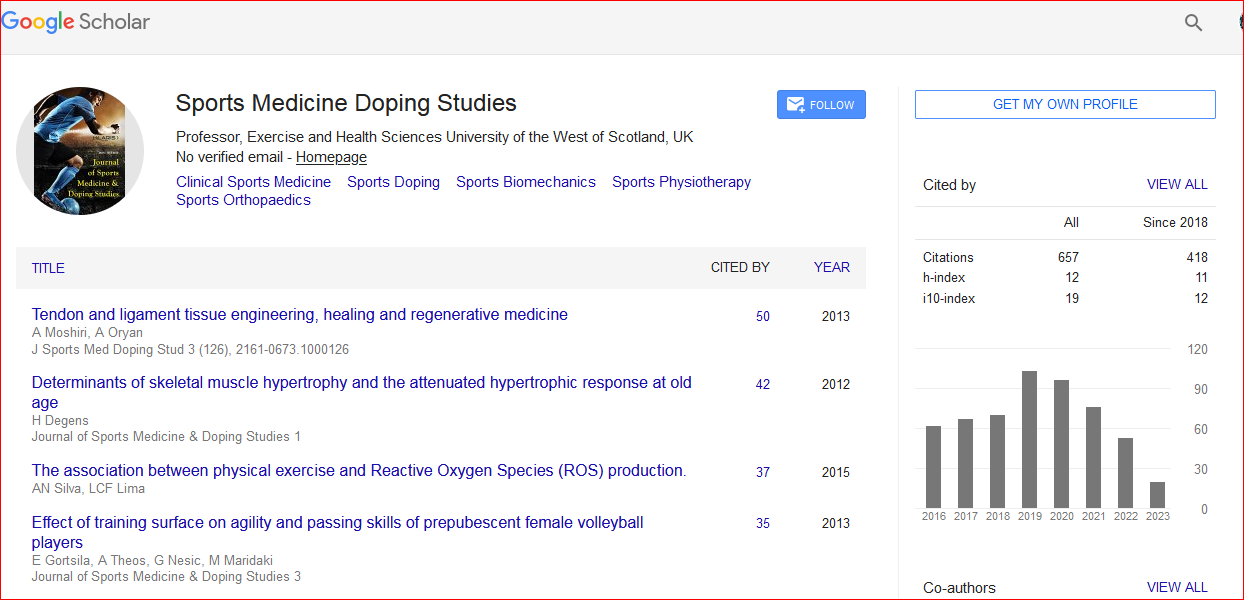
Journal of Sports Medicine & Doping Studies received 1022 citations as per Google Scholar report