Research Article - (2026) Volume 16, Issue 2
Received: 15-Mar-2026, Manuscript No. jnt-26-186497;
Editor assigned: 18-Mar-2026, Pre QC No. P-186497;
Reviewed: 01-Apr-2026, QC No. Q-186497;
Revised: 08-Apr-2026, Manuscript No. R-186497;
Published:
15-Apr-2026
, DOI: 10.5281/zenodo.20279409
Citation: Aida, Lengani Habin Yabama, Balde Mamadou Saliou, Yaméogo Wend’n’mi Aubin Clotaire and Kiba Koumare Alice, et al. “Anemia Management in Hemodialysis Patients in a Low-resource Setting: Blood Transfusion and Unmet Blood Needs in Burkina Faso” J Nephrol Ther 16 (2026): 611.
Copyright: © 2026 Aida LHY. This is an open-access article distributed under the terms of the Creative Commons Attribution License, which permits unrestricted use, distribution, and reproduction in any medium, provided the original author and source are credited.
Introduction: Anemia is a common complication in the advanced stages of Chronic Kidney Disease (CKD) and is associated with high morbidity and mortality. In sub-Saharan Africa, the inaccessibility of Erythropoiesis Stimulating Agents (ESAs) leads to frequent use of Red Blood Cell Transfusions (RBCT). Our study aimed to determine the prevalence of anemia and assess the RBCT needs of hemodialysis patients at Tengandogo University Hospital, Burkina Faso.
Patients and methods: This retrospective study conducted from January 1, 2021, to December 31, 2023. All patients undergoing maintenance hemodialysis for at least 3 months were included.
Results: Seventy-three patients, with a mean age of 44.48 ± 14.57 years were included. The sex ratio was 2.04. All patients were anemic, with a mean hemoglobin level of 7.29 ± 1.41 g/dL. Anemia was severe in 72.6% of them. Only 13 patients (17.81%) regularly received ESAs. Fortyeight patients (65.75%) had been transfused and received an average of 8.81 ± 8.89 units of Packed Red Blood Cells (PRBC) per patient (range: 1-42). Patients who received transfusions had a significantly lower hemoglobin level (p<0.001) and a shorter dialysis vintage (p = 0.003). Over three years, an average of 13.7 units of PRBC were prescribed per patient, totaling 658 units, but only 422 (64.2%) of these were transfused. The non-availability rate was 34%, representing an average of 4.7 unmet PRBC units per patient. Patients with hemoglobin level below 7 g/dL had significantly more unmet PRBC requests (p = 0.015).
Conclusion: The high prevalence of severe anemia and reliance on transfusions is due to the financial inaccessibility of ESAs and intravenous iron. Subsidizing these medications would therefore improve anemia management in hemodialysis patients, reduce morbidity and mortality and preserve RBCT resources for life-threatening emergencies.
Anemia • Hemodialysis • Blood transfusion • Burkina Faso • Sub-saharan Africa
Anemia is a common complication of CKD, with its frequency increasing as the disease progresses [1,2]. It affects between 17.4% and 53.4% of patients with stages 3 to 5 CKD [3].
In these patients, anemia is mainly due to decreased production of erythropoietin by the failing kidneys and impaired iron metabolism [3]. In hemodialysis patients, these causes are compounded by dialysis-related incidents causing blood loss, including vascular access bleeding, extracorporeal circuit clotting and inadequate dialysis [4,5]. Other factors, including nutritional deficiencies, chronic inflammation and hemoglobinopathies also contribute [4,6].
Anemia is associated with an increased risk of cardiovascular events, such as congestive heart failure and ischemic heart disease, as well as higher management costs and increased cardiovascular and overall mortality in patients with CKD [1-3]. It also impairs quality of life and cognitive and functional capacities [1,3].
The treatment of anemia focuses on correcting the underlying mechanism. In hemodialysis patients, first-line treatment for anemia involves iron supplementation and administration of ESAs or Hypoxia-inducible Factor Prolyl Hydroxylase Inhibitors (HIF-PHIs) [5,7]. RBCT may be necessary in cases of severe or poorly tolerated anemia, after assessing the benefit-risk ratio [5].
RBCT are less effective than ESAs for treating renal anemia [1]. Furthermore, the risk of alloimmunization is high, which reduces subsequent chances of kidney transplantation. There is also a risk of transfusion reactions, volume overload, iron overload, hyperkalemia and blood-borne infections [1,2] .
In the United States, the annual management cost for CKD patients with anemia was three times higher than for patients without anemia [3,8,9].
In sub-Saharan Africa, RBCT are a common therapeutic option to treat anemia in hemodialysis patients, due to the unavailability and high cost of ESAs. In Cameroon and Mali, RBCT was practiced in 70.5% and 92.1% of patients, respectively [10,11]. However, in low- and middle-income countries, blood shortages are frequent and negatively impact the prognosis of patients in life-threatening emergencies, particularly children under five and pregnant women [12,13].
Our study aimed to determine the prevalence of anemia and evaluate the transfusion needs of hemodialysis patients at Tengandogo University Hospital.
We conducted a retrospective study, in the hemodialysis unit of the Tengandogo University Hospital from January 1, 2021, to December 31, 2023.
All patients who had been on hemodialysis for at least three months were included in the study. Those who had received blood transfusions outside the dialysis unit and those with incomplete medical records were excluded.
Data were collected from patients' medical records and prescriptions for blood products.
The variables collected included socio-demographic data (age, sex, marital status, education level, occupation, healthcare payment method), medical history (hypertension, diabetes, peptic ulcer, viral hepatitis, chronic heart disease), dialysis data (dialysis duration, number of hemodialysis sessions per week, dry weight), blood pressure (systolic blood pressure, diastolic blood pressure), biological data (complete blood count, ABO/Rhesus D blood group), therapeutic data (blood transfusion, iron supplementation, ESA use) and transfusion data (number of transfusions, number of PRBC units requested, supplied and not covered due to blood unavailability at the blood bank).
The procedure for obtaining PRBCs involves a prescription for blood products, which is sent to the blood bank. Blood transfusion is 100% subsidized and is free for patients in Burkina Faso.
Definitions
Anemia was defined according to the World Health Organization as a Hemoglobin (Hb) level <13 g/dL in men and <12 g/dL in women [5]. Anemia was classified as mild when the hemoglobin level was between 11-11.9 g/dL, moderate between 10.9 and 8 g/dL and severe when the hemoglobin level was <8 g/dL [6].
The decision to transfuse was based on symptoms of poor tolerance of the anemia and was systematic for dialysis patients with a hemoglobin level below 7 g/dL who did not have access to ESAs [5].
The number of PRBC units prescribed by the nephrologists corresponded to the transfusion need. Unmet transfusion need was defined as the difference between the number of PRBC units prescribed and the number delivered by the blood bank.
Statistical Analysis
Analysis was performed using Sphinx 5.0 software. Quantitative variables were expressed as means ± Standard Deviations (SD) and qualitative variables as numbers and percentages. We compared transfused and non-transfused patients. We also compared transfusion needs in the subpopulation with hemoglobin <7g/dL and ≥ 7g/dL.
The Chi-square test was used for comparing qualitative variables and Student's t-test was used for comparing quantitative variables. A p-value <0.05 was considered significant.
During the study period, 90 patients were undergoing chronic hemodialysis. Seventy-three patients (81.1%) met the inclusion criteria. The mean age was 44.48 ± 14.57 years, with a range from 14 to 79 years. Men accounted for 67.12% of the study population. Most of the patients were educated, with 17.81% having university education. The number of hemodialysis sessions was two per week for 62 patients (84.93%). The prevalence of anemia was 100%, with severe anemia in 72.6% of patients (Table 1).
| Variables | All patients (N=73) | Red blood cell transfusion | p-value | |
|---|---|---|---|---|
| Yes (n=48) | No (n=25) | |||
| Age (years), mean ± sd | 44.48 ± 14.57 | 45.44 ± 15.98 | 42.64 ± 11.45 | 0.44 |
| Gender n (%) | ||||
| Male | 49 (67.12) | 29 (59.18) | 20 (40.82) | 0.091 |
| Female | 24 (32.88) | 19 (79.17) | 5 (20.83) | |
| Marital status n (%) | ||||
| Married | 56 (76.71) | 35 (62.5) | 21 (37.5) | |
| Widowed | 2 (2.74) | 2 (100) | 0 | |
| Unmarried | 15 (20.55) | 11 (73.33) | 4 (26.67) | |
| Education level n (%) | ||||
| None | 13 (17.81) | 9 (69.23) | 4 (30.77) | 0.975 |
| Primary | 22 (30.14) | 14 (63.64) | 8 (36.36) | |
| Secondary | 25 (34.25) | 16 (64) | 9 (36) | |
| University | 13 (17.81) | 9 (69.23) | 4 (30.77) | |
| Occupation n (%) | ||||
| Government employee | 18 (24.66) | 12 (66.67) | 6 (33.33) | 0.26 |
| Self-employed worker | 18 (24.66) | 10 (55.56) | 8 (44.44) | |
| Merchant | 12 (16.44) | 5 (41.67) | 7 (58.33) | |
| Student | 8 (10.96) | 7 (87.5) | 1 (12.5) | |
| Farmer | 6 (8.22) | 5 (83.33) | 1 (16.67) | |
| Housewife | 6 (8.22) | 5 (83.33) | 1 (16.67) | |
| Retired | 5 (6.85) | 4 (80) | 1 (20) | |
| Payment method n (%) | ||||
| Out-of-pocket | 68 (93.15) | 46 (67.64%) | 22 (32.36) | 0.209 |
| Insurance | 5 (6.85) | 2 (40) | 3 (60) | - |
| Dialysis vintage (years), mean ± sd | 3.06 ± 2.48 | 2.45 ± 1.75 | 4.24 ± 3.21 | 0.003 |
| Hemodialysis sessions per week n (%) | ||||
| Three | 11 (15.07) | 9 (81.82) | 2 (18.18) | 0.311 |
| Two | 62 (84.93) | 39 (62.9) | 23 (37.1) | |
| Comorbidities | ||||
| Hypertension n (%) | ||||
| Yes | 55 (76.71) | 35 (62.5) | 20 (37.5) | 0.288 |
| No | 18 (24.66) | 13 (76.47) | 5 (23.53) | |
| Peptic ulcer n (%) | ||||
| Yes | 2 (2.74) | 2 (100) | 0 | - |
| No | 71 (97.26) | 46 (64.79) | 25 (35.21) | |
| Hepatitis n (%) | ||||
| Yes | 3 (4.11) | 3 (100) | 0 | 0.429 |
| No | 70 (95.89) | 45 (64.29) | 25 (35.71) | |
| Diabetes n (%) | ||||
| Yes | 2 (2.74) | 1 (50) | 1 (50) | 0.572 |
| No | 71 (97.26) | 47 (66.2) | 24 (33.8) | |
| Chronic heart disease n (%) | ||||
| Yes | 1 (1.37) | 1 (100) | 0 | 0.658 |
| No | 72 (98.63) | 47 (65.28) | 25 (34.72) | |
| Dry weight (kg), mean ± sd | 61.92 ± 11.27 | 60.85 ± 8.84 | 63.95 ± 14.89 | 0.268 |
| Systolic blood pressure (mmHg), mean ± sd | 145.67 ± 23.9 | 145.94 ± 18.94 | 145.16 ± 31.77 | 0.896 |
| Diastolic blood pressure (mmHg), mean ± sd | 89.55 ± 17.83 | 87.79 ± 16.06 | 92.92 ± 20.77 | 0.246 |
| Hemoglobin (g/dL), mean ± sd | 7.29 ± 1.41 | 6.84± 1.18 | 8.15 ± 1.44 | <0.001 |
| Hematocrit (%), mean ± sd | 21.81 ± 3.96 | 20.98 ± 3.57 | 23.38 ± 4.25 | 0.013 |
| Mean corpuscular volume (fl), mean ± sd | 85.54 ± 6.1 | 85.1 ± 6.69 | 86.37 ± 4.76 | 0.402 |
| Microcytosis n (%) | ||||
| Yes | 11 (15.07) | 10 (90.91) | 1 (9.09) | 0.052 |
| No | 62 (84.93) | 38 (61.29) | 24 (38.71) | |
| Mean corpuscular hemoglobin (hg), mean ± sd | 26.64±2.94 | 26.99±3.04 | 25.98±2.66 | 0.165 |
| Hypochromia n (%) | ||||
| Yes | 41 (56.16) | 25 (60.98) | 16 (39.02) | 0.33 |
| No | 32(43.84) | 23 (71.88) | 9 (28.13) | |
| Degree of anemia n (%) | ||||
| Mild | 2 (2.74) | 0 | 2 (100) | 0.008 |
| Moderate | 18 (24.66) | 8 (44.44) | 10 (55.56) | |
| Severe | 53 (72.6) | 40 (75.47) | 13 (24.53) | |
| Blood group n (%) | ||||
| O | 34 (46.58) | 20 (58.82) | 14 (41.18) | 0.607 |
| A | 12 (16.44) | 9 (75) | 3 (25) | |
| B | 25 (34.25) | 18 (72) | 7 (28) | |
| AB | 2 (2.74) | 1 (50) | 1 (50) | |
| Rhesus D n (%) | ||||
| Positive | 63 (86.3) | 41 (65.07) | 22 (34.93) | 0.76 |
| Negative | 10 (13.7) | 7 (70) | 3 (30) | |
| Treatment | ||||
| Iron supplementation, n (%) | 58 (79.45) | 33 (56.9) | 25 (43.1) | 0.001 |
| Oral | 51 (69.86) | 31 (60.78) | 20 (39.22) | |
| Intravenous | 7 (9.59) | 2 (28.57) | 5 (71.43) | |
| ESA, n (%) | 69 (94.52) | 44 (63.77) | 25 (36.23) | 0.357 |
| Irregular | 56 (76.71) | 42 (75) | 16 (25) | |
| Regular | 13 (17.81) | 4 (30.76) | 9 (69.23) | |
Table 1: Comparison of patients who received red blood cells transfusions and those who did not.
Forty-eight patients (65.75%) had received at least one RBCT during the study period. The mean dialysis vintage was significantly shorter in transfused patients (2.45 ± 1.75 years vs. 4.24 ± 3.21 years, p = 0.003). The mean hemoglobin level was significantly lower in transfused patients (6.84 ± 1.18 g/dL vs. 8.15 ± 1.44 g/dL, p < 0.001). All non-transfused patients received iron supplementation (25/25), compared to 68.75% (33/48) of transfused patients (p = 0.001). Among the 53 patients with severe anemia, 40 (75.47%) had been transfused (p = 0.008) (Table 1). One patient experienced significant bleeding from the vascular access during dialysis.
Blood transfusion
A total of 658 PRBC units were prescribed, representing an average of 13.7 ± 12.35 units per patient (range: 1-56 units). Of the 433 units supplied by the blood bank, 11 (2.54%) could not be transfused after pre-transfusion testing. Therefore, 422 PRBC units were transfused, corresponding to an average of 8.81 ± 8.89 units per patient (range: 1-42 units). On average, patients received 6.19 ± 5.71 blood transfusions each (range: 1-25 transfusions).
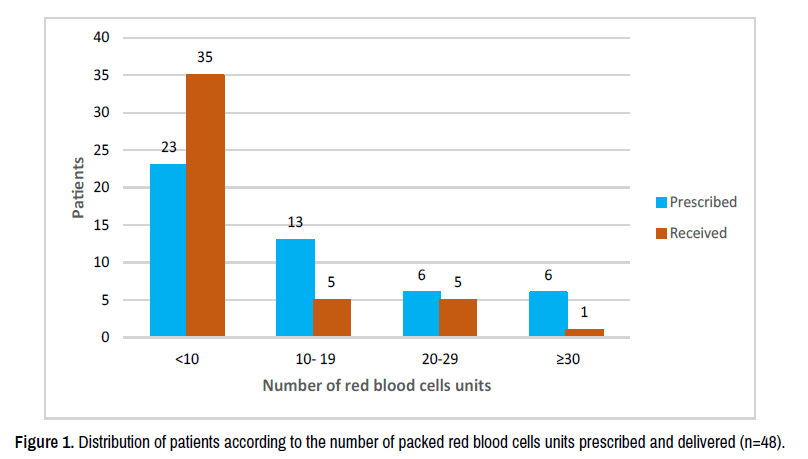
Eleven patients (15.07% of all patients and 22.92% of those who received transfusions) had received at least 10 PRBC units. Of the six patients prescribed more than 30 PRBC units, one patient received 42 PRBC units (Figure 1).
Availability of PRBC
A total of 225 (34%) PRBC units were not delivered, representing an average of 4.69 ± 8.47 unmet PRBC units per patient (range: 0-49). The majority of transfused patients (35/48, 72.91%) received fewer than 10 PRBC units (Figure 1).
The number of PRBC units requested and uncovered was significantly higher in patients with a hemoglobin level <7 g/dL than in those with a hemoglobin level ≥ 7 g/dL, with a statistically significant difference (p = 0,027 and p = 0,015 respectively) (Table 2).
| Variables | All transfused patients (n=48) | Hemoglobin level (g/dL) | p-value | |
|---|---|---|---|---|
| <7 (n=36) | ≥ 7 (n=12) | |||
| Number of transfusions (mean ± sd) | 6.19 ± 5.71 | 6.93 ± 6.4 | 5.05 ± 4.36 | 0.269 |
| Requested PRBC units (mean ± sd) | 13.71 ±12.35 | 16.52 ± 11.97 | 9.42 ± 5.87 | 0.027 |
| Delivered PRBC units (mean ± sd) | 8.81 ± 8.9 | 9.76 ± 8.91 | 7.37 ± 5.31 | 0.368 |
| Unmet PRBC units(mean ± sd) | 4.69 ± 8.47 | 6.69 ± 8.18 | 1.63 ± 2.11 | 0.015 |
Table 2: Comparison of transfused patients according to hemoglobin level and number of red blood cell units requested and delivered (n = 48).
In hemodialysis patients, anemia is primarily due to deficient erythropoietin production and iron deficiency [3,4]. In our study, all patients were anemic, with nearly three-quarters (72.6%) having severe anemia. This prevalence was higher than that observed in other studies [10,11,14].
In our context, the high prevalence of anemia in hemodialysis patients is attributable to the financial inaccessibility of intravenous iron and ESAs, as well as frequently inadequate dialysis. Indeed, 84.93% of our patients received only two four-hour hemodialysis sessions per week, which is below international recommendations [15]. However, inadequate dialysis promotes the accumulation of uremic toxins that inhibit erythropoiesis and worsen iron deficiency by promoting oxidative stress.
Unlike blood products, which are fully subsidized, ESAs in Burkina Faso remain the patient’s financial responsibility, significantly limiting access. This situation explains why 65.75% of our patients required transfusions.
Transfused patients had a significantly lower hemoglobin level (6.8 vs. 8.1 g/dL, p<0.001), confirming the severity of their anemia. The correlation between anemia severity and the number of PRBC units requested was expected and consistent with standard transfusion practices.
The shorter dialysis vintage observed in transfused patients (2.45 years vs. 4.24 years, p=0.003) was unexpected. This may be explained by the fact that, in our setting, patients who survive longer on dialysis tend to have better health status or a higher socioeconomic level, allowing them to better cover medical expenses.
Repeated blood transfusion exposes patients to infectious risks, volume overload (iron overload, hypervolemia, hyperkalemia) and red blood cell and HLA alloimmunization [1,16]. These risks are significant in our hemodialysis population, with patients receiving an average of 8.81 PRBC units and one patient receiving up to 42 PRBC units. Anti-HLA alloimmunization increases with the number of transfusions and compromises the chances of subsequent renal transplantation [16].
The rate of unmet transfusion needs was 34%. This is concerning, as it exposes patients to persistent anemia and its complications. The correlation between severe anemia and unmet PRBC units (p=0.015) suggests that the most severely ill patients are also those who experience the greatest blood shortages, creating a vicious cycle.
This situation reflects the chronic shortage of blood products in sub-Saharan Africa, where the availability rate was 5.9 units per 1,000 inhabitants in 2022, remaining below the WHO recommendation of 10 units per 1,000 inhabitants [17].
In sub-Saharan Africa, severe anemia accounts for over 70% of transfusion indications [17,18] and PRBCs are most often requested urgently in 91.9% of cases [18]. Pediatric and obstetrics-gynecology departments are the main requesters of blood [18]. Patients in these departments with life-threatening conditions; for whom blood transfusion is the only therapeutic option; thus compete for the same limited blood resources as hemodialysis patients with substantial transfusion needs.
Furthermore, the production costs of blood products are high in developing countries, often exceeding the financial capacities of beneficiaries and requiring public subsidies [19]. In Zimbabwe, the production cost of one PRBC unit reached 130.94 USD, equivalent to 13.7% of the annual GDP per capita [20].
Applying a subsidy similar to that granted to blood products in Burkina Faso for ESAs and injectable iron would help ensure optimal anemia management in CKD patients in general and in hemodialysis patients in particular. It would help achieve hemoglobin targets, reduce anemia-related morbidity and mortality and preserve transplantation opportunities, while increasing the availability of PRBCs for life-threatening emergencies and thus benefiting the entire healthcare system.
Our study has limitations. It was retrospective and single-centre and the study population was relatively small, making generalization of the results difficult. Furthermore, certain biological parameters, such as iron status, vitamin B12 and folic acid levels and hemoglobin electrophoresis, were unavailable. Finally, long-term transfusion complications, particularly alloimmunization, were not investigated.
Anemia was universal (100% of patients) and predominantly severe among hemodialysis patients. Two-thirds of patients required blood transfusions, which were unavailable in 34% of cases. The financial inaccessibility of ESAs and intravenous iron constitutes the major obstacle to optimal anemia management in hemodialysis patients. Subsidizing these products represents a public health priority that could improve patient management, increase the availability of blood products in blood banks and ultimately benefit all patients requiring urgent transfusions.
None.
None declared.
Google Scholar, Cross Ref, Indexed at
Google Scholar, Cross Ref, Indexed at
Google Scholar, Cross Ref, Indexed at
Google Scholar, Cross Ref, Indexed at
Google Scholar, Cross Ref, Indexed at
Google Scholar, Cross Ref, Indexed at
Google Scholar, Cross Ref, Indexed at
Google Scholar, Cross Ref, Indexed at
Google Scholar, Cross Ref, Indexed at
Google Scholar, Cross Ref, Indexed at
Google Scholar, Cross Ref, Indexed at
Google Scholar, Cross Ref, Indexed at
Google Scholar, Cross Ref, Indexed at
Google Scholar, Cross Ref, Indexed at
Google Scholar, Cross Ref, Indexed at
Journal of Nephrology & Therapeutics received 784 citations as per Google Scholar report