Perspective - (2025) Volume 15, Issue 2
Received: 02-Jun-2025, Manuscript No. jttr-25-175385;
Editor assigned: 04-Jun-2025, Pre QC No. P-175385;
Reviewed: 18-Jun-2025, QC No. Q-175385;
Revised: 23-Jun-2025, Manuscript No. R-175385;
Published:
30-Jun-2025
, DOI: 10.37421/2161-0991.2025.15.301
Citation: Ohlsson, Katrin. ”Advancing Organ Graft Survival Through Innovation.” J Transplant Technol Res 15 (2025):301.
Copyright: © 2025 Ohlsson K. This is an open-access article distributed under the terms of the Creative Commons Attribution License, which permits unrestricted use, distribution and reproduction in any medium, provided the original author and source are credited.
One significant challenge in transplantation involves the impact of donor-specific antibodies (DSA) on kidney allograft survival. These antibodies are known to notably diminish the long-term viability of the transplanted organ, underscoring the vital need for enhanced detection methodologies and finely tuned management strategies to improve patient outcomes following kidney transplantation [1].
Looking at liver transplantation, researchers have identified critical factors influencing long-term graft survival. These include characteristics specific to the recipient, the severity of their underlying disease, and various donor-related variables. The importance of meticulous donor-recipient matching and the careful optimization of immunosuppression protocols are emphasized as key pathways to improving patient prognosis [2].
For heart transplant recipients, the chosen immunosuppression strategies are paramount. Investigations show that well-considered and expertly managed immunosuppressive regimens can significantly boost graft survival rates and simultaneously decrease the occurrence of adverse events, ultimately paving the way for more individualized post-transplant care [3].
In the realm of pancreas transplantation, particularly across the United States, recent trends indicate ongoing improvements in graft survival. This progress is especially noticeable for simultaneous pancreas-kidney transplants. These positive outcomes are largely attributed to continuous advancements in surgical techniques and the evolution of immunosuppressive therapies [4].
A primary obstacle to achieving enduring survival for lung transplant recipients is chronic lung allograft dysfunction. This condition is thoroughly examined in current research, which seeks to deepen our understanding of its pathogenesis and explore innovative therapeutic strategies aimed at prolonging the life of the lung allograft [5].
Children undergoing intestinal transplantation have shown promising long-term graft survival. A two-decade review from a single institution highlights remarkable progress. These advancements are linked to improved patient selection criteria, refined surgical methodologies, and the development of more effective immunosuppressive treatments tailored for pediatric patients [6].
The role of biomarkers in kidney transplantation is becoming increasingly crucial. Current research explores both the present utility and future potential of these biological indicators. They are vital for accurately predicting rejection, meticulously monitoring the health of the graft, and ultimately fostering better long-term graft survival through highly personalized medical interventions [7].
A significant goal in organ transplantation research is the induction of immunological tolerance. Various methods are being investigated with the core objective of lessening or entirely removing the necessity for continuous immunosuppression. Achieving such tolerance promises to dramatically enhance graft survival and significantly improve the overall quality of life for transplant recipients [8].
Machine learning represents a transformative application in organ transplantation. A comprehensive review showcases its potential to deliver more accurate predictions of graft survival and rejection. It can also significantly enhance risk assessment and guide the development of highly personalized treatment plans, leading to superior patient outcomes [9].
Finally, the technique of Normothermic Regional Perfusion (NRP) in donors after circulatory death has undergone systematic review and meta-analysis. The findings confirm that NRP substantially improves both graft function and survival rates. This suggests its considerable value as a technique that could expand the available donor pool without negatively affecting post-transplant results [10].
Long-term success in organ transplantation hinges on overcoming a range of complex immunological and physiological challenges. For instance, donor-specific antibodies (DSA) are known to significantly diminish kidney allograft survival, highlighting the ongoing need for improved detection and refined management strategies to enhance outcomes for these patients [1]. Similarly, in liver transplantation, careful consideration of recipient characteristics, disease severity, and donor variables is critical for predicting long-term graft survival. Optimal donor-recipient matching and meticulously managed immunosuppression protocols are paramount to improving patient results [2]. The influence of immunosuppression extends to heart transplantation, where thoughtfully chosen and consistently managed regimens demonstrably improve graft survival and mitigate adverse events, paving the way for highly personalized post-transplant care [3]. These areas collectively underscore the foundational role of immunology and careful patient management in transplant longevity.
Advancements in surgical techniques and immunosuppressive therapies have led to notable progress in specific organ transplants. Pancreas transplantation, particularly for simultaneous pancreas-kidney transplants, has witnessed sustained improvements in graft survival rates across the United States [4]. Pediatric intestinal transplantation also presents a success story, with a single institution's two-decade experience showcasing remarkable gains in long-term graft survival. These improvements are credited to better patient selection, refined surgical methods, and more effective immunosuppressive approaches tailored for children [6]. Conversely, chronic lung allograft dysfunction remains a primary impediment to long-term survival in lung transplant recipients. Continued research is essential to understand its development and to devise new therapeutic strategies to extend the lifespan of the lung allograft [5].
Innovation in diagnostics and predictive analytics is revolutionizing transplant care. Biomarkers are increasingly vital in kidney transplantation, offering significant potential for predicting rejection and closely monitoring graft health. Their expanding role contributes to better long-term graft survival through more personalized medical approaches [7]. Parallel to this, the application of machine learning in organ transplantation is transforming risk assessment and treatment planning. This technology has the potential to predict graft survival and rejection with greater accuracy, guiding individualized treatment strategies for improved patient outcomes [9]. These technological advancements are pivotal in moving towards more proactive and precise patient management.
Looking to the future, the pursuit of immunological tolerance in organ transplantation holds immense promise. Exploring various methods to achieve tolerance aims to reduce or eliminate the need for continuous immunosuppression, thereby significantly enhancing graft survival and the recipient's overall quality of life [8]. Expanding the donor pool is another critical area, and techniques like Normothermic Regional Perfusion (NRP) in donors after circulatory death are proving effective. A systematic review and meta-analysis confirm that NRP can significantly improve graft function and survival rates, suggesting it is a valuable technique for widening donor availability without compromising results [10]. Collectively, these efforts represent a multi-faceted approach to advancing transplant medicine, focusing on both recipient care and donor optimization.
Improving long-term graft survival remains a central focus across various organ transplantation fields. Donor-specific antibodies significantly reduce kidney allograft survival, emphasizing the need for better detection and tailored management strategies. For liver transplantation, meticulous donor-recipient matching and optimized immunosuppression protocols are crucial, alongside understanding recipient characteristics and disease severity, for predicting graft survival. Heart transplantation outcomes are heavily influenced by carefully selected and managed immunosuppression regimens, which can reduce adverse events and enable personalized post-transplant care. Pancreas transplantation, particularly simultaneous pancreas-kidney transplants, has seen sustained improvements in graft survival due to advances in surgical techniques and immunosuppressive therapy. Chronic lung allograft dysfunction presents a major challenge to long-term survival for lung transplant recipients, necessitating deeper understanding of its development and innovative therapeutic approaches. Pediatric intestinal transplantation has shown remarkable progress over two decades, attributed to refined patient selection, surgical methods, and effective immunosuppression. The use of biomarkers in kidney transplantation is evolving, playing a significant role in predicting rejection, monitoring graft health, and fostering personalized medical approaches. Achieving immunological tolerance in organ transplantation is a key strategy to reduce or eliminate continuous immunosuppression, thereby enhancing graft survival and recipient quality of life. Furthermore, technological advancements, such as machine learning, are being applied to predict graft survival, assess risk, and guide personalized treatment. Normothermic Regional Perfusion (NRP) in donors after circulatory death is also proving valuable, improving graft function and survival rates and potentially expanding the donor pool.
None
None
Chen T, Zhang M, Lu M. "The impact of donor-specific antibodies on kidney allograft survival: A systematic review and meta-analysis".Front Immunol 14 (2023):1120055.
Indexed at, Google Scholar, Crossref
Varghese J, Ranganathan M, Kumar S. "Predictors of long-term graft survival after liver transplantation in the modern era: A single-center experience".World J Gastroenterol 28 (2022):1286-1298.
Indexed at, Google Scholar, Crossref
Bacher A, Eder S, Krenn C. "Impact of Immunosuppression Strategies on Outcomes After Heart Transplantation: A Propensity-Matched Analysis".J Clin Med 10 (2021):1581.
Indexed at, Google Scholar, Crossref
Axelrod D, Lentine KL, Schnitzler MA. "Contemporary Pancreas Transplant Outcomes and Trends in the United States".Am J Transplant 20 (2020):739-751.
Indexed at, Google Scholar, Crossref
Vos R, Vanaudenaerde BM, Verleden SE. "Chronic lung allograft dysfunction and strategies to improve long-term outcomes: a narrative review".Eur Respir Rev 33 (2024):230188.
Indexed at, Google Scholar, Crossref
Pfrimmer A, Schmelzle M, Vath J. "Long-term graft survival after intestinal transplantation in children: a 20-year single-center experience".Transpl Int 32 (2019):1038-1049.
Indexed at, Google Scholar, Crossref
Hricik DE, Formica RN, Friedewald JJ. "Biomarkers in Kidney Transplantation: Current Landscape and Future Perspectives".Clin J Am Soc Nephrol 18 (2023):164-175.
Indexed at, Google Scholar, Crossref
Nakatani M, Nishimura K, Kaneda K. "Strategies for Achieving Immunological Tolerance in Organ Transplantation".Int J Mol Sci 23 (2022):6785.
Indexed at, Google Scholar, Crossref
Chen T, Lu M, Chen Y. "Machine Learning in Organ Transplantation: A Scoping Review".Front Immunol 12 (2021):756306.
Indexed at, Google Scholar, Crossref
van RCS, Verwer BJ, van dVCH. "Normothermic Regional Perfusion in Donors after Circulatory Death: A Systematic Review and Meta-Analysis".Ann Surg 272 (2020):15-26.
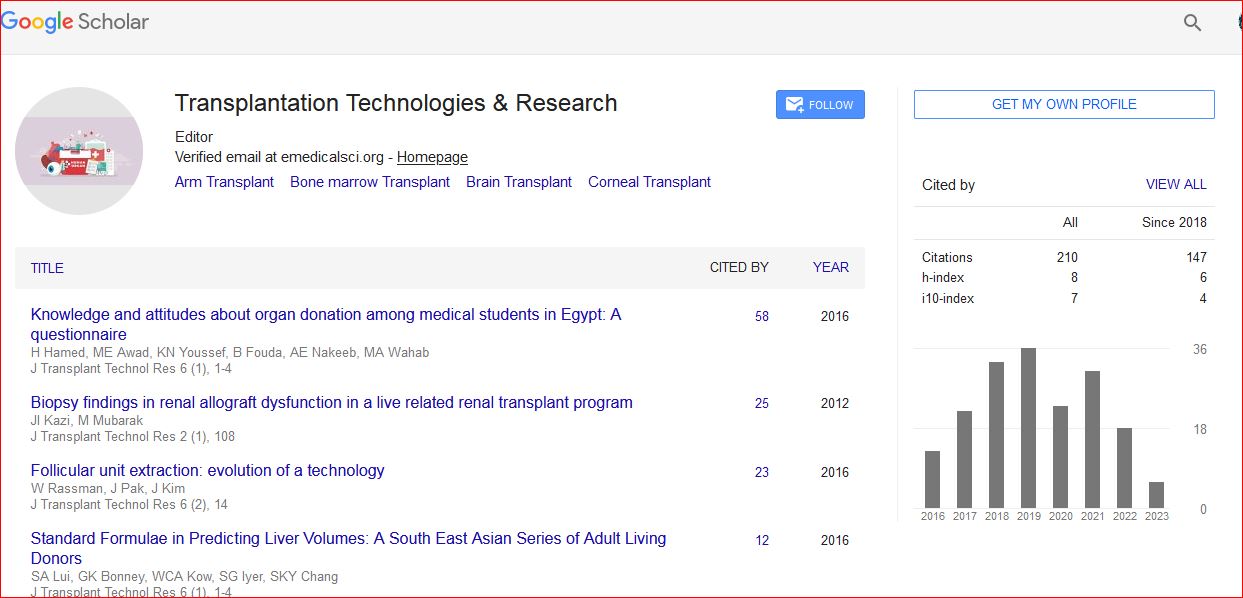
Transplantation Technologies & Research received 223 citations as per Google Scholar report