Perspective - (2025) Volume 16, Issue 2
Received: 01-Mar-2025, Manuscript No. jnmrt-25-172732;
Editor assigned: 03-Mar-2025, Pre QC No. P-172732;
Reviewed: 17-Mar-2025, QC No. Q-172732;
Revised: 24-Mar-2025, Manuscript No. R-172732;
Published:
31-Mar-2025
, DOI: 10.37421/2155-9619.2025.16.641
Citation: Boateng, George N.. ”Advancing Medical Dosimetry & Dose Optimization.” J Nucl Med Radiat Ther 16 (2025):641.
Copyright: © 2025 Boateng N. George This is an open-access article distributed under the terms of the Creative Commons Attribution License, which permits unrestricted use, distribution and reproduction in any medium, provided the original author and source are credited.
Modern medical physics heavily relies on advanced dosimetry and dose optimization to ensure patient safety and maximize therapeutic efficacy across various diagnostic and therapeutic procedures. Computational phantoms, like those employing voxel or boundary representation methods, are increasingly vital for achieving accurate, patient-specific dose calculations[1].
What this really means is that incorporating individual anatomy and tissue characteristics into these models allows for precise absorbed dose prediction, which helps optimize radiation exposure and personalize treatment planning. A significant area of focus is minimizing radiation risks in sensitive populations, notably children undergoing Computed Tomography (CT) scans. Studies emphasize the crucial need to optimize imaging protocols to reduce pediatric radiation dose, utilizing techniques such as iterative reconstruction algorithms and automated exposure control to maintain image quality while enhancing safety[2].
These efforts are paramount for ensuring children's long-term health. Beyond diagnostic imaging, the field of radiation therapy is undergoing a transformative shift through the integration of cutting-edge technologies. Artificial Intelligence (AI) plays a pivotal role in refining dose delivery and optimizing treatment plans in radiation therapy[3].
AIâ??s ability to analyze complex patient data and predict optimal dose distributions leads to more effective treatments with fewer side effects, personalizing therapy to precisely target tumors while sparing healthy tissue. Concurrently, Magnetic Resonance Imaging (MRI)-guided radiation therapy represents a substantial advancement, offering real-time visualization of tumors during treatment[4].
This guidance allows for highly precise dose delivery, adapting to patient motion and anatomical changes, ultimately making treatments safer and more effective. The foundation for such precision often lies in sophisticated simulation methods. Monte Carlo simulations, for example, are critical for modern dosimetry and dose optimization, providing highly accurate predictions of radiation transport and energy deposition within complex patient geometries[5].
This detailed insight is essential for fine-tuning treatment plans and validating dosimetric measurements, pushing the boundaries of personalized radiation medicine. In interventional cardiology, where radiation exposure for both patients and medical staff is a serious concern, various strategies are employed for dose optimization[6].
Techniques like pulsed fluoroscopy, last-image hold, and appropriate collimation are implemented to significantly reduce radiation risk without compromising the effectiveness of intricate cardiac procedures, embodying a smart practice for safety. Further enhancing dosimetric accuracy are advanced imaging techniques. Spectral CT, for instance, improves dosimetry in radiation oncology by providing more detailed material decomposition, which leads to better distinction between different tissue types and more precise dose calculations[7].
This enhanced information is crucial for tailoring treatment plans, ensuring optimal tumor dosage with minimal impact on surrounding healthy tissues. For patients undergoing proton therapy, accurate in vivo dosimetry is essential for verifying the delivered dose inside the patient in real-time[8].
This immediate feedback allows for adjustments to the treatment plan, ensuring the high precision of proton therapy translates into actual clinical benefits. The increasing reliance on hybrid imaging technologies, such as Positron Emission Tomography/Computed Tomography (PET/CT) and Single-Photon Emission Computed Tomography/Computed Tomography (SPECT/CT), presents unique opportunities and challenges for dosimetry[9].
Itâ??s vital to accurately assess and optimize cumulative radiation doses from these combined modalities, balancing diagnostic power with the necessity of dose reduction. The aim is to uphold diagnostic image quality while ensuring patient safety. Finally, advancements in real-time dosimetry, particularly with novel detector technologies, are transforming adaptive radiation therapy[10].
This ability to measure and adjust dose during treatment enables dynamic and responsive therapy, handling changes in tumor size or patient position to ensure optimally targeted and precise radiation, ultimately improving patient outcomes and reducing side effects.
The evolution of medical dosimetry and radiation dose optimization is a critical aspect of modern healthcare, directly impacting patient safety and treatment efficacy. Advanced computational phantoms, including voxel or boundary representation methods, are essential for accurate dosimetry [1]. These patient-specific models incorporate individual anatomy and tissue characteristics, crucial for precise absorbed dose calculations. This precision helps optimize radiation exposure, minimizing risks while maximizing diagnostic or therapeutic benefits, truly personalizing radiation dose planning.
Minimizing radiation risks in sensitive populations, like children undergoing Computed Tomography (CT) scans, is a significant focus [2]. Studies highlight the need to optimize pediatric imaging protocols to reduce dose, utilizing techniques such as iterative reconstruction and automated exposure control. These methods aim to maintain image quality while enhancing safety for children's long-term health. In parallel, radiation therapy is transforming through the integration of artificial intelligence (AI). AI refines dose delivery and optimizes treatment plans, analyzing complex patient data to predict optimal dose distributions [3]. This leads to more effective treatments with fewer side effects, personalizing therapy to precisely target tumors and spare healthy tissue.
Magnetic Resonance Imaging (MRI)-guided radiation therapy represents a substantial advancement, offering real-time tumor visualization during treatment [4]. This real-time guidance enables exceptionally precise dose delivery, adapting to patient motion and anatomical shifts, making treatments safer and more effective. Sophisticated simulation methods also form a foundation for precision. Monte Carlo simulations are critical for modern dosimetry, providing highly accurate predictions of radiation transport and energy deposition in complex patient geometries [5]. This detailed insight is indispensable for fine-tuning treatment plans and validating measurements, pushing personalized radiation medicine forward.
In specialized clinical settings like interventional cardiology, dose optimization is a pressing concern for both patients and staff [6]. Practical strategies, including pulsed fluoroscopy, last-image hold, and appropriate collimation, are implemented to reduce radiation risks without compromising procedural efficacy. This embodies smart safety practices. Advanced imaging modalities, such as spectral CT, further refine dosimetry accuracy in radiation oncology [7]. By providing more detailed material decomposition, spectral CT enables superior tissue differentiation, facilitating more precise dose calculations. This richer information is crucial for tailoring treatment plans, ensuring optimal tumor dosage with minimal impact on healthy tissues.
Furthermore, for advanced treatments like proton therapy, accurate in vivo dosimetry is vital for verifying the actual dose delivered within the patient, ensuring effectiveness and safety [8]. Studies investigate various methodologies for real-time dose verification, allowing immediate adjustments to treatment plans. This ongoing verification is fundamental to personalized medicine, translating proton therapy's precision into tangible patient benefits. The increasing adoption of hybrid imaging technologies, including Positron Emission Tomography/Computed Tomography (PET/CT) and Single-Photon Emission Computed Tomography/Computed Tomography (SPECT/CT), presents both diagnostic opportunities and dosimetry challenges [9]. While these combined modalities offer unparalleled diagnostic power, managing cumulative radiation dose from multiple sources is critically important. Best practices focus on dose reduction while preserving diagnostic image quality. Ultimately, radiation therapy is moving towards greater adaptability and responsiveness with advancements in real-time dosimetry [10]. Leveraging novel detector technologies, clinicians can measure and adjust dose during treatment on the fly, accounting for changes in tumor size or patient position. This dynamic approach is key to maintaining optimal targeting and precision, leading to improved patient outcomes and reduced side effects.
The provided research highlights significant advancements and crucial strategies in medical dosimetry and radiation dose optimization across various medical fields. Key developments include the use of advanced computational phantoms for patient-specific dose planning in diagnostics and therapy, ensuring greater precision by modeling individual anatomies. Efforts are also focused on reducing radiation exposure in sensitive populations, such as children undergoing CT scans, through optimized imaging protocols. Artificial Intelligence (AI) is transforming radiation therapy by refining dose delivery and treatment planning, while MRI-guided radiation therapy offers real-time tumor visualization for highly accurate and adaptable dose application. The precision of dose calculations is further enhanced by Monte Carlo simulations, which accurately model radiation transport in complex geometries, and by spectral CT, which provides detailed tissue differentiation for tailored oncology treatments. Beyond oncology, dose optimization is critical in interventional cardiology, employing techniques like pulsed fluoroscopy to minimize risks for both patients and staff. For advanced treatments like proton therapy, in vivo dosimetry ensures real-time dose verification, crucial for treatment effectiveness and safety. The integration of hybrid imaging modalities like PET/CT and SPECT/CT necessitates careful cumulative dose management. Overall, the trend is towards real-time dosimetry and adaptive radiation therapy, enabling dynamic adjustments during treatment for improved patient outcomes and reduced side effects. These diverse approaches collectively underscore a commitment to safer, more effective, and personalized radiation medicine.
None
None
Indexed at, Google Scholar, Crossref
Indexed at, Google Scholar, Crossref
Indexed at, Google Scholar, Crossref
Indexed at, Google Scholar, Crossref
Indexed at, Google Scholar, Crossref
Indexed at, Google Scholar, Crossref
Indexed at, Google Scholar, Crossref
Indexed at, Google Scholar, Crossref
Indexed at, Google Scholar, Crossref
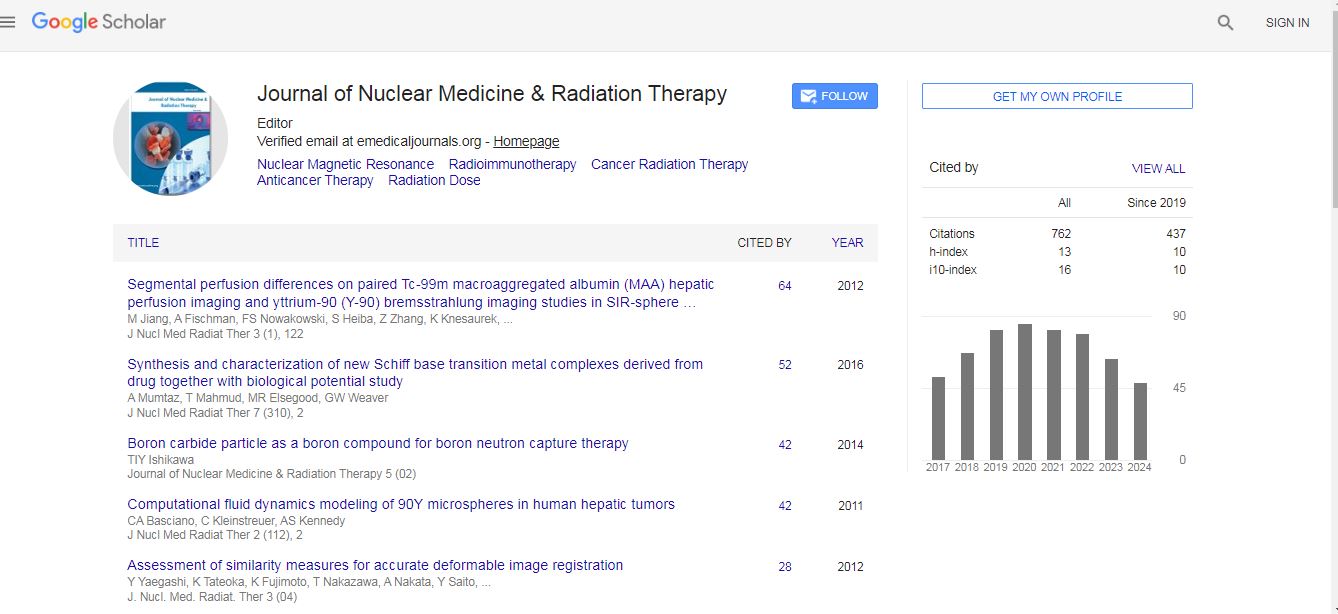
Nuclear Medicine & Radiation Therapy received 706 citations as per Google Scholar report