Commentary - (2025) Volume 16, Issue 6
Received: 03-Nov-2025, Manuscript No. jnmrt-26-186397;
Editor assigned: 05-Nov-2025, Pre QC No. P-186397;
Reviewed: 19-Nov-2025, QC No. Q-186397;
Revised: 24-Nov-2025, Manuscript No. R-186397;
Published:
01-Dec-2025
, DOI: 10.37421/2155-9619.2025.16.678
Citation: Novak, Jan. ”Advancing Alpha Therapy: Precise Microdosimetry
for Cancer.” J Nucl Med Radiat Ther 16 (2025):678.
Copyright: © 2025 Novak J. This is an open-access article distributed under the terms of the Creative Commons Attribution License, which permits unrestricted use, distribution
and reproduction in any medium, provided the original author and source are credited.
The microdosimetry of alpha-emitting nanoparticles is a critical area of research for optimizing their therapeutic potential in solid tumor treatment. Understanding the precise energy deposition at the cellular and subcellular levels is paramount for maximizing therapeutic benefits while minimizing damage to healthy tissues. This involves exploring various models and experimental techniques to quantify alpha particle dose distributions, considering factors such as nanoparticle size, distribution within the tumor microenvironment, and cellular uptake mechanisms. Key insights revolve around the crucial role of precise dosimetry in tailoring treatment strategies and predicting outcomes for next-generation alpha-particle-based radiotherapeutics [1].
Investigating the impact of nanoparticle targeting strategies on absorbed dose within solid tumors is a central theme in this field. This research assesses how different functionalization methods or receptor-mediated uptake influence the accumulation and subsequent energy deposition of alpha-emitting nanoparticles. The significance lies in demonstrating how improved targeting can enhance the dose delivered to tumor cells and potentially reduce irradiation of surrounding healthy tissues, thereby improving the therapeutic index [2].
Radiation physics and dosimetry aspects of alpha-emitting nanoparticles provide a foundational understanding for their clinical application. This includes covering the physical properties of alpha particles, their short range and high linear energy transfer (LET), and how these characteristics are advantageous for targeted therapy. Discussions often involve Monte Carlo simulations and experimental measurements used to determine dose distributions at the cellular level, crucial for predicting biological effects [3].
Cellular and subcellular dosimetry of alpha-emitting nanoparticles is essential for understanding their radiobiological effectiveness. Research in this area examines how energy deposited by alpha particles at the DNA level, within the nucleus or mitochondria, influences cell survival, mutation, or cell death pathways. A key takeaway is the need to correlate microdosimetric data with observed biological responses to optimize treatment efficacy and predict potential long-term effects [4].
Quantifying the dose from alpha-emitting nanoparticles in the complex tumor microenvironment presents significant challenges. This involves discussing how factors such as interstitial fluid, extracellular matrix, and varying cellular densities affect alpha particle range and energy deposition. The focus is on developing more accurate dosimetry models that account for these heterogeneities to better predict therapeutic outcomes [5].
Novel phantom materials and advanced imaging techniques are being developed for the validation of microdosimetry calculations for alpha-emitting nanoparticles. This research presents methods for creating realistic phantoms that mimic tumor tissue properties and demonstrates how techniques like PET or autoradiography can be used to experimentally verify dose distributions predicted by computational models. Ensuring the accuracy and reliability of dosimetry is crucial for clinical translation [6].
The radiobiological consequences of alpha-particle irradiation from nanoparticles are being studied, with a focus on microdosimetric parameters that dictate cell killing. This research correlates dose distributions at the cellular and subcellular level with observed cell survival curves and potential bystander effects. The primary insight is the importance of understanding the high-LET nature of alpha particles and how microdosimetry can predict cell inactivation and long-term genetic damage [7].
Advancements in computational dosimetry for alpha-emitting nanoparticles aim to improve the prediction of dose distribution in tumors. This involves the development and application of sophisticated software tools and algorithms that incorporate detailed anatomical models and nanoparticle kinetics. Computational approaches offer the potential to personalize treatment planning and optimize nanoparticle design [8].
Long-term effects and accumulated dose from alpha-emitting nanoparticles are particularly relevant for chronic exposure or repeated administrations in cancer therapy. This research employs pharmacokinetic and biodistribution models coupled with microdosimetry calculations to estimate cumulative dose to tumors and critical organs over time. Understanding the full impact of nanoparticle radiotherapy beyond the initial treatment course is a key contribution [9].
The use of novel radionuclides and nanoparticle platforms for alpha-emitting targeted therapy, with a focus on microdosimetric considerations, is an active area of investigation. This involves comparing different alpha emitters in terms of their physical properties, decay schemes, and suitability for conjugation to various nanoparticle carriers. The central theme is how the choice of radionuclide and nanoparticle influences the resulting dose distribution and therapeutic efficacy [10].
This work delves into the microdosimetry of alpha-emitting nanoparticles, a crucial aspect for optimizing their efficacy in solid tumor therapy. Understanding how these nanoparticles deposit their energy at the cellular and subcellular levels is paramount for maximizing therapeutic benefit while minimizing off-target damage. The article explores various models and experimental techniques used to quantify alpha particle dose distributions, considering factors such as nanoparticle size, distribution within the tumor microenvironment, and cellular uptake mechanisms. Key insights revolve around the critical role of precise dosimetry in tailoring treatment strategies, predicting treatment outcomes, and developing next-generation alpha-particle-based radiotherapeutics [1].
Investigating the impact of nanoparticle targeting strategies on the absorbed dose within solid tumors is a central theme. This study assesses how different functionalization methods or receptor-mediated uptake influences the accumulation and subsequent energy deposition of alpha-emitting nanoparticles. The significance lies in demonstrating how improved targeting can enhance the dose delivered to tumor cells and potentially reduce irradiation of surrounding healthy tissues, thereby improving the therapeutic index [2].
This article focuses on the radiation physics and dosimetry aspects of alpha-emitting nanoparticles, providing a foundational understanding for their clinical application. It covers the physical properties of alpha particles, their short range and high linear energy transfer (LET), and how these characteristics are advantageous for targeted therapy. The discussion includes Monte Carlo simulations and experimental measurements used to determine dose distributions at the cellular level, crucial for predicting biological effects [3].
Exploring the cellular and subcellular dosimetry of alpha-emitting nanoparticles is essential for understanding their radiobiological effectiveness. This research examines how the energy deposited by alpha particles at the DNA level, within the nucleus or mitochondria, influences cell survival, mutation, or cell death pathways. The key takeaway is the need to correlate microdosimetric data with observed biological responses to optimize treatment efficacy and predict potential long-term effects [4].
This article addresses the challenges and advancements in quantifying the dose from alpha-emitting nanoparticles in the complex tumor microenvironment. It discusses how factors such as interstitial fluid, extracellular matrix, and varying cellular densities affect alpha particle range and energy deposition. The focus is on developing more accurate dosimetry models that account for these heterogeneities to better predict the therapeutic outcome [5].
The use of novel phantom materials and advanced imaging techniques for the validation of microdosimetry calculations for alpha-emitting nanoparticles is explored. This research presents methods for creating realistic phantoms that mimic tumor tissue properties and demonstrates how techniques like PET or autoradiography can be used to experimentally verify dose distributions predicted by computational models. The crucial aspect is ensuring the accuracy and reliability of dosimetry for clinical translation [6].
This study investigates the radiobiological consequences of alpha-particle irradiation from nanoparticles, focusing on the microdosimetric parameters that dictate cell killing. It correlates dose distributions at the cellular and subcellular level with observed cell survival curves and potential bystander effects. The primary insight is the importance of understanding the high-LET nature of alpha particles and how microdosimetry can predict cell inactivation and long-term genetic damage [7].
The article discusses advancements in computational dosimetry for alpha-emitting nanoparticles, aiming to improve the prediction of dose distribution in tumors. It covers the development and application of sophisticated software tools and algorithms that incorporate detailed anatomical models and nanoparticle kinetics. The value lies in demonstrating how computational approaches can personalize treatment planning and optimize nanoparticle design [8].
This research focuses on the long-term effects and accumulated dose from alpha-emitting nanoparticles, particularly relevant for chronic exposure or repeated administrations in cancer therapy. It employs pharmacokinetic and biodistribution models coupled with microdosimetry calculations to estimate cumulative dose to tumors and critical organs over time. The key contribution is understanding the full impact of nanoparticle radiotherapy beyond the initial treatment course [9].
The article explores the use of novel radionuclides and nanoparticle platforms for alpha-emitting targeted therapy, with a focus on microdosimetric considerations. It compares different alpha emitters in terms of their physical properties, decay schemes, and suitability for conjugation to various nanoparticle carriers. The central theme is how the choice of radionuclide and nanoparticle influences the resulting dose distribution and therapeutic efficacy [10].
Research in alpha-emitting nanoparticle therapy is advancing rapidly, focusing on precise microdosimetry to enhance efficacy in cancer treatment. Key areas of investigation include understanding energy deposition at cellular and subcellular levels, optimizing targeting strategies to increase tumor dose while sparing healthy tissues, and developing accurate dosimetry models that account for the complex tumor microenvironment. Computational methods, advanced phantom materials, and novel radionuclide-nanoparticle combinations are being utilized to validate and improve dose predictions. Furthermore, studies are examining the radiobiological consequences, including cell killing and long-term effects, and the development of personalized treatment plans. The overarching goal is to improve therapeutic outcomes and minimize side effects through meticulous dosimetry.
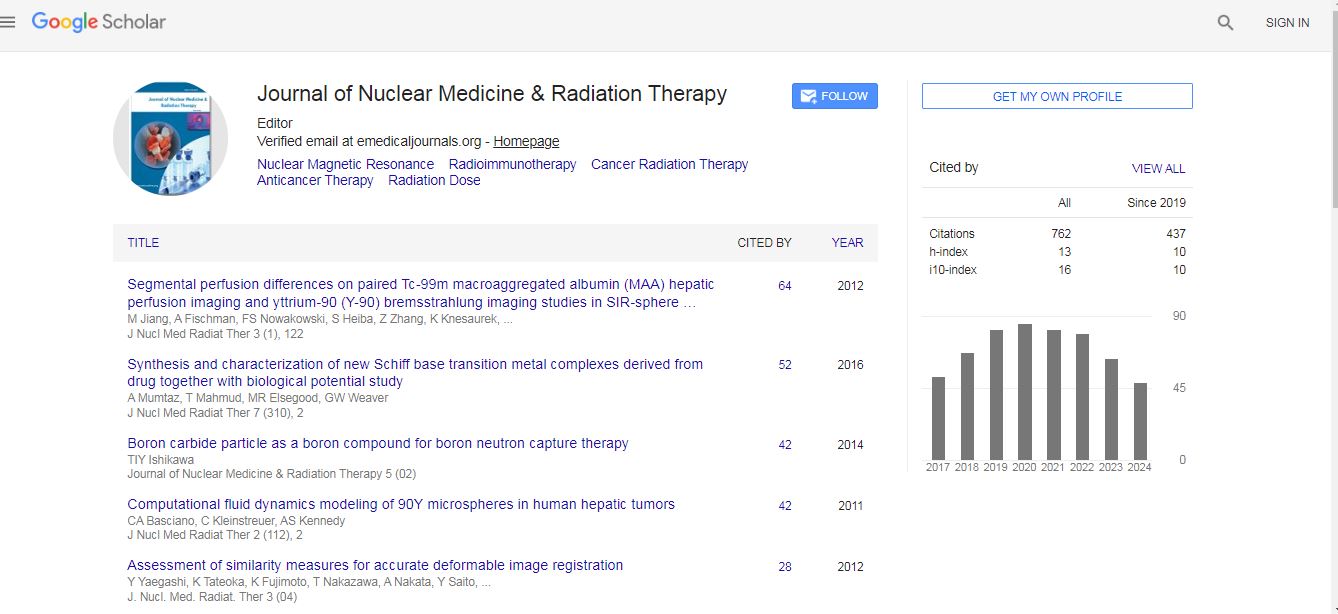
Nuclear Medicine & Radiation Therapy received 706 citations as per Google Scholar report