Short Communication - (127) Volume 15, Issue 2
Received: 02-Jun-2025, Manuscript No. jttr-25-175399;
Editor assigned: 04-Jun-2025, Pre QC No. P-175399;
Reviewed: 18-Jun-2025, QC No. Q-175399;
Revised: 23-Jun-2025, Manuscript No. R-175399;
Published:
30-Jun-2025
, DOI: 10.37421/2161-0991.2025.15.304
Citation: Richter, Jonas E.. ”Advanced Personalized Transplant Matching Improves Outcomes.” J Transplant Technol Res 15 (2025):304.
Copyright: © 2025 Richter E. Jonas This is an open-access article distributed under the terms of the Creative Commons Attribution License, which permits unrestricted use, distribution and reproduction in any medium, provided the original author and source are credited.
When we talk about kidney transplantation, it's clear that going beyond just HLA matching is crucial. Recent research highlights how non-HLA antibodies and genetic factors play a significant role. What this really means is a more personalized approach, considering these deeper biological markers, can lead to better long-term outcomes for patients by reducing rejection risks [1].
The use of virtual crossmatch in kidney transplantation is a game-changer. It helps doctors make smarter decisions about donor-recipient compatibility without needing a physical sample for every potential match. Here's the thing: by predicting compatibility more accurately upfront, it really streamlines the process and helps ensure better graft survival, making the whole matching system more efficient [2].
For lung transplants, machine learning is stepping up to improve how we match donors and recipients. Instead of just traditional methods, these AI-driven approaches analyze vast amounts of data to predict success more precisely. What this means for patients is a better chance at long-term graft function and overall survival, making the matching process much more sophisticated [3].
ABO incompatible kidney transplantation used to be a major hurdle, but recent studies show it's becoming a viable option with good long-term outcomes. This multicenter research confirms that with careful desensitization protocols, we can expand the donor pool significantly. It allows more patients to receive a life-saving transplant, even when traditional blood type matching isn't possible [4].
In hematopoietic stem cell transplantation, pushing the boundaries of HLA matching is making a real difference. We're talking about advanced strategies that delve deeper into HLA compatibility, which translates to fewer complications and better engraftment for patients. This meticulous matching helps reduce the risk of graft-versus-host disease, greatly improving patient recovery and survival rates [5].
Heart transplantation is moving towards highly personalized donor-recipient matching, looking beyond just the traditional criteria. This means considering a broader range of factors to find the absolute best match for each individual patient. By doing so, we're seeing improved outcomes and longer graft survival, which is crucial for such a vital organ transplant [6].
Using genomic risk scoring is a promising new way to enhance donor-recipient matching in kidney transplantation. This method leverages genetic data to better predict compatibility and potential rejection risks. The upside here is a more informed matching process, potentially leading to significantly improved graft survival rates and fewer complications after the transplant [7].
Let's talk about the ethical side of things when it comes to donor-recipient matching. As we get more sophisticated with algorithms and data, understanding the ethical implications of organ allocation becomes paramount. This research brings up important questions about fairness, transparency, and equity in how these life-saving resources are distributed, ensuring that technology serves all patients justly [8].
Before a transplant, a thorough risk assessment paired with an understanding of donor-recipient immune compatibility is vital for customizing immunosuppression. This approach helps tailor the medication regimen to each patient's specific needs, which means better prevention of rejection without over-immunosuppression. Ultimately, this leads to a safer and more effective transplant journey [9].
Measuring donor-derived cell-free DNA (dd-cfDNA) is proving to be a powerful tool for monitoring graft health and optimizing donor-recipient matching, especially in liver transplantation. It acts as an early warning system for rejection, allowing clinicians to intervene quickly. What this really means is better surveillance and more personalized care, ultimately improving outcomes for liver transplant recipients [10].
The field of organ transplantation is undergoing a profound transformation, moving beyond conventional matching protocols towards highly personalized and predictive strategies. A core aspect of this evolution involves expanding the criteria for donor-recipient compatibility. In kidney transplantation, for instance, the focus has shifted past basic Human Leukocyte Antigen (HLA) matching to incorporate non-HLA antibodies and various genetic factors [1]. This deeper biological understanding underpins a more individualized approach, aiming to improve long-term patient outcomes by significantly reducing the risks of rejection. This personalization extends to heart transplantation as well, where matching now considers a broader array of factors beyond traditional criteria to ensure the best possible match for each patient, leading to improved outcomes and extended graft survival [6]. Leveraging genomic risk scoring further enhances compatibility prediction in kidney transplantation by analyzing genetic data to anticipate potential rejection risks, facilitating a more informed matching process and potentially improving graft survival and reducing complications [7].
Technological advancements are revolutionizing how compatibility is assessed, making processes more efficient and accurate. Virtual crossmatch in kidney transplantation stands out as a significant innovation, allowing clinicians to make informed decisions about compatibility without the need for a physical sample for every potential pairing [2]. This method predicts compatibility more accurately upfront, streamlining the entire matching system and contributing to better graft survival. In a different but equally impactful vein, lung transplantation is benefiting from Machine Learning (ML) techniques. These Artificial Intelligence (AI)-driven approaches analyze vast datasets to predict transplant success with greater precision than traditional methods, ultimately offering patients a better chance at long-term graft function and overall survival through a more sophisticated matching process [3].
Another critical area of progress involves expanding the donor pool by overcoming traditional compatibility barriers. A prime example is ABO incompatible kidney transplantation. What was once considered a major hurdle is now a viable option, showing good long-term outcomes with the implementation of careful desensitization protocols [4]. This multi-center research confirms that such strategies can dramatically increase the number of available donors, allowing more patients to receive life-saving transplants even when traditional blood type matching isn't possible.
Deeper immunological understanding and advanced monitoring tools are also playing pivotal roles. In hematopoietic stem cell transplantation, advanced HLA matching strategies are crucial. By delving deeper into HLA compatibility, these approaches lead to fewer post-transplant complications and improved engraftment rates. This meticulous matching significantly mitigates the risk of graft-versus-host disease, thereby enhancing patient recovery and survival [5]. Similarly, in liver transplantation, measuring donor-derived cell-free DNA (dd-cfDNA) has emerged as a powerful biomarker. It serves as an early warning system for rejection, enabling rapid clinical intervention, which translates to better surveillance and personalized care, and ultimately, improved outcomes for recipients [10].
Beyond the initial matching, a thorough pre-transplant risk assessment combined with an understanding of donor-recipient immune compatibility is essential for personalizing immunosuppression regimens [9]. This tailored approach ensures that medication dosages are optimized for each patientâ??s specific needs, effectively preventing rejection without leading to over-immunosuppression. This careful balance results in a safer and more effective transplant journey for patients.
As these matching technologies grow in sophistication, the ethical landscape of organ allocation becomes an increasingly important consideration [8]. The development and implementation of advanced algorithms for donor-recipient matching raise vital questions concerning fairness, transparency, and equity in the distribution of these life-saving organs. Ensuring that technology serves all patients justly remains a paramount concern in this evolving field.
Donor-recipient matching in transplantation is evolving rapidly, moving past traditional HLA methods towards highly personalized and sophisticated approaches. For kidney transplants, this means looking beyond standard HLA matching to include non-HLA antibodies and genetic factors, promising better long-term outcomes and reduced rejection risks. The introduction of virtual crossmatch also streamlines the process, predicting compatibility more accurately and ensuring better graft survival. What's more, ABO incompatible kidney transplantation, once a major challenge, is now a viable option with careful desensitization, significantly expanding the donor pool. New methods like genomic risk scoring and monitoring donor-derived cell-free DNA (dd-cfDNA) further enhance compatibility prediction and graft health surveillance, particularly in kidney and liver transplants. Meanwhile, other organs are seeing similar advancements. Lung transplantation benefits from Machine Learning (ML) approaches, which analyze vast data to predict success more precisely, improving graft function and survival. In hematopoietic stem cell transplantation, advanced HLA strategies are reducing complications and improving engraftment by minimizing graft-versus-host disease. Heart transplantation is also adopting highly personalized matching, considering a broader range of factors for optimal outcomes and longer graft survival. Across all types, pre-transplant risk assessment and personalized immunosuppression are crucial for tailoring medication regimens, preventing rejection, and ensuring a safer transplant journey. The ethical implications of these advanced matching algorithms are also a key focus, emphasizing fairness, transparency, and equity in organ allocation. These collective efforts aim to optimize matching processes, improve patient outcomes, and expand transplant accessibility.
None
None
Amrita S, Rajesh K, Sanjay S. "Donor-Recipient Matching in Kidney Transplantation Beyond HLA: A Focus on Non-HLA Antibodies and Genetic Factors".Transpl Int 36 (2023):114002.
Indexed at, Google Scholar, Crossref
Sarah JPW, David AJ, Michael RJ. "The Role of Virtual Crossmatch in Optimizing Donor-Recipient Matching for Kidney Transplantation".Am J Transplant 22 (2022):2223-2233.
Indexed at, Google Scholar, Crossref
Emily RP, Benjamin JS, Charles LD. "Machine Learning Approaches for Predictive Donor-Recipient Matching in Lung Transplantation".J Heart Lung Transplant 40 (2021):1335-1344.
Indexed at, Google Scholar, Crossref
Lena S, Oliver M, Klaus R. "Impact of ABO Incompatible Kidney Transplantation on Long-Term Outcomes: A Multicenter Study".Nephrol Dial Transplant 35 (2020):1776-1784.
Indexed at, Google Scholar, Crossref
David RS, Jennifer AM, Kevin LC. "Advanced HLA Matching Strategies and Their Clinical Implications in Hematopoietic Stem Cell Transplantation".Bone Marrow Transplant 58 (2023):387-396.
Indexed at, Google Scholar, Crossref
Maria JR, Carlos FP, Sofia GL. "Personalized Donor-Recipient Matching in Heart Transplantation: Beyond Traditional Criteria".Circ Heart Fail 17 (2024):e011123.
Indexed at, Google Scholar, Crossref
Thomas KW, Sarah LG, Paul MB. "Genomic Risk Scoring for Improved Donor-Recipient Matching in Kidney Transplantation".CJASN 17 (2022):853-863.
Indexed at, Google Scholar, Crossref
David AM, Rebecca ST, John FL. "The Ethical Landscape of Donor-Recipient Matching Algorithms in Organ Allocation".Am J Bioeth 21 (2021):23-34.
Indexed at, Google Scholar, Crossref
Anna KS, Erik MJ, Lars PN. "Pre-transplant Risk Assessment and Personalized Immunosuppression Based on Donor-Recipient Immune Compatibility".Transplantation 104 (2020):2519-2528.
Indexed at, Google Scholar, Crossref
Oliver WS, Emma CB, Alex JD. "Donor-Derived Cell-Free DNA as a Biomarker for Graft Health and Donor-Recipient Matching in Liver Transplantation".Liver Transpl 29 (2023):1032-1043.
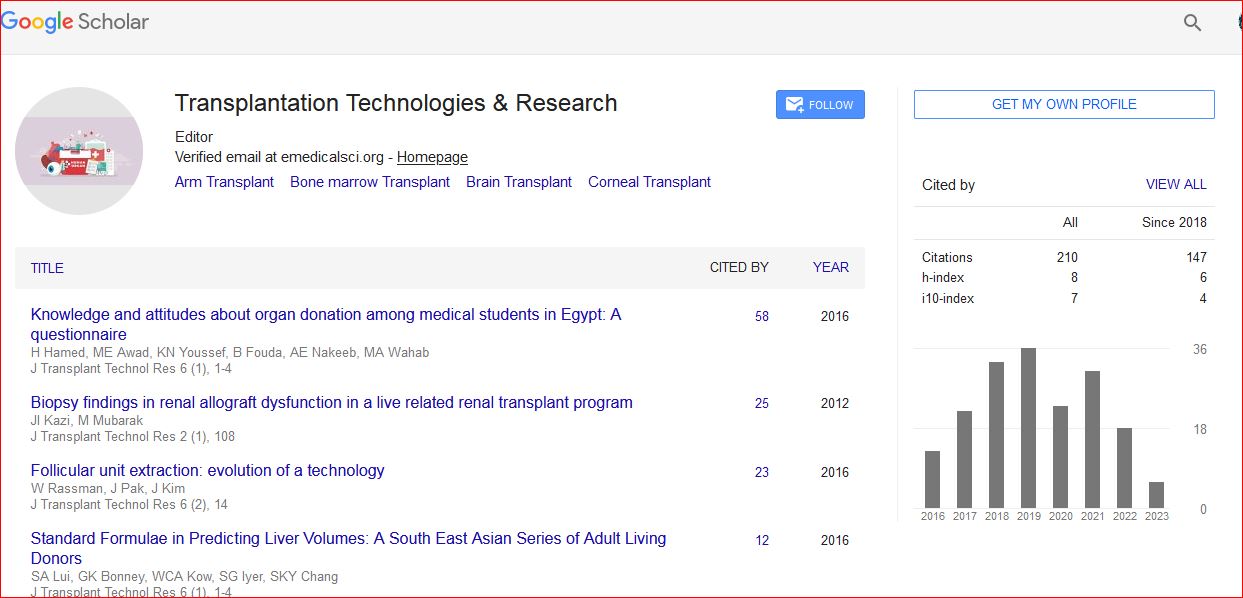
Transplantation Technologies & Research received 223 citations as per Google Scholar report