Opinion - (2025) Volume 14, Issue 6
Received: 01-Dec-2025, Manuscript No. jees-26-187952;
Editor assigned: 03-Dec-2025, Pre QC No. P-187952;
Reviewed: 17-Dec-2025, QC No. Q-187952;
Revised: 22-Dec-2025, Manuscript No. R-187952;
Published:
29-Dec-2025
, DOI: 10.37421/2332-0796.2025.14.211
Citation: Dupont, Paul. ”Advanced Control Techniques for Electrical
Drives.” J Electr Electron Syst 14 (2025):211.
Copyright: © 2025 Dupont P. This is an open-access article distributed under the terms of the Creative Commons Attribution License, which permits unrestricted use,
distribution and reproduction in any medium, provided the original author and source are credited.
The field of electrical drives has witnessed significant advancements, particularly in the development and application of sophisticated control strategies. These strategies are paramount for enhancing performance, improving efficiency, and ensuring robustness in various industrial and automotive applications.
Model Predictive Control (MPC) and Adaptive Control have emerged as powerful tools for optimizing the dynamic response and energy consumption of electrical drives. Their ability to anticipate future system behavior and adjust control actions accordingly makes them ideal for complex scenarios. Sliding Mode Control (SMC) offers inherent robustness against disturbances and parameter variations, making it a compelling choice for applications where precise and reliable control is critical. Techniques for mitigating chattering are crucial for its practical implementation. Fuzzy Logic Control provides a model-free approach to control, allowing for precise speed and position control of induction motor drives. Its ability to adapt to changing load dynamics without relying on an exact motor model is a significant advantage. Adaptive predictive control schemes are being developed to address the challenges posed by varying vehicle parameters and external disturbances in electric vehicle drivetrains. Online parameter estimation within a predictive framework is key to optimizing performance. Neural network-based control strategies, such as direct torque control (DTC) for induction motors, are showing promise in achieving faster dynamic response and reduced torque ripple. Recurrent neural networks are being employed for optimal switching signal prediction. Field-oriented control (FOC) combined with adaptive backstepping techniques is being explored for controlling brushless DC (BLDC) motors. This integration aims to enhance robustness against sensor faults and parameter drifts. Model-Free Adaptive Control (MFAC) presents a paradigm shift by eliminating the need for an accurate motor model. Its online parameter adjustment capabilities lead to improved dynamic characteristics and disturbance rejection. Reinforcement learning (RL) is emerging as a powerful technique for optimizing the control of multi-phase electrical drives. RL agents can learn optimal control policies in real-time to maximize efficiency and minimize torque ripple. A comparative analysis of various advanced control techniques, including MPC, SMC, and fuzzy control, is essential for understanding their suitability for different direct drive applications. Such studies provide valuable insights into their performance characteristics.Advanced control strategies like Model Predictive Control (MPC) and Adaptive Control are being utilized to elevate the performance and efficiency of electrical drives. These techniques are instrumental in improving dynamic response, minimizing energy usage, and guaranteeing stable operation even when faced with fluctuating load conditions or parameter uncertainties. The focus often lies on the practical hurdles of implementation and the potential gains in industrial and electric vehicle settings [1].
The application of sliding mode control (SMC) to permanent magnet synchronous motor (PMSM) drives is a subject of significant research, particularly due to its inherent resilience to external disturbances and variations in motor parameters. Efforts are being made to develop effective methods for reducing chattering and employing higher-order SMC for enhanced tracking accuracy and smoother control [2].
Fuzzy logic-based control is being investigated for its effectiveness in achieving precise speed and position control in induction motor drives. The design of fuzzy controllers that can adapt to dynamic load changes is a key aspect, aiming to improve transient responses and steady-state accuracy without requiring a detailed mathematical model of the motor [3].
An adaptive predictive control scheme tailored for electric vehicle drivetrains addresses the complexities arising from changing vehicle parameters, such as battery state of charge and motor efficiency, as well as external disturbances. This approach employs online parameter estimation within a predictive control framework to optimize energy efficiency and driving performance [4].
A novel neural network-based direct torque control (DTC) strategy is being introduced for induction motors. This innovative approach utilizes a recurrent neural network (RNN) to predict optimal switching signals, with the goal of achieving superior dynamic response, reduced torque ripple, and improved efficiency compared to conventional DTC methods [5].
The integration of field-oriented control (FOC) with adaptive backstepping techniques is being examined for controlling brushless DC (BLDC) motors. The primary objective of this synergistic approach is to bolster robustness against sensor failures and parameter drifts, thereby ensuring reliable operation in safety-critical applications [6].
A model-free adaptive control (MFAC) approach is being proposed for PMSM drives, which circumvents the need for an accurate motor model. This control strategy dynamically adjusts its parameters online based on the system's performance, leading to enhanced dynamic characteristics and superior disturbance rejection capabilities [7].
Research is exploring the application of reinforcement learning (RL) for the optimization of control in multi-phase electrical drives. The development of RL agents capable of learning optimal control policies in real-time is crucial for maximizing efficiency and minimizing torque ripple under dynamic operating conditions [8].
A comparative analysis is being conducted on various advanced control techniques, including MPC, SMC, and fuzzy control, specifically for direct drive systems. This research evaluates their performance in terms of speed regulation, disturbance rejection, and power consumption, offering valuable insights into the suitability of each method for different direct drive applications [9].
This work examines the development of a robust adaptive speed controller for switched reluctance motors (SRMs) utilizing a disturbance observer-based methodology. The controller is designed to improve speed tracking accuracy and reduce torque ripple by effectively compensating for the inherent nonlinearities and uncertainties present in SRM operation [10].
This collection of research explores advanced control techniques for electrical drives, focusing on enhancing performance, efficiency, and robustness. Studies cover Model Predictive Control (MPC), Adaptive Control, Sliding Mode Control (SMC), Fuzzy Logic Control, Neural Network-based control, and Model-Free Adaptive Control (MFAC). Applications range from industrial drives to electric vehicle drivetrains and specialized motors like PMSMs, induction motors, BLDC, and SRMs. Key objectives include improving dynamic response, reducing energy consumption, mitigating torque ripple, and ensuring reliable operation under various uncertainties and disturbances. Comparative analyses and the integration of techniques like reinforcement learning are also highlighted.
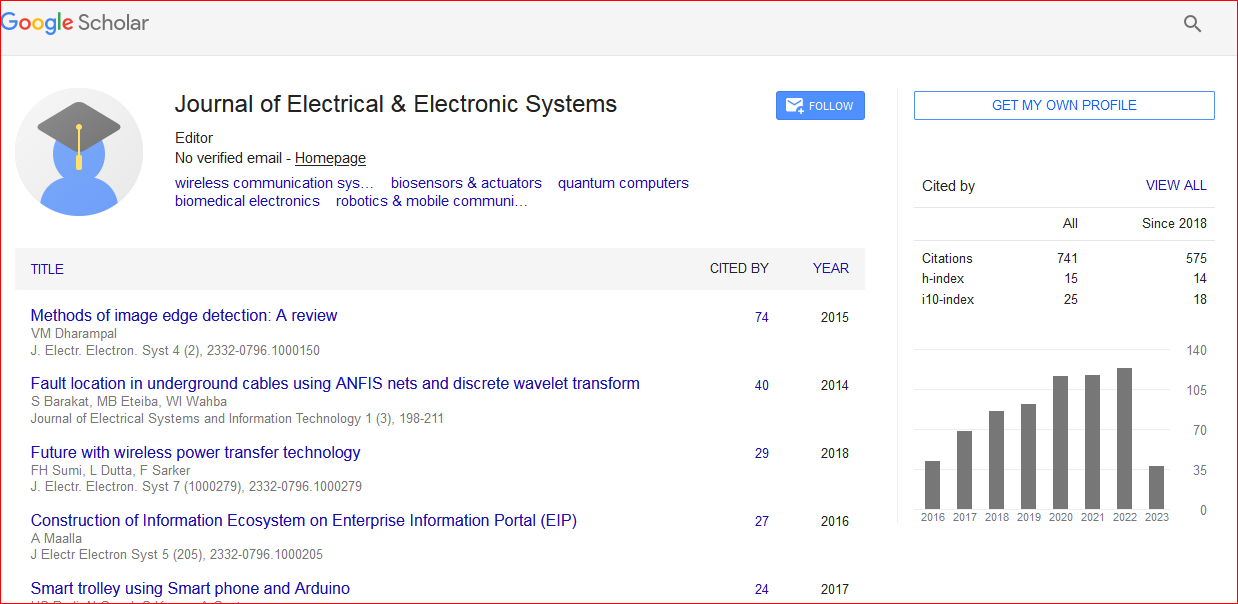
Journal of Electrical & Electronic Systems received 733 citations as per Google Scholar report