Opinion - (2025) Volume 16, Issue 4
Received: 01-Jul-2025, Manuscript No. jnmrt-26-186379;
Editor assigned: 03-Jul-2025, Pre QC No. P-186379;
Reviewed: 17-Jul-2025, QC No. Q-186379;
Revised: 22-Jul-2025, Manuscript No. R-186379;
Published:
29-Jul-2025
, DOI: 10.37421/2155-9619.2025.16.660
Citation: Lee, Jonathan. ”177Lu-PRRT: A Cornerstone for Advanced
Neuroendocrine Tumors.” J Nucl Med Radiat Ther 16 (2025):660.
Copyright: © 2025 Lee J. This is an open-access article distributed under the terms of the Creative Commons Attribution License, which permits unrestricted use, distribution
and reproduction in any medium, provided the original author and source are credited.
Lutetium-177 (177Lu) peptide receptor radionuclide therapy (PRRT) has emerged as a significant treatment option for advanced neuroendocrine tumors (NETs), particularly those expressing somatostatin receptors. This therapy involves targeting tumor cells expressing these receptors with a radiolabeled somatostatin analog, delivering cytotoxic radiation directly to the tumor. Studies demonstrate improved progression-free survival and overall survival in patients treated with 177Lu-PRRT compared to conventional therapies [1].
The NETTER-1 trial, a pivotal Phase 3 study, established the superiority of 177Lu-DOTATATE PRRT over high-dose octreotide in patients with metastatic well-differentiated midgut NETs. The trial showed a significant reduction in the risk of progression or death and a notable improvement in overall survival, solidifying 177Lu-PRRT as a standard of care for this patient population [2].
Beyond the NETTER-1 trial, real-world data from various centers further support the efficacy of 177Lu-PRRT in advanced NETs. These studies highlight consistent improvements in tumor control, symptom management, and quality of life across diverse patient groups and disease characteristics, reinforcing the therapeutic value of this approach [3].
The safety profile of 177Lu-PRRT is generally favorable, with the most common side effects being transient hematologic toxicity and mild gastrointestinal symptoms. Careful patient selection and monitoring are crucial to minimize potential adverse events and optimize treatment outcomes [4].
Personalized dosimetry plays an increasingly important role in optimizing 177Lu-PRRT. Tailoring radiation dose based on individual tumor and organ uptake can potentially enhance therapeutic efficacy while further improving safety, although standardized approaches are still evolving [5].
The selection criteria for 177Lu-PRRT are critical for achieving optimal outcomes. Patients with somatostatin receptor-positive, well-differentiated, and progressive NETs are the primary candidates, with performance status and adequate organ function being essential considerations [6].
The combination of 177Lu-PRRT with other systemic therapies, such as chemotherapy or targeted agents, is an area of active research. Preliminary findings suggest potential synergistic effects, which could further enhance treatment response and overcome resistance mechanisms in advanced NETs [7].
The evolving role of molecular imaging, particularly with Gallium-68 (68Ga) somatostatin receptor PET/CT, is crucial for patient selection for 177Lu-PRRT. High somatostatin receptor expression visualized on PET/CT is a strong predictor of treatment response [8].
Long-term follow-up data for patients treated with 177Lu-PRRT are essential for understanding the durability of response and identifying late toxicities. Ongoing studies are providing valuable insights into the long-term outcomes of this therapy [9].
The development of novel radioligands and therapeutic isotopes is ongoing, aiming to expand the applicability of PRRT to tumors with lower somatostatin receptor expression or different targetable receptors. This innovation holds promise for treating a broader spectrum of NETs and other malignancies [10].
Lutetium-177 (177Lu) peptide receptor radionuclide therapy (PRRT) has emerged as a significant treatment option for advanced neuroendocrine tumors (NETs), particularly those expressing somatostatin receptors. This therapy involves targeting tumor cells expressing these receptors with a radiolabeled somatostatin analog, delivering cytotoxic radiation directly to the tumor. Studies demonstrate improved progression-free survival and overall survival in patients treated with 177Lu-PRRT compared to conventional therapies [1].
The NETTER-1 trial, a pivotal Phase 3 study, established the superiority of 177Lu-DOTATATE PRRT over high-dose octreotide in patients with metastatic well-differentiated midgut NETs. The trial showed a significant reduction in the risk of progression or death and a notable improvement in overall survival, solidifying 177Lu-PRRT as a standard of care for this patient population [2].
Beyond the NETTER-1 trial, real-world data from various centers further support the efficacy of 177Lu-PRRT in advanced NETs. These studies highlight consistent improvements in tumor control, symptom management, and quality of life across diverse patient groups and disease characteristics, reinforcing the therapeutic value of this approach [3].
The safety profile of 177Lu-PRRT is generally favorable, with the most common side effects being transient hematologic toxicity and mild gastrointestinal symptoms. Careful patient selection and monitoring are crucial to minimize potential adverse events and optimize treatment outcomes [4].
Personalized dosimetry plays an increasingly important role in optimizing 177Lu-PRRT. Tailoring radiation dose based on individual tumor and organ uptake can potentially enhance therapeutic efficacy while further improving safety, although standardized approaches are still evolving [5].
The selection criteria for 177Lu-PRRT are critical for achieving optimal outcomes. Patients with somatostatin receptor-positive, well-differentiated, and progressive NETs are the primary candidates, with performance status and adequate organ function being essential considerations [6].
The combination of 177Lu-PRRT with other systemic therapies, such as chemotherapy or targeted agents, is an area of active research. Preliminary findings suggest potential synergistic effects, which could further enhance treatment response and overcome resistance mechanisms in advanced NETs [7].
The evolving role of molecular imaging, particularly with Gallium-68 (68Ga) somatostatin receptor PET/CT, is crucial for patient selection for 177Lu-PRRT. High somatostatin receptor expression visualized on PET/CT is a strong predictor of treatment response [8].
Long-term follow-up data for patients treated with 177Lu-PRRT are essential for understanding the durability of response and identifying late toxicities. Ongoing studies are providing valuable insights into the long-term outcomes of this therapy [9].
The development of novel radioligands and therapeutic isotopes is ongoing, aiming to expand the applicability of PRRT to tumors with lower somatostatin receptor expression or different targetable receptors. This innovation holds promise for treating a broader spectrum of NETs and other malignancies [10].
177Lu-PRRT is an effective treatment for advanced neuroendocrine tumors (NETs), particularly those expressing somatostatin receptors. The NETTER-1 trial demonstrated its superiority over conventional therapies, leading to improved progression-free and overall survival. Real-world data confirm these benefits, showing enhanced tumor control, symptom management, and quality of life. The therapy is generally safe, with manageable side effects requiring careful patient selection and monitoring. Personalized dosimetry is crucial for optimizing efficacy and safety. Selection criteria focus on somatostatin receptor-positive, well-differentiated, progressive NETs with adequate organ function. Research is exploring combination therapies and novel radiopharmaceuticals to broaden PRRT's applicability. Molecular imaging, like 68Ga-somatostatin receptor PET/CT, is vital for patient selection and predicting treatment response. Long-term follow-up data are essential for understanding durability and late toxicities.
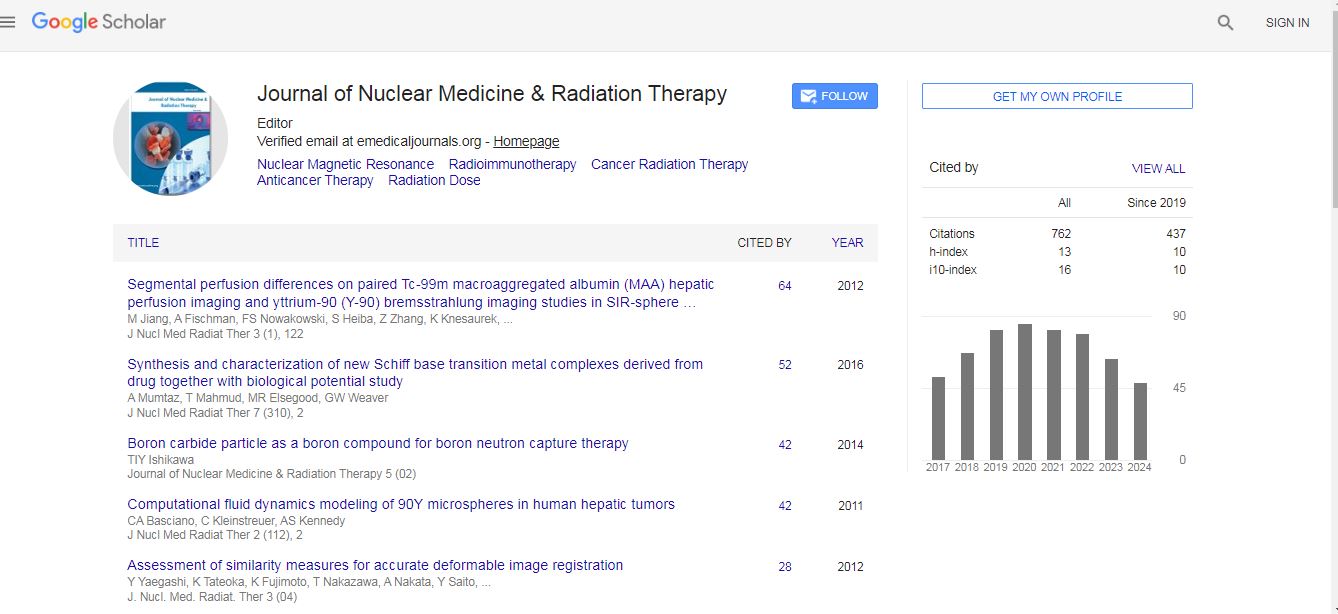
Nuclear Medicine & Radiation Therapy received 706 citations as per Google Scholar report