DOI: 10.37421/2161-0959.2025.15.555
Baris Doner, Tuncay Sahutoglu, Ekrem Kara, Emrah Erkan Mazı and Cuneyt Akgol
DOI: 10.37421/2161-0959.2025.15.552
Objective: This study aimed to investigate the impact of catheter lock solutions in hemodialysis catheters on colonization and explore other factors influencing colonization.
Methods: A total of 73 consecutive patients were prospectively included in the study. Demographic data, etiology, catheter insertion site, number of hemodialysis sessions, duration of catheter use, and history of coronary artery disease, anticoagulant, and antilipidemic drug usage were recorded. Nasal cultures were obtained, and patients were divided into two groups based on the catheter lock solutions used: heparin and 30% trisodium citrate. The frequency of colonization, culture results, and factors affecting colonization were compared between the two solution groups.
Results: A total of 67 catheters were inserted in 59 patients. The mean follow-up duration was 25.4 ± 27.02 (7-113) days, and the mean number of hemodialysis sessions was 10.9 ± 10.8 (2-46) times. Thirty-two catheters in 29 patients were closed with heparin, while 35 catheters in 30 patients were closed with citrate. The heparin group had a longer catheter duration and a higher number of dialysis sessions compared to the citrate group (p<0.005 for both). The presence of systemic infections and nasal carriage was similar between the two groups (p>0.005 for both). The culture positivity rate was 34% in the heparin group and 23% in the citrate group (p: 0.46). The infection rate was higher in jugular catheters closed with heparin and femoral catheters closed with citrate. A significant correlation was observed between catheter tip colonization and a history of infection in the heparin group (r: 0.405, p: 0.02), and between colonization and catheter localization in the citrate group (r: 0.440, p: 0.008).
Conclusion: Catheter lock solutions did not have a significant effect on the frequency of catheter colonization. The site of catheter insertion, duration of catheter use, and systemic infectious status were identified as factors influencing catheter colonization in temporary hemodialysis catheters.
Fredrick Mashili, Alexander Tungu and Maryam Hamad
DOI: 10.37421/2161-0959.2025.15.553
Background: Chronic Kidney Disease (CKD) is an abnormality of kidney structure or function that is present for more than 3 months, resulting in a progressive loss of renal function that can occur over a year. It is a global public health concern affecting around 9.1% of the total global population. In Sub-Saharan Africa (SSA), more than 16% of the population is affected by CKD. Most of the published papers focused more on explaining the prevalence of Chronic Kidney Disease (CKD) regardless of sex differences. No or little study in Zanzibar has explained CKD and its associated factors based on gender. So, this study aimed to address the prevalence of CKD patients based on sex criteria and further determined the risk factors associated with the development of Gender based CKD.
Methods: This cross-sectional prospective study was conducted at Mnazi Mmoja Referral Hospital in Zanzibar. Consecutive sampling was used as the only technique to obtain participants. A standard questionnaire and patient files were used to capture the demographic, clinical characteristics, and risk factors data respectively. SPSS was used to analyze the data. A frequency distribution table was used to calculate the prevalence. Chi-square as well as relative Risk were used to determine the association between factors and gender based CKD.
Results: A total of 97 patients participated in the study. The prevalence of males and females CKD was 57.1% and 42.3% respectively. The mean age of all study participants was 49 ± 12 years respectively, where males’ and females’ mean age were 50 ± 12 and 46 ± 10 years. The majority of the females with CKD were in between 36-45 years while males were 45-60 years. Most of the CKDs were secondary school graduators (M: F=58.9:61). Older age >60 years for males CKD and 36-45 years for females’ age was identified as a statistically significant risk factor for developing a CKD (p<0.05). Hypertension and diabetes were also identified as the risk factors mostly for males than females although the finding was not statistically significant (p>0.05).
Conclusion: The study observed a higher prevalence of male CKD than did females. Factors like old age, hypertension and diabetes were more associated with male's CKD than females. Young females 36-45 years old were identified as a risk factor for the progression of CKD for females.
Aarav K. Mehta
DOI: 10.37421/2161-0959.2025.15.551
Lina Sorensen
DOI: 10.37421/2161-0959.2025.15.552
DOI: 10.37421/2161-0959.2025.15.553
DOI: 10.37421/2161-0959.2025.15.556
DOI: 10.37421/2161-0959.2025.15.557
DOI: 10.37421/2161-0959.2025.15.558
DOI: 10.37421/2161-0959.2025.15.559
DOI: 10.37421/2161-0959.2025.15.560
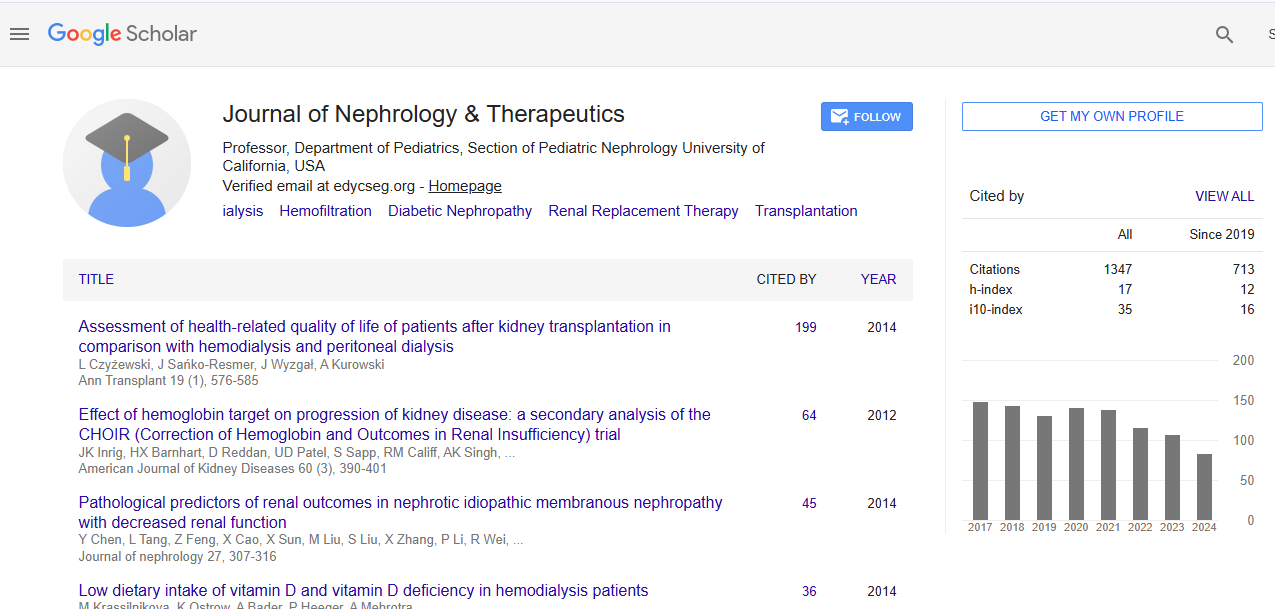
Journal of Nephrology & Therapeutics received 784 citations as per Google Scholar report

 Spanish
  Chinese
  Russian
  German
  French
  Japanese
  Portuguese
  Hindi
Hindi 