Perspective - (2025) Volume 15, Issue 2
Received: 02-Mar-2025, Manuscript No. jnt-26-178927;
Editor assigned: 04-Mar-2025, Pre QC No. P-178927;
Reviewed: 18-Mar-2025, QC No. Q-178927;
Revised: 24-Mar-2025, Manuscript No. R-178927;
Published:
31-Mar-2025
, DOI: 10.37421/2161-0959.2025.15.557
Citation: Gruber, Felix. ”Renal Therapies: Innovations For Better Outcomes.” J Nephrol Ther 15 (2025):557.
Copyright: © 2025 Gruber F. This is an open-access article distributed under the terms of the Creative Commons Attribution License, which permits unrestricted use, distribution and reproduction in any medium, provided the original author and source are credited.
Recent advancements in renal replacement therapies and dialysis modalities are significantly improving patient outcomes and quality of life. This includes innovations in hemodialysis technology, such as wearable artificial kidneys and more efficient dialyzer membranes, alongside the expansion of peritoneal dialysis techniques and home-based therapies. The focus is increasingly on personalized treatment strategies, leveraging technology to better manage fluid balance, electrolyte levels, and uremic toxin clearance, while minimizing treatment burden and complications. Furthermore, ongoing research into bioengineered kidneys and regenerative medicine holds promise for future definitive treatments [1].
The development of wearable and portable hemodialysis devices is transforming the landscape of kidney replacement therapy, offering greater freedom and flexibility for patients. These devices aim to mimic physiological dialysis by allowing for continuous or frequent, lower-volume treatments, which can lead to better fluid management and toxin removal compared to conventional intermittent hemodialysis. Challenges remain in miniaturization, power sources, and patient training, but the potential for improved quality of life is substantial [2].
Improvements in dialyzer membrane technology, including advancements in materials and surface modifications, are enhancing the efficiency and biocompatibility of hemodialysis. Newer membranes offer better solute clearance, reduced protein adsorption, and lower inflammatory responses, contributing to improved patient tolerance and long-term outcomes. Research continues to focus on developing membranes that can effectively remove middle and large molecules, which are poorly cleared by conventional hemodialysis [3].
Peritoneal dialysis (PD) is experiencing a resurgence due to technological refinements and a growing appreciation for its home-based, flexible nature. Innovations include improved PD solutions with better biocompatibility, advanced cycler technology for automated PD, and novel catheter designs to reduce infection rates. PD offers significant advantages in terms of fluid and electrolyte control, cardiovascular stability, and patient autonomy, making it an attractive option for a broader patient population [4].
Home-based dialysis therapies, including both hemodialysis and peritoneal dialysis, are gaining traction as they empower patients with greater control over their treatment schedule and location. This shift is supported by technological advancements that simplify dialysis delivery and monitoring outside of a clinical setting. Successful implementation requires robust patient education, comprehensive support systems, and reliable technology, leading to improved adherence and patient satisfaction [5].
Personalized dialysis treatment, tailored to the individual patient's needs and physiological profile, is becoming increasingly important. This approach moves beyond a one-size-fits-all model, considering factors such as residual renal function, comorbidity, and lifestyle. Advanced monitoring techniques and data analytics are being used to optimize dialysis dose, fluid management, and nutrient delivery, leading to improved clinical outcomes and reduced complications [6].
The integration of artificial intelligence (AI) and machine learning (ML) in nephrology offers powerful tools for optimizing dialysis treatments. AI can analyze vast datasets to predict patient responses, identify optimal dialysis parameters, and detect early signs of complications. This data-driven approach enhances treatment efficacy, reduces adverse events, and supports the development of more personalized and predictive care models in renal replacement therapy [7].
Bioengineered kidneys and regenerative medicine represent the frontier of kidney replacement therapy. Research into generating functional kidney tissue from stem cells or utilizing bio-scaffolds offers the long-term prospect of a biological solution to kidney failure, potentially eliminating the need for dialysis altogether. While still in early stages, these advancements hold immense promise for a definitive cure and reduced treatment burden [8].
The management of fluid balance in dialysis patients remains a critical challenge. Advanced bioimpedance spectroscopy and sophisticated fluid management systems are being developed to accurately assess and manage extracellular fluid volume, aiming to reduce the incidence of both volume overload and dehydration, which are associated with significant morbidity and mortality [9].
Improving the biocompatibility of dialysis materials is crucial for long-term patient health. Research into novel biomaterials and surface treatments for dialyzers and other dialysis equipment aims to reduce inflammatory responses, minimize complement activation, and prevent biofouling. This leads to better patient tolerance, reduced risk of infection, and improved overall outcomes in chronic dialysis patients [10].
Significant progress in renal replacement therapies and dialysis techniques is enhancing patient well-being and life quality. Innovations in hemodialysis, including wearable artificial kidneys and improved dialyzer membranes, are crucial. Simultaneously, peritoneal dialysis methods and home-based therapies are expanding. A key trend is the development of personalized treatment plans that utilize technology for precise management of fluid balance, electrolytes, and uremic toxins, aiming to reduce patient burden and complications. Promising future directions include bioengineered kidneys and regenerative medicine for potential definitive cures [1].
Wearable and portable hemodialysis devices are revolutionizing kidney replacement therapy by offering patients unprecedented freedom and flexibility. These devices are designed to replicate physiological dialysis through continuous or frequent, lower-volume treatments. This approach can result in superior fluid management and toxin clearance compared to traditional intermittent hemodialysis. While challenges related to miniaturization, power supply, and patient training persist, the potential for enhanced quality of life is considerable [2].
Advancements in dialyzer membrane technology, particularly in materials science and surface modification, are leading to more efficient and biocompatible hemodialysis. Modern membranes exhibit enhanced solute clearance, reduced protein adsorption, and diminished inflammatory responses, contributing to improved patient tolerance and long-term health outcomes. Ongoing research is dedicated to creating membranes capable of effectively clearing larger molecules, which are often poorly removed by standard hemodialysis protocols [3].
Peritoneal dialysis (PD) is experiencing renewed interest due to technological improvements and recognition of its benefits for home-based, flexible treatment. Key innovations include biocompatible PD solutions, sophisticated automated PD cyclers, and novel catheter designs aimed at reducing infection risks. PD offers substantial advantages in managing fluid and electrolytes, maintaining cardiovascular stability, and promoting patient autonomy, making it a viable option for a wider patient demographic [4].
Home-based dialysis modalities, encompassing both hemodialysis and peritoneal dialysis, are becoming increasingly popular as they provide patients with greater autonomy over their treatment timing and location. Technological developments are simplifying dialysis delivery and remote monitoring outside of clinical settings. Successful home dialysis relies on comprehensive patient education, strong support networks, and dependable technology, all of which contribute to better adherence and patient satisfaction [5].
Personalized dialysis, a treatment strategy tailored to individual patient characteristics and physiological status, is gaining prominence. This approach moves away from a generalized model, accounting for factors such as residual kidney function, coexisting conditions, and lifestyle. The use of advanced monitoring and data analysis tools allows for optimization of dialysis dosage, fluid management, and nutrient delivery, ultimately leading to improved clinical results and fewer complications [6].
The application of artificial intelligence (AI) and machine learning (ML) in nephrology presents powerful opportunities for enhancing dialysis treatments. AI can process extensive patient data to forecast treatment responses, determine optimal dialysis parameters, and identify early signs of complications. This data-driven methodology boosts treatment effectiveness, minimizes adverse events, and fosters the development of more personalized and predictive care strategies for renal replacement therapy [7].
Bioengineered kidneys and regenerative medicine represent the cutting edge of kidney replacement therapy development. Ongoing research focuses on creating functional kidney tissue from stem cells or using bio-scaffolds, aiming to provide a biological alternative to dialysis for kidney failure. Although these technologies are in their nascent stages, they hold significant potential for a permanent solution and a reduction in treatment-related burdens [8].
Effective fluid balance management in dialysis patients continues to be a critical clinical challenge. Innovations such as advanced bioimpedance spectroscopy and sophisticated fluid management systems are being developed to accurately assess and control extracellular fluid volume. The goal is to mitigate the risks associated with both fluid overload and dehydration, which are linked to considerable patient morbidity and mortality [9].
Enhancing the biocompatibility of materials used in dialysis is paramount for the long-term health of patients undergoing renal replacement therapy. Current research into novel biomaterials and surface treatments for dialyzers and related equipment aims to reduce inflammatory responses, minimize complement system activation, and prevent device biofouling. These efforts contribute to better patient tolerance, a lower risk of infection, and overall improved outcomes in individuals on chronic dialysis [10].
Recent advancements in renal replacement therapies and dialysis modalities are significantly improving patient outcomes and quality of life. Innovations in hemodialysis technology, such as wearable artificial kidneys and more efficient dialyzer membranes, are expanding treatment options. Peritoneal dialysis techniques and home-based therapies are also gaining traction, offering greater patient autonomy. The trend is towards personalized treatment strategies, leveraging technology to optimize fluid balance, electrolyte levels, and toxin clearance while minimizing treatment burden. Future research in bioengineered kidneys and regenerative medicine holds promise for definitive cures. Wearable devices offer enhanced flexibility, while improved dialyzer membranes boost efficiency. Home dialysis empowers patients with greater control. Personalized approaches and AI integration are optimizing treatments. Bioengineered kidneys represent a long-term biological solution. Effective fluid management and biocompatible materials remain key areas of focus to improve patient tolerance and long-term outcomes.
None
None
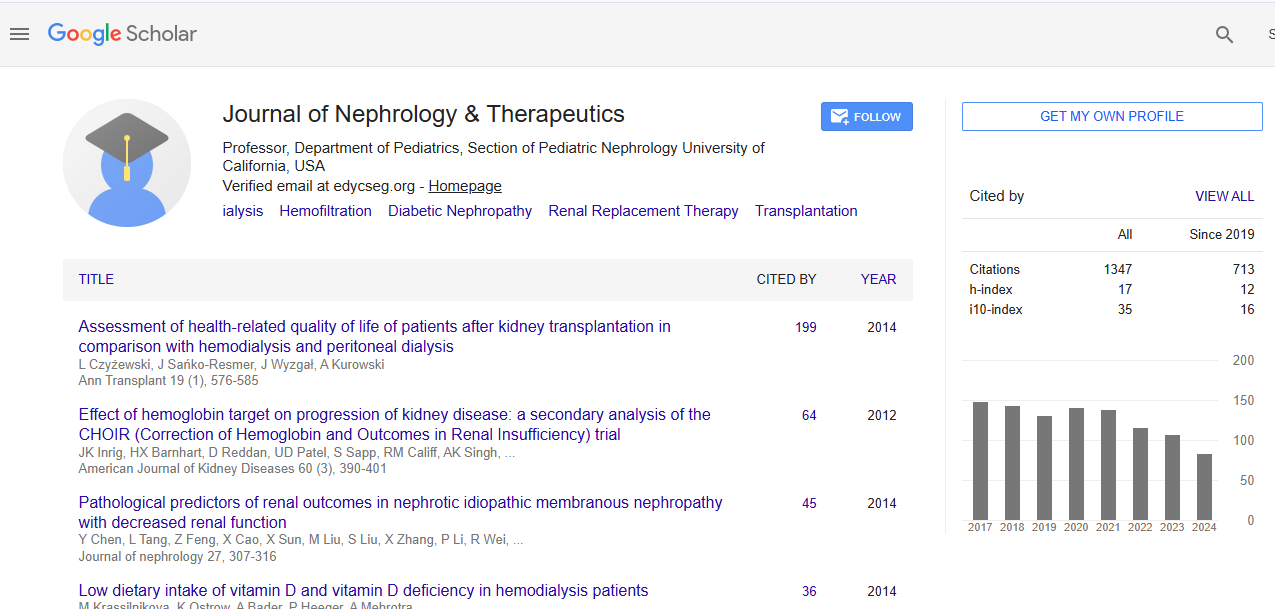
Journal of Nephrology & Therapeutics received 784 citations as per Google Scholar report