Commentary - (2025) Volume 15, Issue 2
Received: 02-Mar-2025, Manuscript No. jnt-26-178926;
Editor assigned: 04-Mar-2025, Pre QC No. P-178926;
Reviewed: 18-Mar-2025, QC No. Q-178926;
Revised: 24-Mar-2025, Manuscript No. R-178926;
Published:
31-Mar-2025
, DOI: 10.37421/2161-0959.2025.15.556
Citation: Nandini, Priya. ”Precision Medicine for Kidney Disease: Tailored Therapies.” J Nephrol Ther 15 (2025):556.
Copyright: © 2025 Nandini P. This is an open-access article distributed under the terms of the Creative Commons Attribution License, which permits unrestricted use,distribution and reproduction in any medium, provided the original author and source are credited.
Precision medicine in nephrology represents a significant paradigm shift in how kidney diseases are understood and managed. This approach moves beyond a one-size-fits-all methodology, focusing instead on tailoring treatments to the unique characteristics of each patient. These individual characteristics encompass a wide range of factors, including a patient's genetic makeup, their environmental exposures, and their lifestyle choices. The ultimate aim of this personalized strategy is to enhance the accuracy of diagnoses, provide more reliable predictions of disease progression, and optimize the effectiveness of therapeutic interventions for various renal conditions, such as chronic kidney disease (CKD) and glomerulonephritis. Key technological advancements like genomic profiling, the identification and utilization of specific biomarkers, and sophisticated imaging techniques are instrumental in this process. These tools allow for the discernment of particular molecular pathways that are active in disease states and the segmentation of patient populations into distinct subgroups. This detailed understanding then paves the way for the development and application of targeted therapies, which hold the promise of substantially improving patient outcomes [1].
The field of pharmacogenomics offers a particularly potent avenue for personalizing drug therapy within nephrology. By delving into an individual's genetic constitution, it becomes possible to understand how their specific genetic makeup influences the way their body metabolizes drugs and responds to them. This knowledge is invaluable in proactively avoiding adverse drug reactions, which can be particularly serious in patients with compromised kidney function. Furthermore, it allows for the optimization of treatment efficacy, ensuring that medications are as effective as possible. This personalized approach is especially critical for managing complex renal conditions that often require multiple medications, such as immunosuppressants used after transplantation or antihypertensive drugs for managing blood pressure. The careful consideration of genetic factors in drug selection and dosing is therefore crucial for enhancing patient safety and achieving the best possible therapeutic results [2].
Biomarkers play an indispensable role in the entire spectrum of kidney disease management, from early detection and accurate prognosis to continuous monitoring of disease activity and treatment response. While traditional markers like serum creatinine have long been used, there is a continuous effort to develop and validate novel biomarkers. These new markers are designed to offer more specific insights into the types of kidney insults occurring, the underlying pathological processes, and the likelihood of a patient responding to specific treatments. This relentless pursuit of precision diagnostics is fundamental to enabling earlier interventions when diseases are more manageable and to ensuring that therapeutic strategies are precisely aligned with the patient's specific condition, thereby maximizing their potential benefit [3].
Understanding the genetic predispositions that underlie various kidney diseases is rapidly advancing and has profound implications for precision nephrology. Conditions such as polycystic kidney disease and certain forms of glomerulonephritis are known to have a strong genetic component. The challenge and opportunity lie in translating this burgeoning genetic knowledge into tangible clinical practice. This involves the routine implementation of genetic testing and comprehensive genetic counseling. By identifying individuals who are at higher genetic risk for developing kidney diseases or specific subtypes of these conditions, clinicians can more effectively stratify patients. This risk stratification empowers both patients and their families to make more informed decisions regarding their health and potential management strategies [4].
In the complex and critical area of kidney transplantation, precision medicine approaches are being employed to optimize immunosuppressive therapy. This involves a detailed consideration of individual patient factors, which extend beyond basic clinical assessments. Key among these are the genetic profiles of both the organ donor and the recipient, as well as a thorough evaluation of the recipient's immunologic risk profile. By personalizing the immunosuppressive regimen, the aim is to significantly reduce the incidence of organ rejection, a major complication that can threaten graft survival. Concurrently, this tailored approach seeks to minimize the potentially serious side effects associated with broad-spectrum immunosuppression, thereby improving the long-term viability and function of the transplanted kidney [5].
The integration of artificial intelligence (AI) and machine learning (ML) is proving to be a revolutionary force in the advancement of precision nephrology. These sophisticated computational technologies possess the remarkable ability to analyze vast and complex datasets that would be otherwise intractable for human interpretation. By identifying intricate patterns and correlations within these datasets, AI and ML can provide powerful predictive capabilities regarding disease outcomes. Furthermore, they can serve as invaluable decision-support tools for clinicians, aiding in the complex process of determining the most appropriate and personalized care strategies for patients suffering from various kidney diseases. This technological augmentation enhances the overall quality and personalization of patient care [6].
Precision medicine is actively being explored and applied to a diverse array of glomerulonephritis subtypes, signaling a move away from generalized treatment paradigms. The core of this precision approach lies in the meticulous stratification of patients. This stratification is based on a deep understanding of their underlying immunologic profiles and specific genetic factors that may be contributing to their disease. Once these individual characteristics are clearly defined, clinicians are better equipped to select targeted therapies that are most likely to be effective. This leads to improved rates of remission and a reduced risk of disease progression, including the ultimate consequence of end-stage renal disease [7].
The economic landscape of precision medicine in nephrology presents a multifaceted picture. While the initial investments required for cutting-edge technologies such as genomic sequencing and advanced diagnostic platforms can be substantial, the long-term economic benefits are considerable. These benefits stem from the increased efficacy of personalized treatments, which lead to fewer complications and better overall patient outcomes. By avoiding costly complications and reducing the need for intensive, less effective interventions, precision medicine has the potential to generate significant cost savings within healthcare systems over time, making it a financially viable and beneficial approach in the long run [8].
A crucial area of focus within precision medicine research in nephrology is the development of novel therapeutic targets specifically for chronic kidney disease (CKD). The current understanding of CKD is that it is a complex and heterogeneous condition. By gaining a deeper insight into the specific molecular drivers that are responsible for disease progression in distinct patient populations, researchers can design and develop new drugs. These novel therapeutics are aimed at intervening at critical junctures in the disease process, with the goal of not only slowing down the progression of CKD but potentially even reversing some of its detrimental effects, thereby preserving kidney function for longer periods [9].
Finally, the successful implementation and adoption of precision medicine in nephrology are heavily reliant on the active engagement and comprehensive education of patients. Empowering patients with clear and accessible information about their unique genetic profile, the range of personalized treatment options available to them, and the potential outcomes associated with these treatments is paramount. This shared understanding fosters a collaborative approach to decision-making between patients and their healthcare providers. Furthermore, it significantly enhances patient adherence to complex therapeutic regimens, which is often a critical factor in achieving successful treatment outcomes and managing chronic kidney conditions effectively [10].
Precision medicine in nephrology represents a transformative approach focused on tailoring therapeutic strategies to individual patient characteristics, including genetic predispositions, environmental influences, and lifestyle factors. This personalized methodology aims to elevate diagnostic precision, enhance the prediction of disease trajectories, and optimize treatment responses for a spectrum of kidney ailments such as chronic kidney disease (CKD) and glomerulonephritis. The bedrock of this approach is the utilization of advanced tools like genomic profiling, the discovery and application of biomarkers, and sophisticated imaging modalities. These technologies are instrumental in elucidating specific molecular pathways involved in disease pathogenesis and in identifying distinct patient subgroups, thereby enabling the development and deployment of targeted therapies with the potential for significantly improved patient outcomes [1].
Pharmacogenomics, a key component of precision medicine, offers a substantial opportunity to individualize drug therapy in nephrology. By understanding the intricate interplay between an individual's genetic makeup and their response to medications, clinicians can proactively mitigate the risk of adverse drug reactions and bolster treatment efficacy. This personalized strategy is particularly vital for managing complex renal conditions, where drugs like immunosuppressants and antihypertensives are frequently prescribed. A pharmacogenomic approach ensures that these medications are used with maximum effectiveness and minimal risk, thereby safeguarding patient well-being and enhancing treatment success [2].
Biomarkers are indispensable for the comprehensive management of kidney diseases, playing critical roles in early detection, prognostic assessment, and therapeutic monitoring. Beyond conventional markers such as creatinine, ongoing research is dedicated to the development and validation of novel biomarkers. These emerging markers aim to provide more precise identification of specific kidney injuries and more accurate prediction of treatment responsiveness. This continuous advancement in precision diagnostics facilitates earlier therapeutic interventions and the implementation of highly targeted treatment strategies within nephrology, ultimately leading to better disease control [3].
The burgeoning understanding of genetic predispositions to kidney diseases, including conditions like polycystic kidney disease and certain forms of glomerulonephritis, is a cornerstone of precision nephrology. The effective translation of this genetic knowledge into clinical practice hinges on the widespread implementation of genetic testing and genetic counseling services. Through these avenues, clinicians can accurately stratify patients based on their genetic risk factors, enabling more informed decision-making for both patients and their families regarding disease management and prevention strategies [4].
In the realm of kidney transplantation, precision medicine is instrumental in optimizing immunosuppressive therapy. This personalized approach considers a multitude of individual factors, notably the genetic profiles of both the donor and the recipient, alongside a thorough assessment of the recipient's immunologic risk. By meticulously tailoring immunosuppression, the primary objectives are to minimize the incidence of organ rejection and to curtail the occurrence of treatment-related side effects. These efforts collectively contribute to enhancing the long-term survival and function of the transplanted kidney [5].
The integration of artificial intelligence (AI) and machine learning (ML) is revolutionizing precision nephrology by enabling the sophisticated analysis of large and complex datasets. These advanced computational tools can identify subtle patterns, predict disease trajectories with greater accuracy, and provide invaluable support for clinical decision-making. Consequently, AI and ML are significantly enhancing the capacity to deliver personalized care to patients afflicted with a wide range of kidney diseases, thereby improving the overall quality of management [6].
Precision medicine methodologies are increasingly being applied to the management of various types of glomerulonephritis, marking a departure from generalized treatment protocols. A critical aspect of this precision-driven strategy involves the careful stratification of patients based on their specific immunologic profiles and underlying genetic factors. This detailed characterization allows clinicians to select targeted therapies that are most likely to achieve remission and prevent disease progression, thereby reducing the risk of advancing to end-stage renal disease [7].
The economic implications of implementing precision medicine in nephrology are substantial. While the initial capital outlay for advanced technologies like genomic sequencing and sophisticated diagnostic tools may be considerable, the long-term financial benefits are compelling. These benefits are realized through more effective treatments, a reduction in complications, and improved patient outcomes, which collectively contribute to significant cost savings within healthcare systems over time. Thus, precision medicine represents a potentially cost-effective approach in the long run [8].
The identification of novel therapeutic targets for chronic kidney disease (CKD) is a paramount objective within the field of precision medicine in nephrology. By achieving a profound understanding of the molecular mechanisms that drive CKD progression in specific patient cohorts, researchers are empowered to develop innovative drugs. These new therapeutic agents are designed to intervene at critical molecular junctures, with the goal of retarding or even reversing the progression of the disease, thereby preserving renal function [9].
Crucially, the successful integration and adoption of precision medicine in nephrology are contingent upon robust patient engagement and effective education. Empowering patients with comprehensive knowledge regarding their genetic makeup, the spectrum of personalized treatment options, and the anticipated outcomes fosters shared decision-making. This collaborative approach, underpinned by informed consent and understanding, significantly improves patient adherence to complex therapeutic regimens, a vital component for successful chronic kidney disease management [10].
Precision medicine in nephrology tailors treatments to individual patient characteristics like genetics, environment, and lifestyle, aiming to improve diagnosis, predict progression, and optimize therapy for kidney diseases. Key tools include genomic profiling, biomarkers, and advanced imaging for targeted therapies. Pharmacogenomics personalizes drug therapy to avoid adverse reactions and enhance efficacy, especially for immunosuppressants and antihypertensives. Biomarkers are crucial for early detection, prognosis, and monitoring, with novel markers improving precision diagnostics. Understanding genetic predispositions enables risk stratification and informed decision-making. Kidney transplantation benefits from personalized immunosuppression based on genetic and immunologic factors to reduce rejection and side effects. AI and machine learning analyze vast datasets for better predictions and clinical decisions. Targeted therapies for glomerulonephritis are developed based on immunologic and genetic profiles. While initial investments are high, precision medicine offers long-term economic benefits through effective treatments and reduced complications. Developing novel therapeutic targets for CKD aims to slow or reverse disease progression. Patient engagement and education are vital for shared decision-making and treatment adherence.
None
None
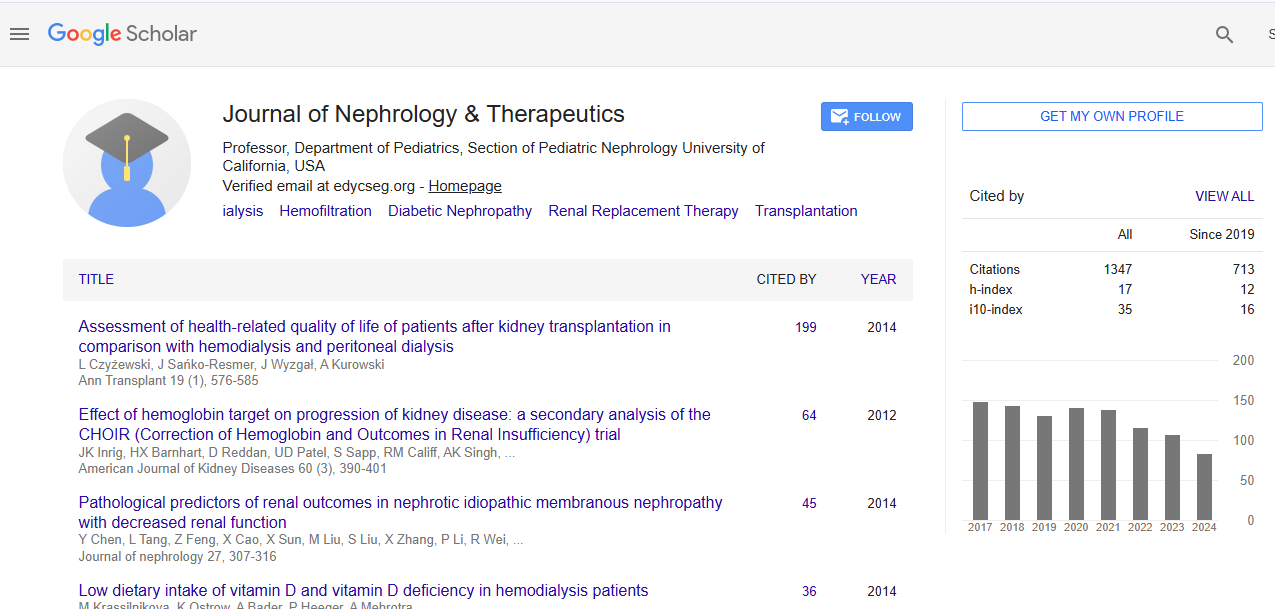
Journal of Nephrology & Therapeutics received 784 citations as per Google Scholar report