Short Communication - (2025) Volume 15, Issue 2
Received: 02-Mar-2025, Manuscript No. jnt-26-178930;
Editor assigned: 04-Mar-2025, Pre QC No. P-178930;
Reviewed: 18-Mar-2025, QC No. Q-178930;
Revised: 24-Mar-2025, Manuscript No. R-178930;
Published:
31-Mar-2025
, DOI: 10.37421/2161-0959.2025.15.560
Citation: Owusu, Daniel K.. ”Revolutionary Glomerulonephritis Treatments: Personalized Medicine Advances.” J Nephrol Ther 15 (2025):560.
Copyright: © 2025 Owusu K. Daniel This is an open-access article distributed under the terms of the Creative Commons Attribution License, which permits unrestricted use, distribution and reproduction in any medium, provided the original author and source are credited.
The field of nephrology is experiencing a dynamic period of innovation, particularly in the management of glomerulonephritis, a complex group of kidney diseases characterized by inflammation of the glomeruli. Recent advancements have focused on developing more targeted and effective therapeutic strategies to improve patient outcomes. This includes the exploration of novel drug repurposing and the development of sophisticated biologics designed to address the specific pathological mechanisms underlying these conditions. A significant trend is the increasing emphasis on personalized medicine, leveraging genetic and molecular insights to tailor treatment regimens to individual patients. This evolving landscape also encompasses the challenges and opportunities presented by rare forms of glomerulonephritis. Diagnosing and treating these less common variants often requires specialized approaches, and recent clinical trials are investigating emerging therapies that offer new hope for patients with previously refractory disease. The importance of a multidisciplinary care model is paramount in addressing the multifaceted needs of these patients. Furthermore, a deeper understanding of the inflammatory pathways involved in glomerulonephritis is paving the way for more precise therapeutic interventions. New biological agents are being developed to modulate specific immune responses, offering a potentially more effective and less toxic alternative to traditional broad immunosuppressive therapies. The identification of potential biomarkers to predict treatment response is also a critical area of research. The frontier of treating glomerulonephritis is rapidly expanding with the emergence of gene therapy approaches. Research is delving into the genetic underpinnings of certain glomerulonephritides, exploring the potential of gene editing technologies to correct disease-causing mutations. While still in its early stages, this area holds immense promise for fundamentally altering the treatment paradigm for genetic forms of the disease. Precision medicine is also making significant inroads into the management of specific conditions like IgA nephropathy, a common cause of glomerulonephritis. By understanding the molecular subtypes of the disease, clinicians can move beyond a generalized approach and select targeted therapies that address the unique biological drivers of the illness. The exploration of new drugs affecting the gut-kidney axis is particularly noteworthy in this context. A growing area of investigation is the intricate relationship between the gut microbiome and glomerulonephritis. Emerging evidence suggests a link between gut dysbiosis and kidney inflammation, opening up novel therapeutic avenues. Microbiome-modulating therapies, such as probiotics and fecal microbiota transplantation, are being explored as potential new treatment options. Another promising regenerative approach under scrutiny is stem cell transplantation. Research is examining the mechanisms by which stem cells might exert protective effects on the kidneys, including their ability to modulate immune responses and promote tissue repair. While challenges remain, this regenerative strategy offers a potential pathway for restoring kidney function. The role of complement inhibition in treating complement-mediated glomerulonephritis is becoming increasingly defined. There have been significant updates on approved therapies and ongoing research into novel modulators of the complement pathway, highlighting their efficacy in specific glomerular disease subtypes and underscoring the importance of precise patient selection. For patients with chronic glomerulonephritis, targeting fibrotic pathways is a critical area of development. Understanding the mechanisms of kidney fibrosis and investigating novel antifibrotic agents aims to halt or reverse renal scarring, thereby preserving kidney function in individuals with progressive disease. This represents a crucial effort to manage the long-term consequences of chronic kidney inflammation. Finally, the unique challenges and opportunities in treating pediatric glomerulonephritis are being addressed. Emerging therapies, including targeted immunosuppression and agents for specific genetic forms, are transforming the management of kidney disease in children. Early diagnosis and diligent long-term follow-up are crucial for optimizing outcomes in this vulnerable population [1][2][3][4][5][6][7][8][9][10].
The treatment of glomerulonephritis is undergoing a significant transformation, driven by advancements in understanding the underlying pathophysiology and the development of novel therapeutic modalities. One of the key areas of progress lies in the exploration of new drug strategies, including the repurposing of existing medications and the creation of targeted biologics, which have shown promise in enhancing treatment efficacy for patients with these kidney disorders. The paradigm is shifting towards personalized medicine, where genetic and molecular profiling plays an increasingly important role in guiding treatment decisions and optimizing patient care [1].
Addressing the complexities of rare forms of glomerulonephritis presents a distinct set of challenges in terms of diagnosis and treatment. Recent clinical trials are investigating emerging therapies, such as complement inhibitors and innovative immunosuppressive agents, offering renewed hope for individuals with conditions that were once considered refractory. The importance of integrated, multidisciplinary care is widely recognized as essential for managing these rare and often severe kidney diseases [2].
Significant focus is also being placed on targeting specific inflammatory pathways implicated in glomerulonephritis. New biological agents that modulate the immune system are being developed, aiming to provide a more precise therapeutic approach compared to traditional, broader immunosuppression. The identification and validation of biomarkers that can predict a patient's response to these targeted treatments are crucial for maximizing their effectiveness and minimizing potential side effects [3].
A groundbreaking frontier in renal medicine is the development of gene therapy for glomerulonephritis. This approach targets the genetic basis of certain forms of the disease, with gene editing technologies offering the potential to correct the underlying mutations. Early preclinical and clinical findings are providing insights into the complex but immense promise of this innovative treatment strategy for inherited kidney disorders [4].
The application of precision medicine is particularly evident in the management of IgA nephropathy, a prevalent cause of glomerulonephritis. By gaining a deeper understanding of the molecular subtypes of this disease, clinicians can move beyond a one-size-fits-all treatment model and select therapies that are specifically tailored to the individual patient's condition. The investigation of new drugs that influence the gut-kidney axis represents a novel avenue for therapeutic intervention [5].
The intricate role of the gut microbiome in the pathogenesis and treatment of glomerulonephritis is a rapidly evolving area of research. Growing evidence links imbalances in gut bacteria (dysbiosis) to kidney inflammation, and this has spurred interest in microbiome-modulating therapies. Approaches such as probiotics and fecal microbiota transplantation are being explored as potential novel treatment options for these kidney diseases [6].
Stem cell transplantation is being critically examined for its therapeutic potential across various forms of glomerulonephritis. Researchers are investigating the mechanisms by which stem cells might exert beneficial effects, including immunomodulation and the promotion of tissue repair. While current limitations are being addressed, this regenerative approach holds promise for the future management of kidney disease [7].
The landscape of complement inhibition in the treatment of complement-mediated glomerulonephritis is continuously evolving. Updates on approved therapies and ongoing research into novel complement pathway modulators are providing valuable insights into their effectiveness in specific glomerular disease subtypes. The careful selection of patients for these targeted therapies is paramount to achieving optimal outcomes [8].
For patients with chronic glomerulonephritis, targeting fibrotic pathways is a crucial therapeutic goal. This involves understanding the molecular mechanisms that drive kidney fibrosis and investigating novel antifibrotic agents designed to halt or reverse renal scarring. The ultimate aim is to preserve kidney function and prevent disease progression in these long-term conditions [9].
Addressing the unique needs of pediatric glomerulonephritis requires specialized approaches. Emerging therapies, including targeted immunosuppression and novel agents for specific genetic forms of the disease, are significantly improving the management of kidney disease in children. The emphasis on early diagnosis and comprehensive long-term follow-up remains critical for ensuring the best possible outcomes for young patients [10].
Recent advancements in treating glomerulonephritis are revolutionizing kidney disease management. Novel therapeutic strategies include drug repurposing and targeted biologics, with a growing emphasis on personalized medicine informed by genetic and molecular insights. Rare forms of the disease are benefiting from new clinical trials exploring therapies like complement inhibitors and immunosuppressants, underscoring the need for multidisciplinary care. Research is also focusing on targeting inflammatory pathways with biological agents and identifying biomarkers for treatment response. Gene therapy represents a frontier for genetic forms of glomerulonephritis, while precision medicine is tailored for conditions like IgA nephropathy, considering the gut-kidney axis. The gut microbiome's role is being explored through microbiome-modulating therapies. Stem cell transplantation and complement inhibition are other promising avenues, with antifibrotic agents targeting chronic disease progression. Pediatric glomerulonephritis management is improving with specialized therapies and emphasis on early diagnosis and long-term follow-up.
None
None
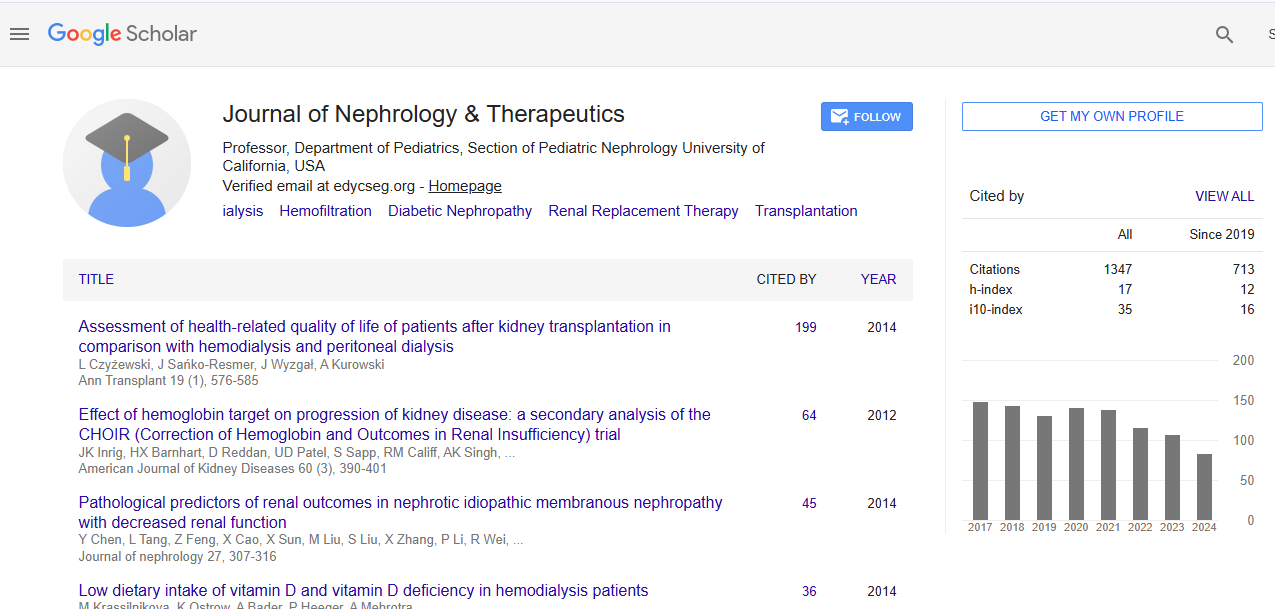
Journal of Nephrology & Therapeutics received 784 citations as per Google Scholar report