Zainab Marafie
University of Manchester, United Kingdom
Posters & Accepted Abstracts: J Sports Med Dop Stud
Statement of the Problem: Injuries among elite athletes remain a significant concern, often leading to periods of reduced performance and long-term consequences. The high physical and psychological demands placed on athletes, particularly in football, have made the early identification of injury risk a priority in sports medicine. This is especially important for preventing anterior cruciate ligament (ACL) tears, stress fractures, and hamstring strains. Traditional screening and prevention methods often lack the precision and personalisation required for timely intervention. Methodology: This poster explores the role of Artificial Intelligence (AI), specifically machine learning (ML) algorithms, in injury risk prediction among elite athletes. Recent studies employing explainable ML models, including XGBoost and Random Forest, demonstrate the integration of biomechanical parameters. This includes joint stiffness and eccentric hamstring strength, along with training load variables such as sprint frequency and match exposure, all contributing to individualised risk assessments. These models are built upon extensive datasets obtained from wearable technologies, performance testing protocols, and historical injury records, enabling the identification of subtle risk patterns not easily detected through conventional means. Findings: Current evidence indicates that AI-assisted models can predict soft tissue injuries with an accuracy of 88 to 95% in targeted athlete populations. For example, explainable ML techniques have been successfully applied to assess hamstring injury risk in professional football players by analysing of neuromuscular and biomechanical characteristics. Another study involving 880 elite athletes demonstrated the potential of machine learning in identifying predictors of ACL injury via comprehensive screening batteries. Conclusion: AI presents a transformative advancement in injury prevention strategies within elite sport. Facilitating data-driven decision-making can help reduce injury incidence, improve athlete longevity, and optimise training loads. Nevertheless, implementation challenges such as data consistency, model transparency, and ethical considerations surrounding athlete monitoring must be addressed to realise its potential in clinical environments.
Zainab Marafie is a dedicated medical student at the University of Manchester with a passion for advancing healthcare through research, education, and leadership. She has gained diverse experience through internships in clinical, educational, and marketing settings, including shadowing in surgical and pediatric departments and participating in environmental health projects. Zainab has demonstrated strong leadership abilities as a Camp Leaders instructor and as an active social media lead and representative of the Kuwait Medical Student Association UK (KuMSA UK), where she has organized orientation programs, debates, and interview preparations. She has also contributed to health education through social media outreach and event organization. Zainab’s academic excellence is reflected in her MOHE Merit Award for ranking in the top 2% of her cohort. Her interests lie in sports medicine and musculoskeletal rehabilitation, supported by recent conference participation and research projects.
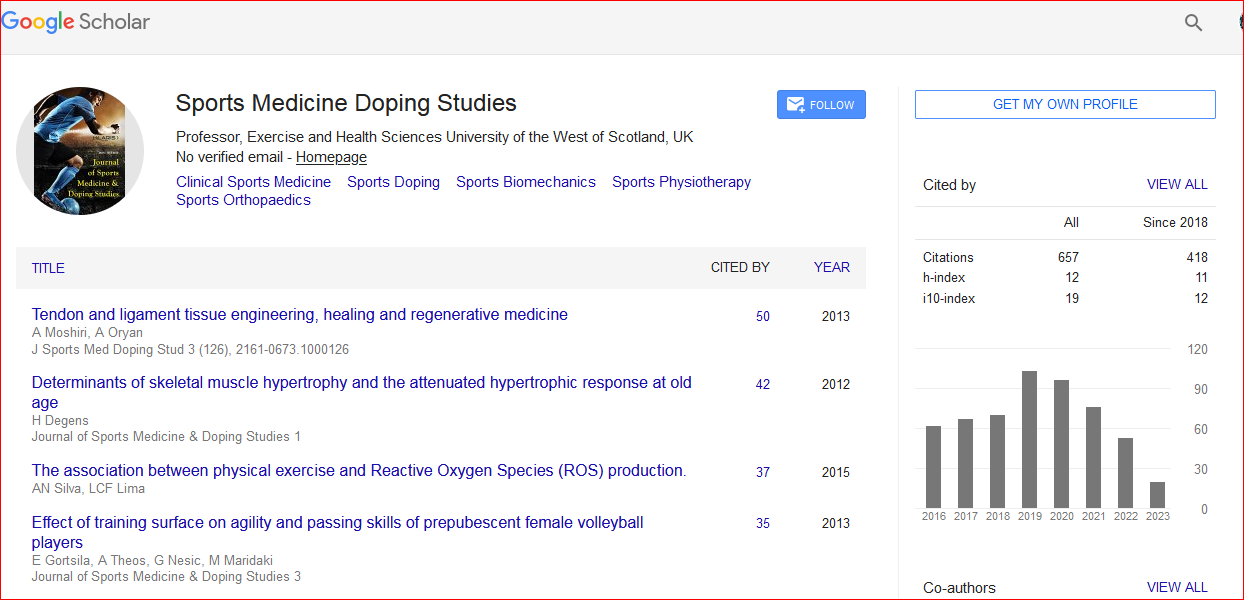
Journal of Sports Medicine & Doping Studies received 1022 citations as per Google Scholar report
 Spanish
  Chinese
  Russian
  German
  French
  Japanese
  Portuguese
  Hindi
Hindi 