Brief Report - (2025) Volume 16, Issue 4
Received: 01-Aug-2025, Manuscript No. jbsbe-26-183306;
Editor assigned: 04-Aug-2025, Pre QC No. P-183306;
Reviewed: 18-Aug-2025, QC No. Q-183306;
Revised: 22-Aug-2025, Manuscript No. R-183306;
Published:
29-Aug-2025
, DOI: 10.37421/2165-6210.2025.16.512
Citation: Petrova, Natalia. ”Wireless Biosensors: Revolutionizing Remote Health Monitoring.” J Biosens Bioelectron 16 (2025):512.
Copyright: © 2025 Petrova N. This is an open-access article distributed under the terms of the Creative Commons Attribution License, which permits unrestricted use, distribution and reproduction in any medium, provided the original author and source are credited.
Wireless biosensor networks are fundamentally transforming the landscape of remote health monitoring, enabling the continuous and real-time collection of physiological data from individuals situated outside conventional clinical environments. This advanced technological paradigm facilitates the early detection of emergent health issues, allows for precise and personalized adjustments to treatment regimens, and ultimately contributes to significantly improved patient outcomes by providing timely insights into their health status [1].
The integration of the Internet of Things (IoT) with sophisticated biosensor networks is a critical step in the development of intelligent and responsive healthcare systems. IoT architectures provide the essential infrastructure for seamless connectivity, efficient data aggregation from disparate sources, and the remote accessibility of vital health parameters, thereby amplifying the capabilities of wireless biosensors for the effective management of chronic diseases and the advancement of preventative care strategies [2].
Energy harvesting techniques have emerged as a vital component for ensuring the long-term operational viability of wearable biosensors deployed in remote monitoring applications. Investigations into novel methods for capturing ambient energy, including kinetic and solar power, are crucial for sustainably powering wireless biosensing systems, which in turn reduces the reliance on frequent battery replacements and significantly extends the overall lifespan of these devices [3].
Ensuring robust security and maintaining strict privacy are paramount concerns within the context of wireless biosensor networks designed for remote health monitoring. These networks are inherently susceptible to various vulnerabilities when transmitting sensitive patient data wirelessly, necessitating the proposal and implementation of advanced encryption and authentication mechanisms to safeguard information [4].
The development of miniaturized and highly wearable biosensors capable of continuously measuring key physiological biomarkers, such as glucose, lactate, and electrolytes, represents a cornerstone advancement in the field of remote health monitoring. Recent innovations in sensor fabrication, advanced material science, and microfluidics are enabling precise and non-invasive analyte detection, paving the way for more personalized and proactive healthcare interventions [5].
Efficient data transmission protocols are indispensable for the successful deployment and reliable operation of wireless biosensor networks, particularly in remote geographical areas characterized by limited or unreliable network connectivity. Analyzing various wireless communication technologies, including Bluetooth Low Energy, LoRa, and emerging 5G standards, helps to determine their suitability for transmitting biosensor data while considering power consumption, operational range, and required data throughput [6].
The application of sophisticated machine learning (ML) and artificial intelligence (AI) algorithms is revolutionizing the way data generated by wireless biosensor networks is analyzed and interpreted. These intelligent systems offer the potential for real-time anomaly detection, sophisticated predictive diagnostics, and the facilitation of highly personalized health interventions, thereby enhancing both the diagnostic accuracy and the overall clinical utility of remote monitoring systems [7].
The biocompatibility and long-term stability of biosensor materials are absolutely crucial considerations for applications involving in-vivo implantation or continuous on-body wear in remote health monitoring scenarios. Research into advanced materials and innovative surface functionalization techniques is vital for ensuring consistent biosensor performance and minimizing any potential adverse biological responses, leading to the development of safer and more effective continuous monitoring devices [8].
The rigorous clinical validation of wireless biosensor networks is an essential prerequisite for their widespread adoption and integration into mainstream healthcare practices. Developing comprehensive frameworks for evaluating the accuracy, reliability, and demonstrable clinical impact of biosensor-based remote monitoring systems, specifically tailored for various diseases, is critical, with a strong emphasis on employing rigorous testing methodologies and promoting patient adherence [9].
The successful design and implementation of intuitive and user-friendly interfaces for remote health monitoring systems are pivotal for fostering patient engagement and ensuring widespread acceptance of these technologies. The development of easily navigable mobile applications and comprehensive dashboards allows both patients and healthcare providers to effectively access, visualize, and interact with the generated biosensor data, thereby promoting a more collaborative and empowered approach to health management [10].
Wireless biosensor networks are revolutionizing remote health monitoring by enabling continuous, real-time data collection from individuals outside traditional clinical settings. This technology facilitates early detection of health issues, personalized treatment adjustments, and improved patient outcomes. Key advancements include miniaturized biosensors, efficient wireless communication protocols, and robust data processing algorithms, addressing challenges like power consumption, data security, and signal reliability for widespread adoption [1].
The integration of the Internet of Things (IoT) with biosensor networks is crucial for developing smart healthcare systems. This article explores how IoT architectures enable seamless connectivity, data aggregation, and remote access to vital health parameters, enhancing the capabilities of wireless biosensors for chronic disease management and preventative care. Challenges related to interoperability and data privacy are also discussed [2].
Energy harvesting techniques are vital for the long-term operation of wearable biosensors in remote monitoring applications. This research investigates novel methods for capturing ambient energy (e.g., kinetic, solar) to power wireless biosensing systems, thereby reducing the need for frequent battery replacements and extending device lifespan. The findings highlight strategies for efficient energy management and integration [3].
Security and privacy are paramount concerns in wireless biosensor networks for remote health monitoring. This paper addresses the vulnerabilities associated with transmitting sensitive patient data wirelessly and proposes advanced encryption and authentication mechanisms. The focus is on ensuring data integrity, confidentiality, and user privacy while maintaining efficient communication [4].
The development of miniaturized and wearable biosensors capable of continuously measuring biomarkers such as glucose, lactate, and electrolytes is a cornerstone of remote health monitoring. This article reviews the latest innovations in sensor fabrication, material science, and microfluidics that enable precise and non-invasive analyte detection, paving the way for personalized and proactive healthcare [5].
Efficient data transmission protocols are critical for the success of wireless biosensor networks, especially in remote areas with limited connectivity. This work analyzes various wireless communication technologies (e.g., Bluetooth Low Energy, LoRa, 5G) and their suitability for transmitting biosensor data, focusing on factors like power consumption, range, and data throughput. Optimization strategies for reliable data delivery are explored [6].
The application of machine learning and artificial intelligence (AI) algorithms is transforming the analysis of data generated by wireless biosensor networks. This paper highlights how AI can be used for real-time anomaly detection, predictive diagnostics, and personalized health interventions, thereby enhancing the diagnostic accuracy and clinical utility of remote monitoring systems [7].
Biocompatibility and long-term stability of biosensor materials are crucial for in-vivo and on-body applications in remote health monitoring. This research explores advanced materials and surface functionalization techniques that ensure biosensor performance and minimize adverse biological responses, leading to safer and more effective continuous monitoring devices [8].
The clinical validation of wireless biosensor networks is essential for their adoption in mainstream healthcare. This study presents a framework for evaluating the accuracy, reliability, and clinical impact of biosensor-based remote monitoring systems for specific diseases. Emphasis is placed on rigorous testing methodologies and patient adherence [9].
The design and implementation of user-friendly interfaces for remote health monitoring systems are crucial for patient engagement and acceptance. This article discusses the development of intuitive mobile applications and dashboards that allow patients and healthcare providers to access, visualize, and interact with biosensor data, fostering a more collaborative approach to health management [10].
Wireless biosensor networks are revolutionizing remote health monitoring by enabling continuous, real-time data collection. Advancements in miniaturized sensors, wireless communication, and data processing are key. The integration of IoT enhances smart healthcare systems for chronic disease management. Energy harvesting techniques are vital for sustainable operation, while robust security and privacy measures are essential for data protection. Miniaturized wearable sensors facilitate continuous biomarker monitoring, supported by efficient data transmission protocols and advanced AI/ML for data analysis. Biocompatible materials ensure device safety, and clinical validation frameworks are crucial for healthcare adoption. User-friendly interfaces promote patient engagement and collaborative health management.
None
None
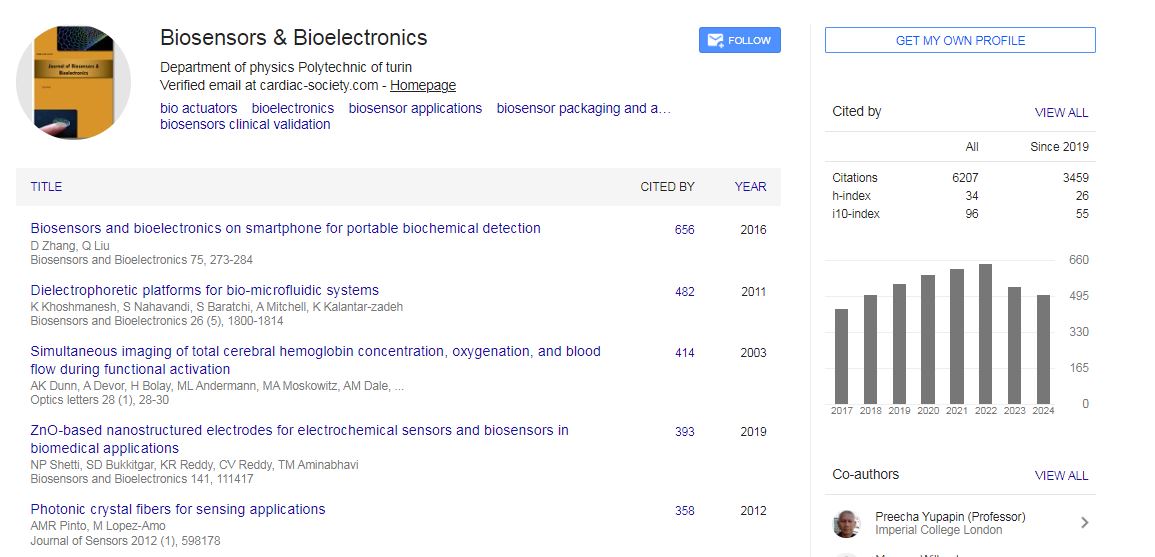
Biosensors & Bioelectronics received 6207 citations as per Google Scholar report