Opinion - (2025) Volume 15, Issue 5
Received: 02-Oct-2025, Manuscript No. jeat-26-188651;
Editor assigned: 06-Oct-2025, Pre QC No. P-188651;
Reviewed: 20-Oct-2025, QC No. Q-188651;
Revised: 23-Oct-2025, Manuscript No. R-188651;
Published:
30-Oct-2025
, DOI: 10.37421/2161-0525.2025.15.871
Citation: Ali, Zainab. ”Wastewater Contaminants Threaten
Aquatic Ecosystems.” J Environ Anal Toxicol 15 (2025):871.
Copyright: © 2025 Ali Z. This is an open-access article distributed under the terms of the Creative Commons Attribution License, which permits unrestricted use, distribution
and reproduction in any medium, provided the original author and source are credited.
This review delves into the pervasive and detrimental impacts of common wastewater contaminants on aquatic ecosystems, focusing on their physiological and reproductive health effects on indicator species. Wastewater, a complex matrix, often carries a cocktail of pollutants including heavy metals, emerging organic compounds, pharmaceuticals, and microplastics, posing significant risks to aquatic life and ecosystem integrity [1].
The endocrine-disrupting potential of ubiquitous chemicals such as bisphenol A (BPA) and its analogues, commonly found in treated wastewater, has been a focal point of research. These compounds can profoundly interfere with hormonal systems in fish, leading to alterations in gene expression related to reproduction and metabolism, thereby impacting fertility and offspring development [2].
Heavy metals like cadmium and lead, frequently discharged in industrial wastewater effluents, present a significant genotoxic and mutagenic threat to aquatic invertebrates. Studies utilizing sensitive assays have provided clear evidence of DNA damage and chromosomal aberrations in organisms exposed to these metals, highlighting the severe genetic risks associated with chronic exposure [3].
Pharmaceuticals, including antibiotics and antidepressants, are increasingly detected in municipal wastewater and exert a range of sublethal effects on aquatic vertebrates. These contaminants can impair vital functions such as behavior and development, leading to reduced swimming performance and delayed larval development in species like zebrafish, underscoring the ecological consequences of these 'pseudo-persistent' compounds [4].
Microplastics, another prevalent wastewater contaminant, act as crucial vectors for persistent organic pollutants (POPs) within aquatic food webs. Their ability to adsorb and transport these harmful chemicals leads to increased contaminant burdens at higher trophic levels, creating a critical pathway for chemical exposure and biomagnification in aquatic ecosystems [5].
Agricultural runoff, a significant contributor to wastewater composition, often carries pesticide residues that pose substantial risks to amphibian populations. Exposure to common insecticides has been linked to decreased fertilization rates, increased developmental abnormalities, and even sex reversal in amphibians, emphasizing the widespread ecological threat posed by agrochemicals to sensitive vertebrates [6].
Complex mixtures of industrial wastewater contaminants, including solvents and plasticizers, can have profound impacts on primary producers in marine environments. Chronic low-level exposure to these mixtures has been shown to significantly reduce photosynthetic efficiency and biomass in marine phytoplankton, thereby impacting the base of marine food webs and overall primary productivity [7].
Organophosphate pesticides, frequently identified in wastewater, are neurotoxic to developing aquatic organisms. Studies on juvenile fish have revealed impaired learning, memory capabilities, and alterations in neurotransmitter levels following exposure, indicating subtle yet significant impacts on neural development and cognitive function [8].
Per- and polyfluoroalkyl substances (PFAS), often referred to as 'forever chemicals,' are persistent contaminants found in wastewater that can significantly compromise the immune systems of aquatic invertebrates. Research on mussels has demonstrated suppressed immune responses and increased susceptibility to pathogens, posing a substantial threat to the health and resilience of these populations [9].
The synergistic effects of thermal pollution from wastewater discharge combined with chemical contaminants can dramatically exacerbate toxicity to aquatic life. Elevated temperatures can amplify the adverse effects of heavy metals and organic pollutants, leading to increased oxidative stress, reduced energy reserves, and ultimately lower survival rates in freshwater fish [10].
The study by Smith et al. [1] provides a comprehensive review of the detrimental impacts of common wastewater contaminants, including heavy metals and emerging organic pollutants, on the physiological and reproductive health of key aquatic indicator species. It highlights the significant bioaccumulation potential of these substances and their subsequent transfer through the food chain, emphasizing the risks to ecosystem integrity and potentially human health. The authors stress the urgent need for improved wastewater treatment strategies to mitigate these toxicological effects [1].
Chen et al. [2] detail the molecular mechanisms through which bisphenol A (BPA) and its analogues, prevalent in treated wastewater, disrupt endocrine systems in fish. Their findings reveal significant alterations in gene expression related to reproduction and metabolism, leading to reduced egg production and impaired sperm quality, underscoring the endocrine-disrupting potential of these compounds even at low concentrations in aquatic environments [2].
Rodriguez et al. [3] examine the genotoxic and mutagenic impacts of heavy metals, particularly cadmium and lead, from industrial wastewater effluents on daphnia. Using Comet assay and micronucleus tests, the study provides clear evidence of DNA damage and chromosomal aberrations, directly correlating with exposure levels. This highlights the severe genetic risk posed by chronic exposure to these metals for aquatic invertebrates [3].
Kim et al. [4] assess the ecotoxicological profile of pharmaceuticals, such as antibiotics and antidepressants, commonly found in municipal wastewater. Their research demonstrates significant sublethal effects on the behavior and development of zebrafish, including impaired swimming performance and delayed larval development, emphasizing the growing concern over the 'pseudo-persistence' of pharmaceuticals and their ecological consequences [4].
Wang et al. [5] evaluate the bioaccumulation and biomagnification of microplastics and associated chemical contaminants in the aquatic food web. Laboratory experiments using algae, zooplankton, and small fish demonstrate that microplastics act as vectors for persistent organic pollutants (POPs), leading to increased contaminant burdens at higher trophic levels. This study highlights a critical pathway for chemical exposure in aquatic ecosystems [5].
Johnson et al. [6] investigate the impact of pesticide residues in agricultural runoff, a significant component of wastewater, on the reproductive success of amphibians. Exposure to common insecticides led to decreased fertilization rates, increased developmental abnormalities, and sex reversal in tadpoles, emphasizing the widespread ecological risk of agrochemicals to sensitive aquatic vertebrates [6].
Suzuki et al. [7] examine the effects of a complex mixture of industrial wastewater contaminants, including solvents and plasticizers, on the growth and survival of marine phytoplankton. Their research reveals that chronic low-level exposure significantly reduces photosynthetic efficiency and biomass, impacting primary productivity at the base of marine food webs. The synergistic effects of these mixed contaminants are a key concern [7].
Brown et al. [8] study the neurotoxic effects of organophosphate pesticides, commonly found in wastewater, on the development and cognitive function of juvenile fish. Behavioral assays and neurochemical analysis showed impaired learning and memory capabilities, along with alterations in neurotransmitter levels, highlighting the subtle but significant impacts on the neural development of aquatic organisms [8].
Patel et al. [9] assess the toxic impact of per- and polyfluoroalkyl substances (PFAS), 'forever chemicals' found in wastewater, on the immune system of aquatic invertebrates. Studies on mussels revealed suppressed immune responses and increased susceptibility to pathogens following exposure, indicating a significant threat to the health and resilience of invertebrate populations [9].
Lee et al. [10] examine the combined effects of thermal pollution and chemical contaminants from wastewater on the metabolic rates and thermal tolerance of freshwater fish. Results indicate that elevated temperatures exacerbate the toxicity of heavy metals and organic pollutants, leading to increased oxidative stress and reduced energy reserves, ultimately lowering survival rates. This interaction poses a significant synergistic threat [10].
Wastewater contaminants pose significant threats to aquatic ecosystems. Research highlights the detrimental physiological and reproductive impacts of heavy metals, emerging organic pollutants, pharmaceuticals, and microplastics on various aquatic indicator species. These substances can disrupt endocrine systems, cause genetic damage, impair behavior and development, and act as vectors for persistent organic pollutants. Agricultural runoff contributes pesticide residues that harm amphibian reproduction, while industrial effluents affect primary producers. Neurotoxic pesticides impact fish cognition, and 'forever chemicals' like PFAS compromise invertebrate immunity. Furthermore, thermal pollution from wastewater exacerbates contaminant toxicity, leading to increased stress and reduced survival rates in fish. The findings underscore the urgent need for improved wastewater treatment to mitigate these widespread ecological risks.
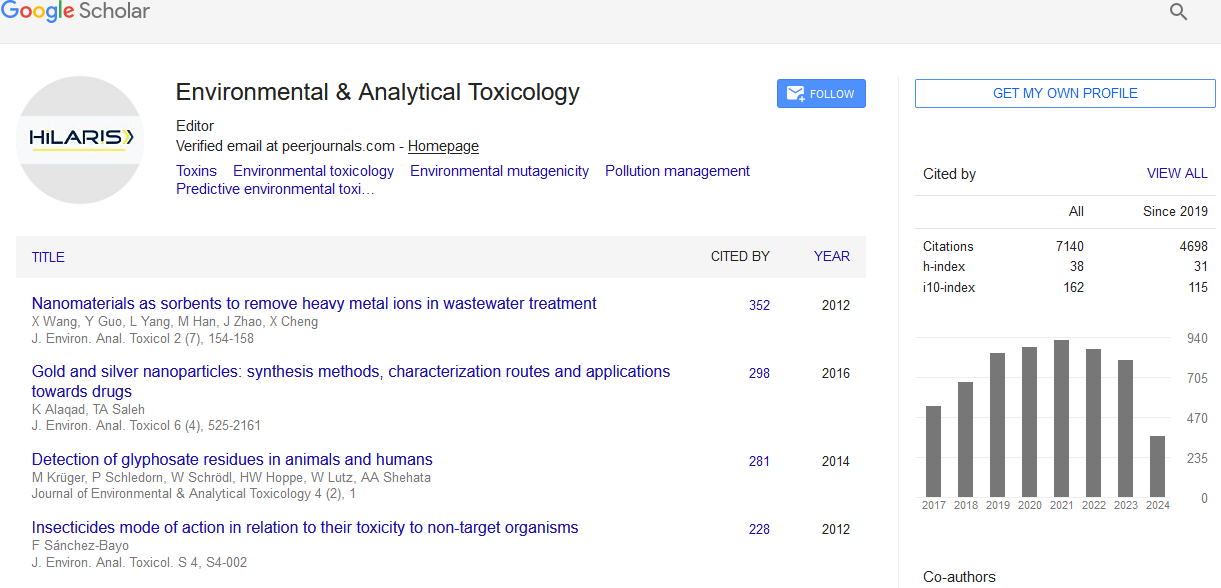
Environmental & Analytical Toxicology received 6818 citations as per Google Scholar report