Brief Report - (2025) Volume 16, Issue 6
Received: 03-Nov-2025, Manuscript No. jnmrt-26-186394;
Editor assigned: 05-Nov-2025, Pre QC No. P-186394;
Reviewed: 19-Nov-2025, QC No. Q-186394;
Revised: 24-Nov-2025, Manuscript No. R-186394;
Published:
01-Dec-2025
, DOI: 10.37421/2155-9619.2025.16.674
Citation: Okafor, Samuel. ”Multi-Isotope Therapy: Powering Precision
Nuclear Oncology.” J Nucl Med Radiat Ther 16 (2025):674.
Copyright: © 2025 Okafor S. This is an open-access article distributed under the terms of the Creative Commons Attribution License, which permits unrestricted use, distribution
and reproduction in any medium, provided the original author and source are credited.
The field of nuclear medicine oncology is undergoing a significant transformation with the advent of multi-isotope therapy, a sophisticated approach aimed at enhancing the efficacy and safety of radionuclide treatments. This innovative strategy focuses on combining different radioisotopes to create more targeted and potent therapeutic regimens, thereby overcoming some of the limitations inherent in traditional single-isotope therapies. The synergistic interaction between carefully selected isotopes promises to deliver a more comprehensive attack on cancer cells, potentially leading to improved patient outcomes and reduced treatment-related toxicities [1].
The development of novel theranostic agents is a cornerstone for the successful implementation of combination radionuclide therapy. By integrating diagnostic and therapeutic radioisotopes within a single molecular construct, researchers are enabling precise tumor visualization followed by targeted therapeutic intervention. This dual capability allows for personalized treatment planning, ensuring that the therapeutic dose is delivered precisely where it is needed, minimizing exposure to healthy tissues [2].
Understanding the radiobiological principles that underpin multi-isotope therapy is crucial for its rational design and application. Combining isotopes with distinct emission characteristics, such as alpha, beta, and Auger electrons, can result in complementary patterns of cellular damage. This approach can potentially overcome resistance mechanisms that often develop in tumors treated with single radioisotopes, thereby enhancing overall therapeutic efficacy. The careful selection of isotopes based on their emission properties is key to achieving optimal therapeutic synergy [3].
The clinical translation of multi-isotope therapy is an area of intense research and development, with promising preclinical and early clinical data emerging for specific cancer types. Significant challenges remain in areas such as dose optimization and patient selection, which are critical for maximizing therapeutic benefit while minimizing side effects. The potential for treating disseminated disease through the targeted delivery of multiple radionuclides to various tumor sites is a particularly exciting prospect for this therapeutic modality [4].
The design and synthesis of sophisticated radiopharmaceuticals are fundamental to enabling multi-isotope combination therapy. This involves the development of molecules capable of efficiently carrying multiple isotopes or facilitating their sequential delivery to tumor sites. The utilization of bifunctional chelators and advanced targeting vectors is essential for creating stable in vivo agents that exhibit selective accumulation within tumor tissues, thereby maximizing therapeutic impact [5].
Radiosensitization represents a critical mechanism through which combination isotope therapy can exert its effects. By combining isotopes with different decay properties, researchers aim to induce synergistic damage to cancer cell DNA and other vital cellular components. This enhanced cellular damage can render tumors more susceptible to subsequent treatments and reduce the likelihood of resistance emerging, ultimately leading to improved tumor control [6].
Despite the significant promise of multi-isotope therapy, several challenges and future directions need to be addressed for its widespread clinical adoption. These include careful isotope selection, precise dosimetry, optimization of delivery methods, and the necessity for robust, well-designed clinical trials. Fostering interdisciplinary collaboration among researchers, clinicians, and industry partners is paramount to successfully translating these advanced strategies into effective clinical practice [7].
The effective delivery of multiple radioisotopes to tumor sites is dependent on sophisticated targeting strategies. Various approaches, including the use of small molecules, peptides, and antibodies engineered to carry and release therapeutic radionuclides, are being explored. The ultimate goal is to achieve high tumor-to-organ ratios, which are essential for maximizing therapeutic efficacy while concurrently minimizing systemic toxicity [8].
A particularly promising area within multi-isotope therapy involves the combination of alpha and beta emitting isotopes. Alpha particles, with their short range and high linear energy transfer, can deliver potent localized damage, while beta particles offer deeper penetration. This complementary action can be highly effective in targeting both the primary tumor mass and potential micrometastases, offering a unique therapeutic advantage [9].
Personalized medicine plays an increasingly vital role in guiding the development and application of multi-isotope therapy protocols. Incorporating patient-specific factors, such as tumor heterogeneity and individual radiosensitivity, allows for the optimization of isotope selection and dosing. This tailored approach is crucial for developing individualized treatment regimens that maximize efficacy and minimize adverse effects, ushering in an era of truly personalized radionuclide therapy [10].
This exploration delves into the sophisticated realm of multi-isotope therapy, highlighting its potential to overcome limitations in traditional radionuclide treatments. By strategically combining different radioisotopes, researchers are developing more targeted and effective strategies for various cancers. The focus is on synergizing the therapeutic benefits of each isotope, potentially reducing side effects and improving patient outcomes. This approach represents a paradigm shift in nuclear medicine oncology, offering new avenues for treating challenging malignancies [1].
The development of novel theranostic agents is central to advancing combination radionuclide therapy. This article discusses how pairing diagnostic and therapeutic radioisotopes within the same molecule allows for precise tumor targeting and personalized treatment planning. The ability to visualize uptake and then deliver a therapeutic dose is a significant advantage, enabling a more informed and effective treatment strategy [2].
This paper examines the radiobiological principles underlying multi-isotope therapy. It explains how combining isotopes with different emission characteristics (e.g., alpha, beta, Auger electrons) can lead to complementary damage patterns within tumor cells, potentially overcoming resistance mechanisms and improving therapeutic efficacy. Understanding these differences is key to designing optimal combinations and maximizing the therapeutic ratio [3].
The clinical application of multi-isotope therapy is explored, focusing on specific cancer types where this approach shows promise. This article reviews preclinical and early clinical data, discussing challenges in dose optimization and patient selection. The potential for treating disseminated disease through targeted delivery of multiple isotopes is a key area of interest for advancing patient care [4].
This study investigates the design and synthesis of novel radiopharmaceuticals for combination therapy. It emphasizes the importance of bifunctional chelators and targeting vectors that can efficiently carry multiple isotopes or deliver them in a sequential manner. The goal is to create molecules that are stable in vivo and selectively accumulate in tumor tissues, enhancing therapeutic delivery [5].
Radiosensitization by combination isotope therapy is a critical aspect discussed here. The article explores how different isotopes can synergistically damage cancer cell DNA and other cellular components, potentially making tumors more susceptible to further treatment or reducing the likelihood of resistance development. This approach aims to maximize tumor kill while minimizing damage to healthy tissues [6].
This review focuses on the challenges and future directions in the development of multi-isotope therapy protocols. It addresses issues such as isotope selection, dosimetry, delivery methods, and the need for robust clinical trials. The authors emphasize the importance of interdisciplinary collaboration to translate these advanced strategies into effective clinical practice [7].
The targeting mechanisms for delivering multiple radioisotopes to tumor sites are discussed in depth. This article covers various strategies, including small molecules, peptides, and antibodies, engineered to carry and release therapeutic radionuclides. The aim is to achieve high tumor-to-organ ratios for enhanced efficacy and reduced toxicity [8].
This paper explores the potential of combining alpha and beta emitting isotopes for enhanced tumoricidal effects. It details how the short range and high linear energy transfer of alpha particles, coupled with the deeper penetration of beta particles, can offer a unique therapeutic advantage by targeting both the primary tumor mass and micrometastases [9].
The role of personalized medicine in guiding multi-isotope therapy protocols is examined. This article discusses how patient-specific factors, such as tumor heterogeneity and individual radiosensitivity, can be used to optimize the selection and dosing of different radioisotopes, leading to more tailored and effective treatment regimens [10].
Multi-isotope therapy is emerging as a powerful strategy in nuclear medicine oncology, aiming to improve cancer treatment by combining radioisotopes for enhanced efficacy and reduced toxicity. This approach leverages synergistic radiobiological effects and the development of novel theranostic agents for precise tumor targeting and personalized treatment planning. Key to its success are advancements in radiopharmaceutical design, sophisticated targeting mechanisms, and a deep understanding of radiobiological principles. While challenges in clinical translation, dose optimization, and patient selection remain, the potential of multi-isotope therapy, particularly combinations like alpha and beta emitters, shows significant promise. Personalized medicine is central to tailoring these complex protocols, with ongoing research focused on addressing these challenges to bring this innovative therapy to wider clinical application.
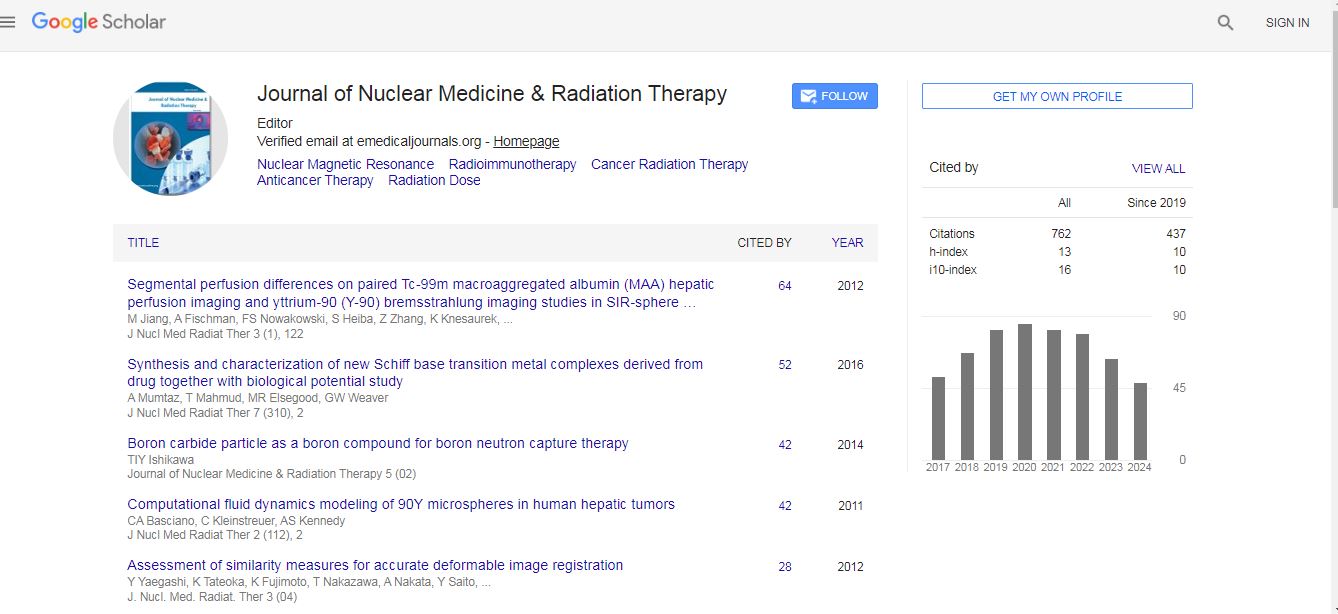
Nuclear Medicine & Radiation Therapy received 706 citations as per Google Scholar report