Perspective - (2025) Volume 11, Issue 3
Received: 02-Jun-2025, Manuscript No. jctt-26-188409;
Editor assigned: 04-Jun-2025, Pre QC No. P-188409;
Reviewed: 18-Jun-2025, QC No. Q-188409;
Revised: 23-Jun-2025, Manuscript No. R-188409;
Published:
30-Jun-2025
, DOI: 10.37421/2471-9323.2024.10.327
Citation: Al-Harbi, Fatima. ”Synergistic Hair and Skin Beauty Ingredient Benefits.” J Cosmo Tricho 11 (2025):327.
Copyright: © 2025 Al-Harbi F. This is an open-access article distributed under the terms of the Creative Commons Attribution License, which permits unrestricted use, distribution and reproduction in any medium, provided the original author and source are credited.
The burgeoning field of cosmetology and trichology is witnessing a significant paradigm shift, moving towards integrated approaches that leverage the synergistic potential of ingredients for both hair and skin health. Historically, these domains were often treated in isolation, with distinct product lines and research focuses. However, a growing body of evidence suggests that many compounds, celebrated for their benefits to one, can offer parallel advantages to the other. This evolving understanding is paving the way for novel formulations and holistic beauty rituals that promise enhanced efficacy and comprehensive care. Advancements in ingredient science have illuminated how components traditionally associated with hair nourishment, such as keratin and specialized oils, can also contribute positively to skin barrier function and overall radiance. This realization encourages a more unified perspective on cosmetic formulation, where ingredients are assessed for their dual-action capabilities. The exploration of these shared benefits is critical for developing sophisticated beauty products that cater to multifaceted consumer needs. Furthermore, the development of innovative delivery systems is playing a crucial role in maximizing the efficacy of cosmetic actives across both scalp and facial skin. Techniques like liposomal encapsulation are being investigated for their ability to transport potent antioxidants and peptides, thereby supporting improved hair growth cycles and simultaneously addressing visible signs of skin aging. This technological integration is key to unlocking synergistic effects. Specific protein complexes, often found in premium hair treatments, are now being recognized for their impact on skin elasticity and hydration. For instance, hydrolyzed keratin has shown potential in signaling skin cells to boost collagen production, which is vital for maintaining skin firmness and optimal moisture retention. This discovery underscores the molecular commonalities in biological pathways relevant to both hair and skin. The utilization of botanical extracts, long lauded for their hair-strengthening properties, is also expanding into formulations targeting sensitive skin. These plant-derived actives offer a dual benefit by providing soothing antioxidant and anti-inflammatory effects for the skin, while concurrently fostering a healthier scalp environment conducive to robust hair growth. Ceramides, essential lipids for maintaining barrier function, are emerging as powerful dual-benefit ingredients for both hair and skin. Research indicates that topical application of ceramides can effectively restore the lipid structure in both hair cuticles and skin, leading to a reduction in hair breakage and an increase in skin suppleness and resilience. Similarly, the anti-aging potential of peptide complexes, often sourced from ingredients found in hair growth serums, is being explored for their impact on skin. These peptides may stimulate fibroblast activity, thereby enhancing collagen and elastin production, which are crucial for diminishing the appearance of wrinkles and improving skin texture. The principles governing luxurious skin creams are also being applied to hair care, with humectants and emollients demonstrating significant benefits. Ingredients like hyaluronic acid and shea butter, known for their hydrating properties, can draw moisture into the hair shaft and smooth the cuticle, offering enhanced hydration and manageability for hair. Antioxidants commonly found in high-end hair conditioners are revealing their photoprotective capabilities for skin as well. Compounds such as Vitamin E and ferulic acid are being studied for their ability to help mitigate UV-induced damage, protecting both hair and skin cells from environmental stressors and premature aging. Finally, the incorporation of advanced skincare ingredients like plant-derived stem cells into hair growth formulations is a promising development. These potent actives are being investigated for their capacity to rejuvenate scalp follicles, promoting healthier, more resilient hair growth and contributing to a more integrated approach to cosmetic science.
The intricate interplay between advanced hair care ingredients and their benefits for skin texture and health is a focal point of current cosmetic research. Luxurious hair treatments often feature components such as keratin and specialized oils, which have been found to positively influence skin barrier function and enhance dermal radiance. This synergistic effect supports a holistic approach to beauty regimens, integrating scalp and facial care [1].
Novel delivery systems are revolutionizing the efficacy of cosmetic actives, particularly in applications aimed at both scalp health and facial skin rejuvenation. Liposomal encapsulation, for instance, is being harnessed to deliver potent antioxidants and peptides, which can lead to improved hair growth cycles and a visible reduction in skin aging signs [2].
The role of specific protein complexes, frequently found in premium hair treatment formulations, extends to enhancing skin elasticity and hydration. Ingredients like hydrolyzed keratin have demonstrated the capacity to stimulate skin cells, promoting increased collagen production and thereby improving the skin's firmness and moisture retention capabilities [3].
Botanical extracts, renowned for their hair-strengthening properties, are also being explored for their utility in formulations designed for sensitive skin. These naturally derived actives offer dual benefits by providing antioxidant and anti-inflammatory effects that soothe the skin while simultaneously cultivating a healthy scalp environment conducive to hair vitality [4].
Ceramide-rich formulations are proving to be exceptionally beneficial for both hair cuticle integrity and skin barrier function. The topical application of ceramides aids in restoring the lipid structure of both hair and skin, resulting in diminished breakage and enhanced suppleness across both tissues [5].
The anti-aging potential of peptide complexes, often derived from ingredients utilized in hair growth serums, is a significant area of interest. These peptides are suggested to stimulate fibroblast activity in the skin, leading to an increased production of collagen and elastin, which consequently reduces the appearance of wrinkles [6].
Humectants and emollients, commonly integrated into high-end skin creams, are now recognized for their capacity to improve hair hydration and manageability. Ingredients such as hyaluronic acid and shea butter can effectively draw moisture into the hair shaft and smooth the cuticle, offering a dual advantage for both hair and skin hydration needs [7].
Antioxidants present in luxurious hair conditioners are also demonstrating photoprotective properties relevant to skin health. Components like Vitamin E and ferulic acid are being investigated for their ability to help mitigate UV-induced damage, thereby protecting both hair and skin cells from environmental aggressors [8].
Advanced skincare innovations, such as plant-derived stem cells, are being incorporated into hair growth formulations. These potent actives have shown promise in rejuvenating scalp follicles and promoting healthier, more resilient hair growth, bridging the gap between sophisticated skincare and trichological solutions [9].
The integration of prebiotics and postbiotics into cosmetic products aims to enhance the skin microbiome and promote scalp health. By balancing the microbial ecosystem, these ingredients can lead to improved skin barrier function and create a more favorable environment for hair follicle activity [10].
Current research highlights the synergistic benefits of cosmetic ingredients for both hair and skin. Ingredients like keratin, specialized oils, and ceramides, traditionally used in hair care, are now recognized for their positive impact on skin barrier function and radiance. Novel delivery systems, such as liposomal encapsulation, enhance the efficacy of actives for scalp and facial rejuvenation. Botanical extracts and antioxidants offer dual benefits, soothing skin while promoting hair health and protecting against UV damage. Peptide complexes show anti-aging potential by boosting collagen and elastin. Humectants and emollients improve hair hydration while also benefiting skin. The use of plant stem cells and microbiome-balancing prebiotics and postbiotics further integrates hair and skin care, offering comprehensive beauty solutions.
None
None
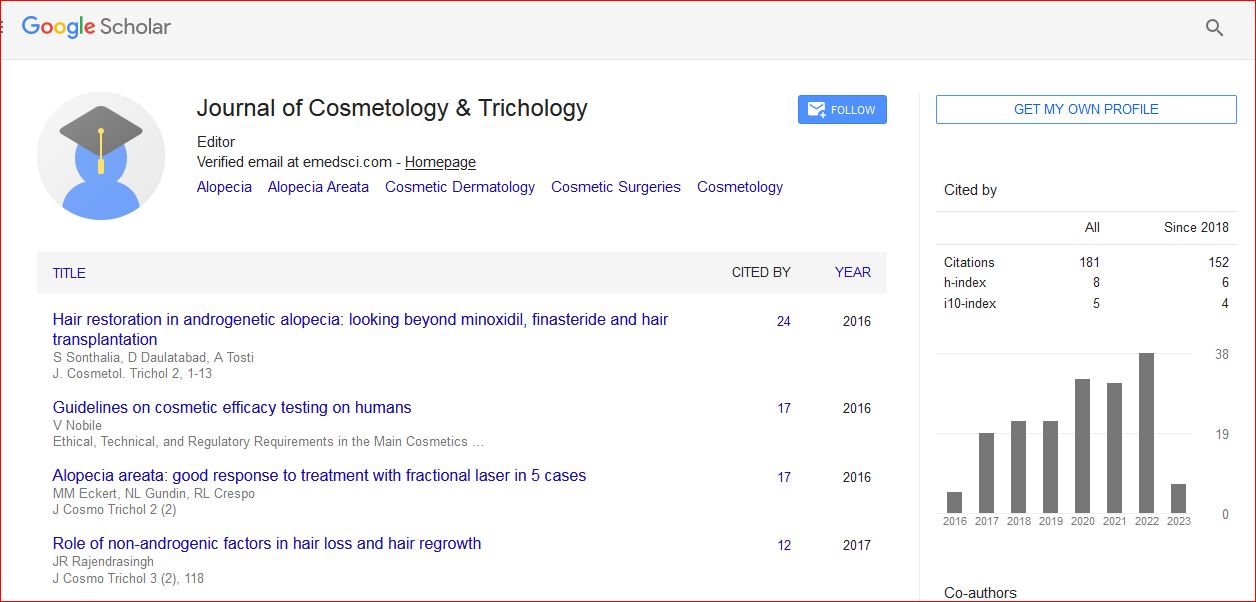
Journal of Cosmetology & Trichology received 180 citations as per Google Scholar report