Opinion - (2025) Volume 11, Issue 3
Received: 01-May-2025, Manuscript No. aso-26-184615;
Editor assigned: 05-May-2025, Pre QC No. P-184615;
Reviewed: 19-May-2025, QC No. Q-184615;
Revised: 22-May-2025, Manuscript No. R-184615;
Published:
29-May-2025
, DOI: 10.37421/2471-2671.2025.11.169
Citation: Peterson, Noah. ”Surgical Margins: Prognostic Predictors
for Cancer Outcomes.” Arch Surg Oncol 11 (2025):169.
Copyright: © 2025 Peterson N. This is an open-access article distributed under the terms of the Creative Commons Attribution License, which permits unrestricted use,
distribution and reproduction in any medium, provided the original author and source are credited.
Achieving negative surgical margins is a paramount objective in oncologic surgery, fundamentally influencing patient survival and disease recurrence rates. This principle is consistently highlighted across various cancer types, underscoring its universal importance in effective cancer treatment. The presence of residual cancer cells at the surgical site, termed a positive margin, is directly linked to a higher likelihood of the cancer returning and a diminished overall survival prognosis [1].
For colorectal cancer, the concept of complete mesocolic excision (CME) has emerged as a critical strategy aimed at enhancing local control and improving patient survival. This technique focuses on ensuring adequate and consistent surgical margins by performing a meticulous dissection of the mesocolon. Evidence suggests that high-quality CME, characterized by the preservation of intact mesocolic planes, results in superior oncologic outcomes when contrasted with conventional surgical approaches [2].
In breast cancer surgery, particularly in breast-conserving procedures, the status of surgical margins is a significant determinant of treatment success. The presence of residual tumor cells, even in the form of micrometastases at the margin, can substantially compromise disease-free survival and overall survival. This necessitates careful pathological evaluation and standardized protocols for margin assessment [3].
For pancreatic cancer, attaining an R0 resection, which signifies the absence of residual tumor at all margins, is a formidable yet essential goal for achieving long-term patient survival. The complexity of the pancreatic anatomy and the aggressive nature of the tumor biology present considerable challenges in precisely assessing and achieving clear margins. Advances in neoadjuvant therapy have shown promise in improving resectability and thus the likelihood of achieving R0 status [4].
The management of lung cancer, specifically non-small cell lung cancer (NSCLC), relies heavily on the achievement of negative surgical margins to minimize the risk of local recurrence. Evolving definitions of negative margins and their correlation with survival are subjects of ongoing research, emphasizing the need for precise pathological evaluation and meticulous surgical technique to ensure optimal oncologic outcomes [5].
In the realm of head and neck cancers, surgical margin status is a pivotal factor in determining local control and overall survival. Various definitions of margins, including inked margins and microscopic involvement, have been investigated for their predictive value. Even narrow margins, less than 1 mm, have been associated with an increased risk of recurrence, highlighting the importance of achieving wide margins whenever feasible [6].
For localized prostate cancer treated with radical prostatectomy, positive surgical margins are unequivocally linked to an elevated risk of biochemical recurrence and the subsequent need for adjuvant therapies. This underscores the critical role of surgical technique and meticulous specimen handling in achieving negative margins and optimizing long-term oncologic control [7].
In endometrial cancer, especially in the context of minimally invasive surgery, surgical margin status is a crucial consideration due to the potential for port-site metastasis. Positive margins, even microscopic ones, can significantly elevate the risk of recurrence and adversely affect survival. Challenges in achieving adequate margins in advanced stages necessitate careful management and consideration of adjuvant therapies [8].
The prognostic impact of surgical margin status in soft tissue sarcomas is well-established. Positive or close margins are consistently associated with a higher incidence of local recurrence and distant metastasis, ultimately diminishing overall survival. This emphasizes the necessity of wide en bloc resection with clear margins for effective oncologic control [9].
In the treatment of hepatocellular carcinoma (HCC) via hepatectomy, surgical margin status plays a vital role in determining the risk of intrahepatic recurrence and patient survival. Achieving a sufficient margin, typically defined as greater than 0.1 cm, is correlated with improved long-term outcomes, whereas positive margins are linked to a higher rate of recurrence [10].
The fundamental importance of negative surgical margins in oncologic surgery cannot be overstated, as their achievement is directly associated with improved patient survival and reduced rates of cancer recurrence. When residual cancer cells are left behind at the surgical site, referred to as a positive margin, the prognosis for the patient is significantly worsened across a spectrum of cancer types. Advancements in intraoperative assessment and molecular diagnostics are continuously being developed to enhance the accuracy of margin evaluation, ultimately aiming to improve oncologic outcomes [1].
Complete mesocolic excision (CME) represents a paradigm shift in colorectal cancer surgery, focusing on achieving superior oncologic outcomes through meticulous dissection and the achievement of adequate surgical margins. The technical precision of CME, characterized by intact mesocolic planes, is believed to lead to wider and more consistent margins, thereby minimizing the likelihood of positive margins and intramesocolic tumor spread. This approach has profound implications for reducing local recurrence rates and enhancing survival [2].
In breast cancer, particularly following breast-conserving surgery, the status of surgical margins is a critical prognostic indicator. The presence of even minimal residual disease at the margin, such as micrometastases, can exert a substantial negative impact on disease-free and overall survival. Consequently, the adoption of standardized margin assessment protocols and the exploration of novel adjuvant therapies for patients with positive or close margins are strongly advocated [3].
For pancreatic cancer, achieving an R0 resection, meaning no residual tumor at the margins, is a significant challenge but is vital for long-term survival. Factors influencing R0 resection rates and their correlation with survival are areas of active investigation. The complex anatomy and tumor biology in this region necessitate precise margin assessment, and ongoing research is exploring the limitations of current methods and the potential of emerging technologies to improve outcomes [4].
In the surgical management of non-small cell lung cancer (NSCLC), the attainment of negative surgical margins is crucial for preventing local recurrence. The definition of what constitutes a negative margin and its correlation with survival outcomes following procedures like lobectomy or segmentectomy are continually being refined. The findings in this area reinforce the importance of meticulous surgical technique and precise pathological evaluation to ensure the best possible oncologic results [5].
For head and neck cancers, the status of surgical margins holds significant predictive power regarding local control and ultimate patient survival. Studies have investigated the prognostic value of various margin definitions, including inked margins and microscopic involvement, in forecasting recurrence-free and overall survival. The consensus is that even narrow margins, often defined as less than 1 mm, can be associated with an increased risk of recurrence, underscoring the importance of achieving wide margins whenever surgically feasible [6].
In the context of localized prostate cancer, the impact of surgical margin status following radical prostatectomy on patient outcomes is well-documented. Positive surgical margins are consistently associated with an increased risk of biochemical recurrence and a subsequent requirement for adjuvant treatment. Research in this area also explores how surgical technique and specimen handling influence the ability to achieve negative margins, emphasizing the value of meticulous surgical practice [7].
The significance of surgical margins in endometrial cancer, particularly in relation to the risk of port-site metastasis during minimally invasive procedures, is a critical area of study. Positive margins, including microscopic involvement, can substantially elevate the risk of recurrence and negatively impact survival. The challenges associated with achieving adequate margins in certain advanced stages highlight the potential benefits of adjuvant therapies for affected patients [8].
A comprehensive systematic review and meta-analysis examining surgical margin status in soft tissue sarcomas has revealed a strong correlation between positive or close margins and an increased risk of local recurrence and distant metastasis. These factors ultimately affect overall survival, emphasizing that achieving wide en bloc resection with clear margins is paramount for optimal oncologic control in the management of these complex tumors [9].
In patients undergoing partial hepatectomy for hepatocellular carcinoma (HCC), the status of surgical margins is a key determinant of outcomes, influencing the risk of intrahepatic recurrence and overall patient survival. Achieving a sufficient margin, often considered to be greater than 0.1 cm, is linked to improved long-term results, while positive margins are associated with a higher incidence of recurrence. Tumor characteristics and surgical techniques are also discussed as factors influencing margin positivity [10].
Negative surgical margins are crucial for improving patient survival and reducing cancer recurrence across various cancer types. Positive margins, where residual cancer cells remain, are consistently associated with poorer prognoses. Techniques like complete mesocolic excision in colorectal cancer aim to achieve wider margins. In breast, lung, prostate, endometrial, and pancreatic cancers, margin status is a significant prognostic factor, influencing recurrence rates and the need for adjuvant therapies. Even narrow margins in head and neck cancers and soft tissue sarcomas increase recurrence risk. Achieving R0 resection in pancreatic cancer is challenging but vital for survival. For hepatocellular carcinoma, sufficient margins correlate with better long-term outcomes. Advances in intraoperative assessment and molecular diagnostics are being developed to enhance accuracy.
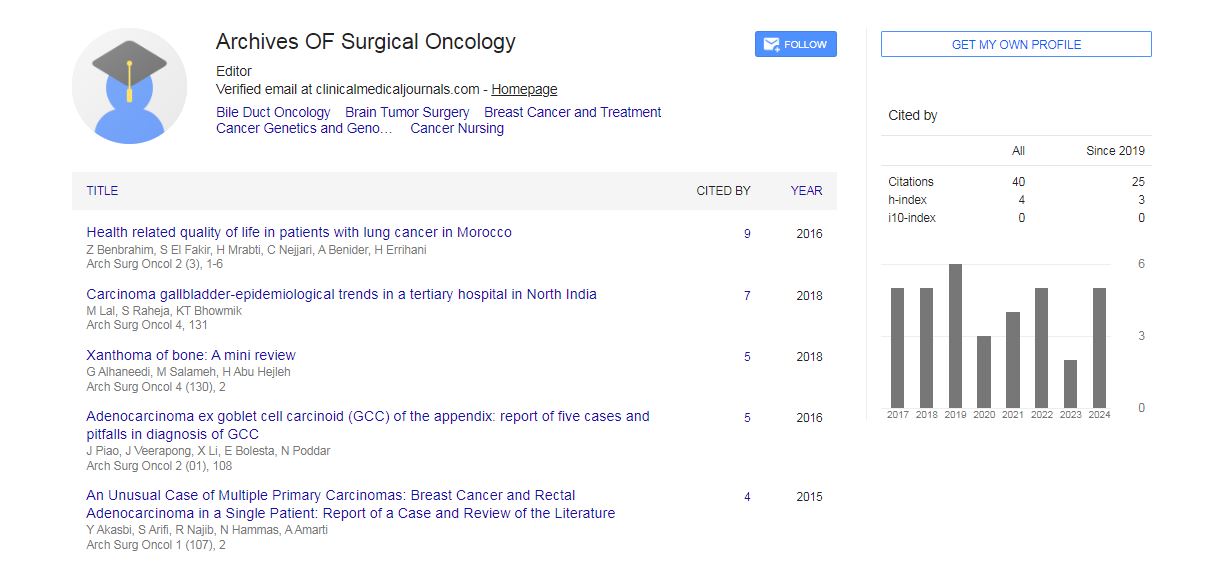
Archives of Surgical Oncology received 37 citations as per Google Scholar report