Brief Report - (2025) Volume 15, Issue 4
Received: 01-Jul-2025, Manuscript No. jsmds-25-174508;
Editor assigned: 03-Jul-2025, Pre QC No. P-174508;
Reviewed: 17-Jul-2025, QC No. Q-174508;
Revised: 22-Jul-2025, Manuscript No. R-174508;
Published:
29-Jul-2025
, DOI: 10.37421/2161-0673.2025.15.436
Citation: Fontaine, Aria. ”Sports Science Advancements: Holistic Athlete Performance, Ethics.” J Sports Med Doping Stud 15 (2025):436.
Copyright: © 2025 Fontaine A. This is an open-access article distributed under the terms of the Creative Commons Attribution License, which permits unrestricted use,
distribution and reproduction in any medium, provided the original author and source are credited.
The field of sports science continually advances, seeking to optimize athlete performance, enhance well-being, and ensure safety through a blend of psychological, physiological, and technological interventions. Modern research explores various facets, from mental resilience to training methods and ethical considerations shaping the future of sport. Understanding the psychological makeup of athletes is crucial. One study explored the connection between mental toughness and coping strategies in elite athletes, revealing gender as a key moderating factor [1].
This highlights that female and male athletes, even with similar mental fortitude, often employ distinct coping mechanisms, necessitating tailored psychological support. Further emphasizing mental well-being, a systematic review found self-compassion positively influences athletic performance and resilience [2].
It helps athletes manage setbacks, reduces self-criticism, and fosters greater mental strength. Integrating self-compassion training is suggested as a valuable addition to athletic development programs. Physical safety is paramount. Neuromuscular training significantly reduces injury rates in adolescent athletes across various sports, a finding confirmed by a systematic review and meta-analysis [3].
This strongly supports implementing structured neuromuscular programs as a primary injury prevention strategy in youth sports settings. Specifically addressing common injuries, a prospective study identified key risk factors for hamstring strain injuries in elite Australian Rules footballers, including previous injury and muscle strength imbalances [4].
These insights are vital for developing targeted prevention programs to reduce injury incidence and severity. Optimal recovery is essential for sustained performance. A review detailed key nutritional strategies, focusing on carbohydrate and protein intake, to accelerate post-exercise recovery [5].
Proper timing and specific macronutrient ratios are crucial for glycogen repletion and muscle repair, enhancing performance and minimizing downtime. In performance enhancement, caffeine's ergogenic benefits across various exercise modalities are well-established, with recent findings on optimal dosing and timing [6].
However, individual variability in response suggests a personalized approach for athletes incorporating caffeine strategically. Training methodologies also evolve. High-Intensity Interval Training (HIIT) effectively improves cardiovascular fitness and body composition, as discussed in a paper detailing its physiological adaptations [7].
HIIT offers practical applications for health and athletic performance, recognized for its time-efficient nature. For athletes combining different training types, concurrent training, which blends strength and endurance, involves unique physiological adaptations [8].
A systematic review provided insights into potential interference effects and outlined strategies to optimize programming for athletes seeking both strength and cardiovascular improvements. Technology plays an increasingly vital role. A review highlighted how wearable technology is used in sports to monitor performance, optimize training, and prevent injuries [9].
It also looked ahead to future advancements in sensor technology and data analytics, predicting further revolutions in athletic preparation. Finally, as scientific advancements in sports progress, ethical considerations become critical. A review addressed the complex ethical landscape surrounding gene doping and genetic testing [10].
Concerns about fairness, athlete autonomy, and potential health risks necessitate robust regulatory frameworks and educational initiatives to navigate these emerging challenges in sports ethics.
Modern sports science is a dynamic field that continually seeks to optimize athletic performance, enhance well-being, and mitigate risks through a comprehensive understanding of various interconnected factors. This extensive research covers psychological resilience, advanced physiological training, nutritional interventions, and the critical ethical considerations emerging with new technologies.
The psychological dimension of athletic success is profoundly explored. Studies highlight how mental toughness and coping strategies are intertwined, with gender playing a significant moderating role in elite athletes [1]. For example, female athletes often employ distinct coping mechanisms compared to males, even at similar levels of mental toughness, indicating a need for gender-sensitive psychological support. Complementing this, research on self-compassion reveals its positive influence on athletic performance and overall well-being [2]. It empowers athletes to effectively navigate setbacks, diminish self-criticism, and cultivate essential resilience. The integration of self-compassion training is thus recommended as a valuable adjunct to existing athletic development programs, fostering a more sustainable and healthy athletic career.
Injury prevention remains a cornerstone of athlete care. Neuromuscular training has been robustly demonstrated to significantly reduce injury rates among adolescent athletes across various sports [3]. This evidence strongly supports the widespread implementation of structured neuromuscular programs as a primary, effective strategy for injury prevention in youth sports environments, ultimately enhancing athlete safety and long-term participation. Furthermore, targeted research has identified key risk factors for specific injuries, such as hamstring strain injuries in elite Australian Rules footballers [4]. These factors include a history of previous injuries and underlying muscle strength imbalances. Understanding these precise risk factors is crucial for developing and implementing tailored prevention programs that can substantially reduce both the incidence and severity of these common and often debilitating injuries in high-performance settings.
Beyond injury prevention, optimizing recovery and performance through nutritional and ergogenic strategies is vital. Comprehensive reviews identify key nutritional approaches, particularly emphasizing carbohydrate and protein intake, designed to accelerate post-exercise recovery [5]. The timing and specific ratios of these macronutrients are critical for efficient glycogen repletion and optimal muscle repair, directly contributing to enhanced performance and reduced recovery times for athletes. Similarly, the ergogenic benefits of caffeine across diverse exercise modalities are well-established, with recent findings providing clearer guidance on optimal dosing and timing [6]. However, it is important to acknowledge significant individual variability in response, suggesting that a personalized approach is best for athletes strategically incorporating caffeine into their performance plans.
Training methodologies are continuously refined to maximize physiological adaptations and efficiency. High-Intensity Interval Training (HIIT), for example, has shown considerable effectiveness in improving cardiovascular fitness and body composition [7]. This approach offers practical applications for both general health and athletic performance, largely due to its time-efficient nature. For athletes engaged in concurrent training, combining both strength and endurance exercises, a systematic review provides valuable insights into how these modalities interact and influence physiological adaptations [8]. The review specifically addresses potential interference effects and offers strategies to optimize concurrent training programs, ensuring athletes can effectively achieve improvements in both strength and cardiovascular endurance.
Finally, the intersection of technology and ethics is increasingly prominent in modern sport. Wearable technology is now widely utilized to monitor performance, optimize training loads, and aid in injury prevention [9]. Future advancements in sensor technology and data analytics are expected to further revolutionize athletic preparation and competitive strategies, offering unprecedented levels of data-driven insights. Concurrently, the ethical landscape surrounding gene doping and genetic testing in sports presents complex challenges [10]. Concerns about fairness, athlete autonomy, and potential health risks are paramount. This necessitates the establishment of robust regulatory frameworks and comprehensive educational initiatives to responsibly navigate these emerging ethical dilemmas, ensuring the integrity and safety of sport.
Recent advancements in sports science underscore a holistic approach to athlete development, integrating psychological, physiological, and technological insights. Psychologically, studies reveal the complex interplay between mental toughness and coping strategies, noting how gender influences these mechanisms in elite athletes. Furthermore, self-compassion emerges as a valuable tool, enhancing performance, aiding in setback recovery, and building resilience, suggesting its inclusion in athlete training programs. On the physical front, injury prevention is a critical focus. Neuromuscular training has proven highly effective in reducing injury rates among adolescent athletes, advocating for its widespread implementation. Specific attention is given to identifying risk factors for common injuries, such as hamstring strains in elite footballers, to inform targeted prevention strategies. Nutritional science provides crucial guidance for optimizing recovery, emphasizing specific carbohydrate and protein intake ratios and timing for efficient glycogen repletion and muscle repair. Performance enhancement also includes ergogenic aids like caffeine, where research highlights its benefits across various exercises but advises a personalized approach due to individual variability. Training methodologies are continuously refined. High-Intensity Interval Training (HIIT) is recognized for its effectiveness in improving cardiovascular fitness and body composition, offering a time-efficient solution. For athletes pursuing multiple goals, concurrent training strategies are explored to optimize physiological adaptations while minimizing interference effects between strength and endurance development. Technologically, wearable devices are revolutionizing performance monitoring, training optimization, and injury prevention, with future advancements promising even greater insights. These scientific progressions are, however, balanced with critical ethical considerations, particularly concerning gene doping and genetic testing in sports. Discussions emphasize fairness, athlete autonomy, and health risks, highlighting the need for robust regulations and educational initiatives to maintain the integrity of sport. This collective body of work provides comprehensive strategies to enhance athlete safety, performance, and ethical practice.
None
None
Indexed at, Google Scholar, Crossref
Indexed at, Google Scholar, Crossref
Indexed at, Google Scholar, Crossref
Indexed at, Google Scholar, Crossref
Indexed at, Google Scholar, Crossref
Indexed at, Google Scholar, Crossref
Indexed at, Google Scholar, Crossref
Indexed at, Google Scholar, Crossref
Indexed at, Google Scholar, Crossref
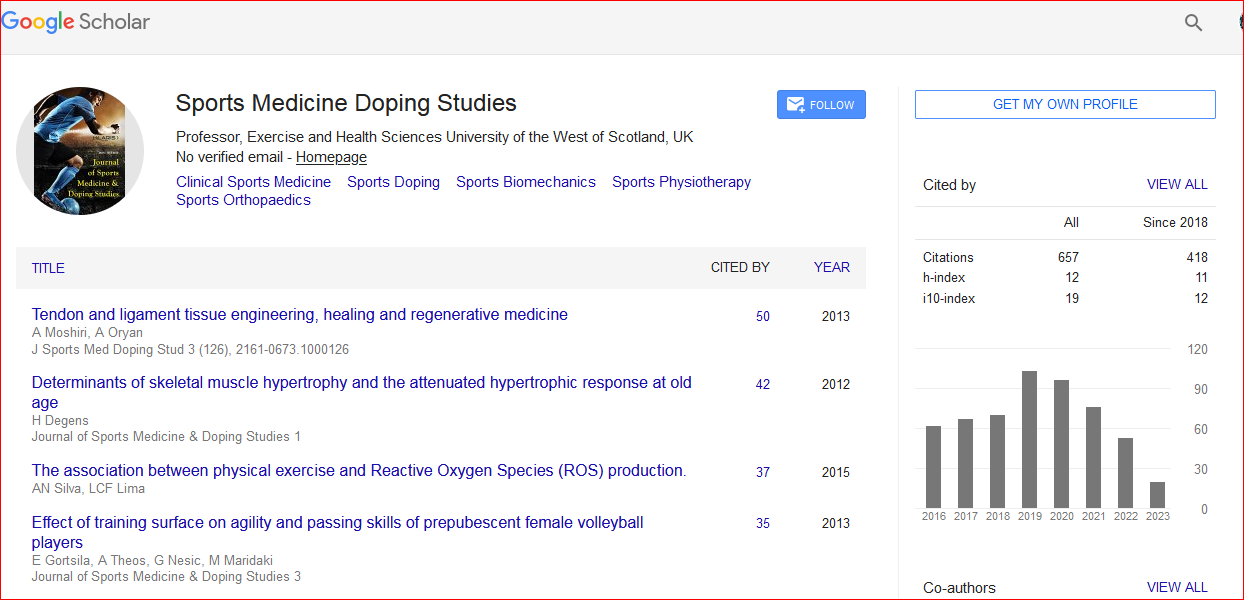
Journal of Sports Medicine & Doping Studies received 1022 citations as per Google Scholar report