Perspective - (2025) Volume 15, Issue 5
Received: 02-Oct-2025, Manuscript No. jeat-26-188648;
Editor assigned: 06-Oct-2025, Pre QC No. P-188648;
Reviewed: 20-Oct-2025, QC No. Q-188648;
Revised: 23-Oct-2025, Manuscript No. R-188648;
Published:
30-Oct-2025
, DOI: 10.37421/2161-0525.2025.15.868
Citation: Benali, Youssef. ”Solvent Risks: Environmental, Health,
and Remediation Challenges.” J Environ Anal Toxicol 15 (2025):868.
Copyright: © 2025 Benali Y. This is an open-access article distributed under the terms of the Creative Commons Attribution License, which permits unrestricted use, distribution
and reproduction in any medium, provided the original author and source are credited.
The pervasive environmental presence of industrial solvents and their multifaceted toxicological impacts are a significant concern for ecological and human health. This review delves into the widespread distribution of common solvents such as toluene, xylene, and chlorinated hydrocarbons, which are released through various industrial processes and product usage, leading to contamination of soil, water, and air systems [1].
The research meticulously details the complex mechanisms of toxicity, encompassing neurotoxicity, hepatotoxicity, and nephrotoxicity, while also outlining crucial biomonitoring strategies essential for assessing exposure levels within ecosystems and human populations. Furthermore, emerging concerns regarding the synergistic toxic effects of solvent mixtures are addressed, underscoring an urgent necessity for the implementation of stricter regulatory controls and the development of innovative remediation techniques to mitigate these environmental burdens [1].
Focusing specifically on the aquatic environment, this study scrutinizes the bioaccumulation and ecotoxicity of volatile organic compounds (VOCs) originating from industrial solvent runoff. It quantifies the uptake of these solvents by aquatic organisms, including fish and invertebrates, and critically assesses their detrimental impact on reproductive success and larval development. The findings unequivocally demonstrate significant adverse effects, even at remarkably low environmental concentrations, thereby posing a substantial threat to aquatic biodiversity. The paper further explores the degradation pathways of these solvents within water bodies and their propensity to transform into more toxic byproducts, necessitating a deeper understanding of their environmental fate [2].
This research undertakes a thorough evaluation of the profound impact that industrial solvent emissions exert on soil microbial communities and their associated ecological functions. Employing advanced sequencing techniques, the study elucidates significant shifts in microbial diversity and alterations in enzyme activity within soils contaminated with solvents like benzene and xylene. It reveals that chronic exposure to these contaminants can precipitate a marked reduction in essential nutrient cycling processes, consequently impairing soil health and hindering plant growth. In response to these findings, the authors propose the implementation of microbial remediation strategies as a viable approach to mitigate these detrimental effects [3].
This paper thoroughly investigates the atmospheric fate and transport dynamics of industrial solvents, examining their substantial contribution to the pervasive issue of air pollution. It delves into the intricate photochemical reactions that these solvents undergo within the troposphere, which ultimately lead to the formation of detrimental ground-level ozone and secondary organic aerosols. Utilizing sophisticated atmospheric modeling tools, the study endeavors to predict the spatial distribution of solvent concentrations and their consequential health implications for populations residing in close proximity to industrial zones. Based on these predictions, the paper offers practical recommendations for the adoption of advanced emission control technologies [4].
This comprehensive review consolidates the current scientific understanding of the neurotoxic effects associated with common industrial solvents. It meticulously details the biochemical and cellular mechanisms by which solvents, including n-hexane and methyl ethyl ketone, disrupt normal neuronal function, leading to observable damage in both the peripheral and central nervous systems. The paper critically discusses established occupational exposure limits, outlines effective diagnostic approaches for identifying solvent-induced neuropathy, and explores the potential for long-term neurological sequelae. Crucially, it emphasizes the paramount importance of implementing robust preventative measures within industrial settings to safeguard worker health [5].
This experimental study investigates the specific mechanisms of hepatotoxicity and nephrotoxicity induced by chronic exposure to a range of industrial solvents commonly found in products such as printing inks and degreasers. Through carefully designed animal models, the research elucidates the intricate cellular and molecular pathways responsible for liver and kidney damage, including the roles of oxidative stress and inflammatory responses. The findings highlight the pronounced dose-dependent nature of these toxic effects and successfully identify specific biomarkers that can facilitate the early detection of organ damage. Furthermore, the study addresses the concerning issue of synergistic toxicity that arises when individuals are co-exposed to multiple solvents simultaneously [6].
This article tackles the significant challenges encountered in the biomonitoring of complex mixtures of industrial solvents within environmental samples. It showcases the application of advanced analytical techniques, notably gas chromatography-mass spectrometry (GC-MS) and liquid chromatography-mass spectrometry (LC-MS), which are instrumental in the accurate identification and quantification of multiple solvents present in water, soil, and various biological matrices. The study strongly emphasizes the critical importance of developing and implementing robust methodologies that are capable of assessing cumulative and synergistic toxic effects, which are frequently underestimated when exposure is evaluated on a solvent-by-solvent basis [7].
This research undertakes a focused examination of the developmental and reproductive toxicity associated with certain industrial solvents that are widely utilized in the plastics and paint manufacturing industries. Employing both in vitro and in vivo models, the study meticulously investigates the multifaceted impact of these solvents on endocrine disruption, fetal development, and overall reproductive outcomes. The findings successfully identify specific solvents that pose considerable risks to reproductive health and development, thereby issuing a strong call for the urgent revision of current risk assessments and regulatory frameworks to ensure the adequate protection of vulnerable populations, particularly pregnant women and young children [8].
This paper presents a comprehensive overview and evaluation of diverse remediation strategies applicable to industrial solvent-contaminated sites. It critically assesses the effectiveness of a range of physical, chemical, and biological methods, including established techniques such as soil vapor extraction, activated carbon adsorption, and bioremediation utilizing specialized microbial consortia. The study further discusses the practical feasibility, cost-effectiveness, and overall environmental impact associated with each proposed technique, aiming to provide valuable guidance for site managers and environmental policymakers. It also candidly highlights the inherent challenges associated with the effective treatment of complex mixtures of industrial solvents [9].
This study explores the increasingly recognized issue of endocrine-disrupting effects stemming from certain industrial solvents, with a particular emphasis on those integrated into consumer products and manufacturing processes. It meticulously examines the intricate ways in which these solvents can interfere with the delicate hormonal systems of both wildlife and humans, potentially leading to a spectrum of adverse health outcomes, including reproductive abnormalities, developmental deficits, and an elevated susceptibility to various diseases. The research emphatically calls for heightened attention to the endocrine-disrupting potential of solvents within environmental risk assessments and advocates for a decisive shift towards the adoption of safer chemical alternatives in industrial applications [10].
The pervasive environmental presence of industrial solvents and their multifaceted toxicological impacts necessitate thorough investigation and understanding. Common solvents like toluene, xylene, and chlorinated hydrocarbons, released through industrial activities and product use, contaminate soil, water, and air. Research details their mechanisms of toxicity, including neurotoxicity, hepatotoxicity, and nephrotoxicity, and explores biomonitoring strategies for exposure assessment in ecosystems and human populations. Concerns about solvent mixtures and their synergistic effects highlight the need for stricter regulations and innovative remediation techniques [1].
In the aquatic realm, the bioaccumulation and ecotoxicity of volatile organic compounds (VOCs) from industrial solvent runoff are examined. Studies quantify solvent uptake by fish and invertebrates, assessing impacts on reproduction and larval development. Findings indicate significant adverse effects even at low concentrations, threatening aquatic biodiversity. Degradation pathways and the formation of toxic byproducts in water bodies are also explored [2].
Industrial solvent emissions significantly impact soil microbial communities and ecological functions. Advanced sequencing reveals shifts in microbial diversity and enzyme activity in soils contaminated with solvents like benzene and xylene. Chronic exposure reduces nutrient cycling, affecting soil health and plant growth. Microbial remediation strategies are proposed to mitigate these effects [3].
The atmospheric fate and transport of industrial solvents and their role in air pollution are investigated. Photochemical reactions in the troposphere lead to ozone and secondary organic aerosol formation. Atmospheric modeling predicts solvent concentrations and health implications for populations near industrial zones, with recommendations for emission control technologies provided [4].
Common industrial solvents exhibit significant neurotoxic effects. Mechanisms by which solvents like n-hexane and methyl ethyl ketone disrupt neuronal function, causing peripheral and central nervous system damage, are detailed. Occupational exposure limits, diagnostic approaches for solvent-induced neuropathy, and potential long-term sequelae are discussed, emphasizing preventative measures in industrial settings [5].
Hepatotoxicity and nephrotoxicity induced by chronic exposure to specific industrial solvents are explored. Animal models elucidate cellular and molecular pathways of liver and kidney damage, including oxidative stress and inflammatory responses. The dose-dependent nature of toxic effects and biomarkers for early detection are highlighted, along with synergistic toxicity from co-exposure [6].
Challenges in biomonitoring complex mixtures of industrial solvents in environmental samples are addressed. Advanced analytical techniques like GC-MS and LC-MS are used for identification and quantification in various matrices. The importance of robust methodologies for assessing cumulative and synergistic toxic effects, often underestimated, is emphasized [7].
Developmental and reproductive toxicity of industrial solvents used in plastics and paint industries are examined. In vitro and in vivo models assess impacts on endocrine disruption, fetal development, and reproductive outcomes. Specific risky solvents are identified, calling for updated risk assessments and regulatory frameworks to protect vulnerable populations like pregnant women and children [8].
A comprehensive review of remediation strategies for industrial solvent-contaminated sites is presented. The effectiveness of physical, chemical, and biological methods, including soil vapor extraction, activated carbon adsorption, and bioremediation, is evaluated. Feasibility, cost-effectiveness, and environmental impact are discussed, offering guidance for site managers and policymakers, and noting challenges in treating complex solvent mixtures [9].
Emerging concerns regarding endocrine-disrupting effects of industrial solvents used in consumer products and manufacturing are explored. These solvents can interfere with hormonal systems in wildlife and humans, leading to reproductive abnormalities, developmental issues, and increased disease susceptibility. The research advocates for greater attention to endocrine-disrupting potential in risk assessments and a move towards safer chemical alternatives [10].
Industrial solvents pose significant environmental and health risks due to their widespread presence and toxicological effects. These chemicals contaminate soil, water, and air, leading to neurotoxicity, hepatotoxicity, nephrotoxicity, and impacts on aquatic life and soil microbial communities. Atmospheric transport contributes to air pollution, while specific solvents can cause developmental and reproductive harm. Addressing these issues requires advanced biomonitoring techniques, effective remediation strategies, and a shift towards safer chemical alternatives. The synergistic toxicity of solvent mixtures further complicates risk assessment and management, emphasizing the need for stricter regulatory controls and comprehensive environmental health strategies.
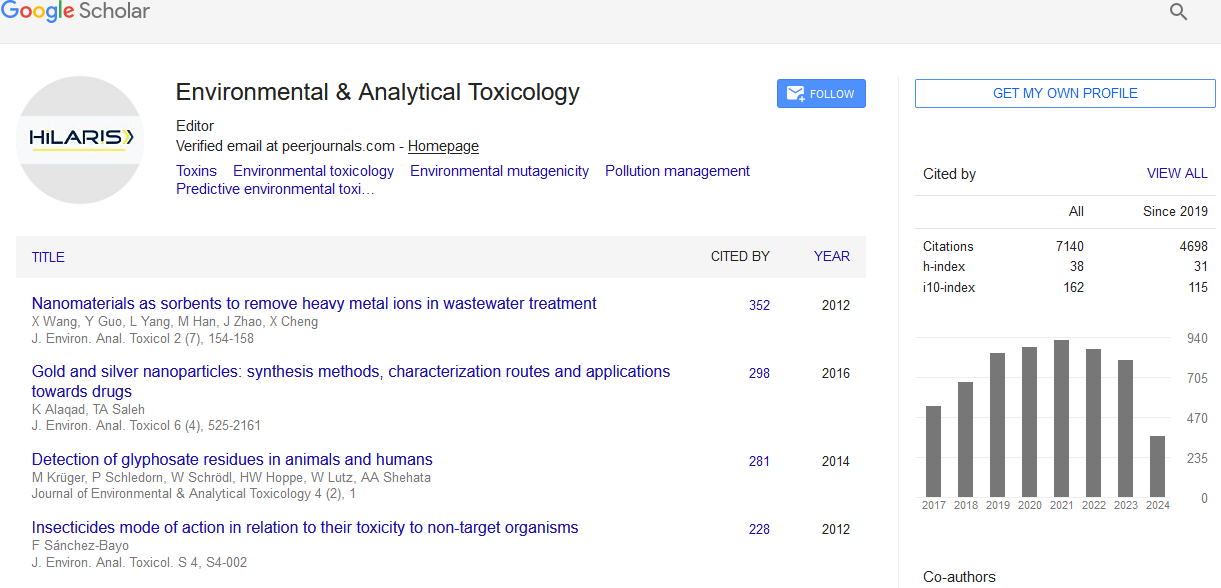
Environmental & Analytical Toxicology received 6818 citations as per Google Scholar report