Commentary - (2025) Volume 13, Issue 5
Received: 01-Oct-2025, Manuscript No. JCMG-26-185563;
Editor assigned: 03-Oct-2025, Pre QC No. P-185563;
Reviewed: 17-Oct-2025, QC No. Q-185563;
Revised: 22-Oct-2025, Manuscript No. R-185563;
Published:
29-Oct-2025
, DOI: 10.37421/2472-128X.2025.13.359
Citation: Rossi, Isabella. ”Single-Cell Genomics: Revolutionizing Precision Medicine.” J Clin Med Genomics 13 (2025):359.
Copyright: © 2025 Rossi I. This is an open-access article distributed under the terms of the Creative Commons Attribution License, which permits unrestricted use, distribution and reproduction in any medium, provided the original author and source are credited.
Single-cell sequencing is a transformative technology fundamentally reshaping the landscape of clinical genomics by offering unparalleled resolution into cellular heterogeneity. This advanced approach allows for detailed examination of individual cells, uncovering critical insights into the intricate mechanisms of diseases, their progression, and the efficacy of various treatment responses. By dissecting complex tissues at the single-cell level, researchers can accurately identify distinct cell populations, delineate their unique genetic profiles, and elucidate their specific roles in a spectrum of conditions, including but not limited to cancer, autoimmune disorders, and developmental abnormalities. The application of single-cell sequencing is steadily expanding beyond fundamental research, increasingly being integrated into diagnostic and prognostic tools, thereby charting a course towards more personalized and effective therapeutic strategies [1].
The capacity to profile individual cells using cutting-edge technologies such as scRNA-seq, scATAC-seq, and single-cell multi-omics is progressively revealing the previously hidden cellular diversity within tumors. This detailed understanding is paramount for deciphering clonal evolution, identifying rare cell populations that confer therapeutic resistance, and ultimately developing more targeted and effective therapies. A significant aspect of recent advancements lies in the development of sophisticated computational tools that are essential for the analysis of the massive datasets generated by single-cell experiments, thereby enabling more robust biological interpretation and facilitating clinical translation [2].
Single-cell technologies are exerting a profound influence on our understanding of the immune system, both in states of health and disease. The ability to analyze immune cells at the single-cell level empowers researchers to identify novel subsets, meticulously map immune responses to infections or cancers, and discover crucial biomarkers for immune-mediated diseases. This granular examination of immune cell diversity is indispensable for the development of next-generation immunotherapies and vaccines, promising new avenues for disease intervention [3].
The clinical utility of single-cell genomics is experiencing a rapid expansion into the realm of diagnostics. The precise identification of specific cell populations or molecular signatures that are intrinsically linked to disease onset, progression, or treatment efficacy is enabling more accurate diagnoses and sophisticated patient stratification. This burgeoning field encompasses critical applications in prenatal diagnostics, the analysis of liquid biopsies, and the early detection of cancers, collectively driving a paradigm shift towards a more personalized approach to healthcare [4].
Single-cell RNA sequencing (scRNA-seq) has emerged as an exceptionally powerful tool for dissecting the complex cellular landscape characteristic of a wide array of diseases. Its application within cancer research, for example, permits the precise identification of tumor cells, stromal cells, and immune cells, offering a comprehensive view of the tumor microenvironment and its profound impact on patient outcomes. This level of detail is absolutely indispensable for the discovery of novel therapeutic targets and the accurate prediction of patient response to therapy [5].
The integration of single-cell genomics with advanced spatial technologies is presenting an unprecedented opportunity to construct detailed cellular atlases within their native tissue contexts. This innovative 'spatial single-cell' approach meticulously preserves the spatial information of cells, thereby enabling researchers to gain a deeper understanding of complex cell-cell interactions and intricate tissue architectures in relation to disease pathology. This is particularly relevant for unraveling how cellular heterogeneity contributes to the pathogenesis of complex diseases [6].
Advancements in single-cell multi-omics are providing a more holistic and integrated view of cellular states by enabling the simultaneous measurement of diverse molecular modalities, such as genomics, transcriptomics, and epigenomics, within individual cells. This comprehensive approach facilitates a deeper understanding of gene regulation, cellular identity, and functional states, which is critically important for identifying disease drivers and uncovering therapeutic vulnerabilities [7].
The clinical implementation of single-cell genomics, while promising, is currently encountering several significant challenges. These include issues related to data standardization, the requirement for substantial computational infrastructure, and the inherent cost associated with large-scale experimentation. Nevertheless, continuous technological improvements and the ongoing development of standardized protocols are steadily paving the way for its more routine integration into clinical settings. The importance of fostering interdisciplinary collaboration is paramount to overcoming these existing hurdles and successfully translating single-cell discoveries into tangible clinical benefits [8].
Single-cell analysis is fundamentally transforming our comprehension of rare diseases by facilitating the identification of cellular phenotypes and molecular mechanisms that were previously intractable to study. This powerful approach holds immense potential for diagnosing rare genetic disorders, elucidating disease pathogenesis at an intricate cellular level, and identifying promising therapeutic targets for conditions that affect a small patient population [9].
The application of single-cell genomics to the field of developmental biology is yielding unparalleled resolution into critical cellular processes such as cell fate decisions, lineage tracing, and the establishment of tissue organization during embryonic development. Understanding these fundamental biological processes at the single-cell level provides crucial insights into the origins of congenital anomalies and the cellular underpinnings of developmental disorders [10].
Single-cell sequencing is revolutionizing clinical genomics by enabling high-resolution analysis of cellular heterogeneity, revealing critical insights into disease mechanisms, progression, and treatment response. This technology allows for the dissection of complex tissues at the individual cell level, identifying distinct cell populations, their genetic profiles, and their roles in conditions like cancer, autoimmune disorders, and developmental abnormalities. Its application is expanding from basic research to diagnostic and prognostic tools, paving the way for more personalized and effective therapeutic strategies [1].
The ability to profile individual cells with technologies like scRNA-seq, scATAC-seq, and single-cell multi-omics is unmasking previously hidden cellular diversity within tumors. This is crucial for understanding clonal evolution, identifying rare cell populations that drive resistance, and developing targeted therapies. The journal highlights advancements in computational tools essential for analyzing the massive datasets generated by single-cell experiments, enabling more robust biological interpretation and clinical translation [2].
Single-cell technologies are profoundly impacting our understanding of the immune system in health and disease. By analyzing immune cells at the single-cell level, researchers can identify novel subsets, map immune responses to infections or cancer, and discover biomarkers for immune-mediated diseases. This deep dive into immune cell diversity is critical for developing next-generation immunotherapies and vaccines [3].
The clinical utility of single-cell genomics is rapidly expanding into diagnostics. Identifying specific cell populations or molecular signatures associated with disease onset, progression, or treatment efficacy allows for more precise diagnosis and patient stratification. This includes applications in prenatal diagnostics, liquid biopsies, and early cancer detection, moving towards a more personalized approach to healthcare [4].
Single-cell RNA sequencing (scRNA-seq) has become a powerful tool for dissecting the cellular landscape of various diseases. Its application in cancer research, for instance, allows for the identification of tumor cells, stromal cells, and immune cells, providing a comprehensive view of the tumor microenvironment and its impact on patient outcomes. This detail is indispensable for developing new therapeutic targets and predicting treatment response [5].
The integration of single-cell genomics with spatial technologies offers an unprecedented opportunity to map cellular atlases in their native tissue context. This 'spatial single-cell' approach preserves the spatial information of cells, allowing researchers to understand cell-cell interactions and tissue architecture in relation to disease pathology. This is particularly relevant for understanding how cellular heterogeneity contributes to complex diseases [6].
Advancements in single-cell multi-omics are providing a more holistic view of cellular states by simultaneously measuring different molecular modalities (e.g., genomics, transcriptomics, epigenomics) within the same cell. This integrated approach allows for a deeper understanding of gene regulation, cellular identity, and functional states, which is crucial for identifying disease drivers and therapeutic vulnerabilities [7].
The clinical implementation of single-cell genomics faces challenges related to data standardization, computational infrastructure, and the cost of experimentation. However, ongoing technological improvements and the development of standardized protocols are paving the way for its routine use in clinical settings. The journal emphasizes the importance of interdisciplinary collaboration to overcome these hurdles and translate single-cell discoveries into tangible clinical benefits [8].
Single-cell analysis is transforming our understanding of rare diseases by enabling the identification of cellular phenotypes and molecular mechanisms that were previously intractable. This approach can help in diagnosing rare genetic disorders, understanding disease pathogenesis at a cellular level, and identifying potential therapeutic targets for conditions affecting a small patient population [9].
The application of single-cell genomics to developmental biology is providing unparalleled resolution into cell fate decisions, lineage tracing, and the establishment of tissue organization during embryonic development. Understanding these fundamental processes at the single-cell level offers crucial insights into congenital anomalies and the cellular basis of developmental disorders [10].
Single-cell sequencing is revolutionizing clinical genomics by providing high-resolution analysis of cellular heterogeneity, crucial for understanding disease mechanisms and developing personalized therapies. Technologies like scRNA-seq and multi-omics are revealing hidden cellular diversity in tumors, essential for targeted treatments. The immune system's complexity is being unraveled, leading to advancements in immunotherapies. Single-cell genomics is expanding into diagnostics for precise patient stratification and early disease detection. Spatial single-cell approaches are mapping cellular atlases in tissue context, and multi-omics offers a holistic view of cellular states. Despite challenges in clinical implementation like data standardization and cost, ongoing improvements and collaboration are paving the way for its wider adoption. This technology is also transformative for rare disease research and developmental biology, offering deep insights into cellular processes and disease pathogenesis.
None
None
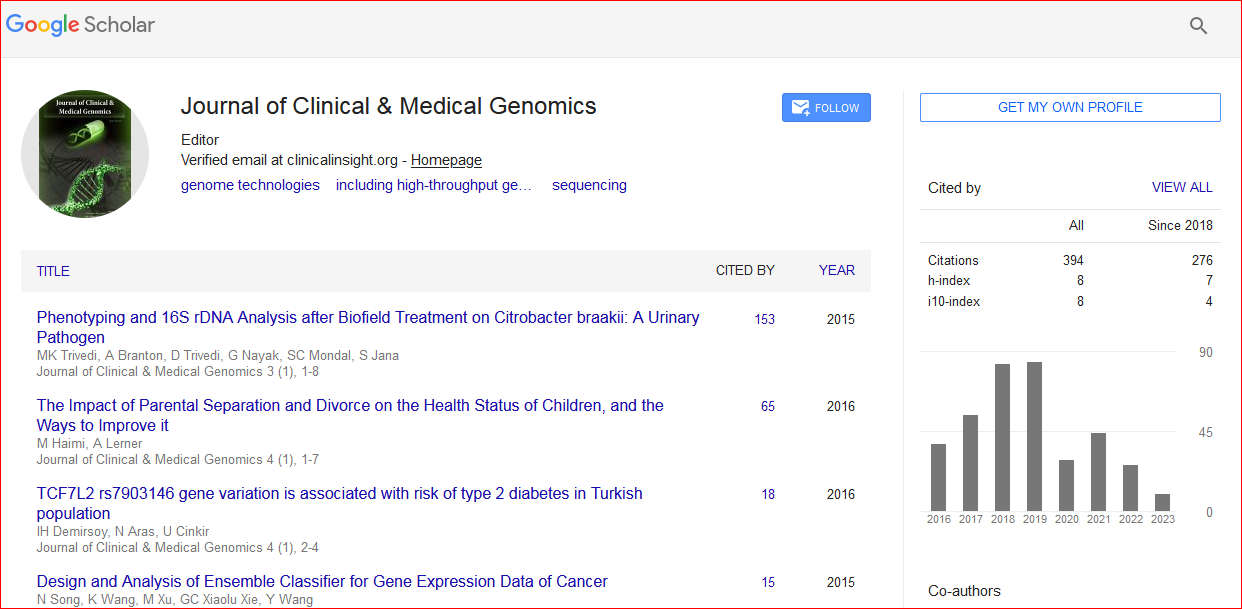
Journal of Clinical & Medical Genomics received 391 citations as per Google Scholar report