Opinion - (2025) Volume 11, Issue 4
Received: 01-Aug-2025, Manuscript No. jctt-26-188416;
Editor assigned: 04-Aug-2025, Pre QC No. P-188416;
Reviewed: 18-Aug-2025, QC No. Q-188416;
Revised: 22-Aug-2025, Manuscript No. R-188416;
Published:
29-Aug-2025
, DOI: 10.37421/2471-9323.2024.10.334
Citation: AlMansouri, Noor. ”Shine Bright: The Science of Luminous Hair.” J Cosmo Tricho 11 (2025):334.
Copyright: © 2025 AlMansouri N. This is an open-access article distributed under the terms of the Creative Commons Attribution License, which permits unrestricted use, distribution and reproduction in any medium, provided the original author and source are credited.
The pursuit of luminous hair is intricately linked to a comprehensive understanding of scalp health and the vitality of hair follicles, forming the bedrock of healthy and radiant locks [1].
Maintaining a balanced scalp microbiome through gentle cleansing practices is paramount for fostering an optimal environment for hair growth and shine. Disruptions within the scalp's microbial ecosystem can precipitate inflammatory responses and impede the natural hair growth cycle, underscoring the importance of its delicate balance [2].
The integrity of the hair shaft, particularly the outer layer known as the cuticle, plays a critical role in how light reflects off the hair, directly influencing its perceived luminescence and smoothness [3].
Nutritional status exerts a profound influence on the synthesis of keratin, the primary structural protein of hair, and the overall function of hair follicles, highlighting the internal factors that contribute to hair quality [4].
Environmental stressors, such as ultraviolet radiation and atmospheric pollutants, can induce oxidative damage to the hair structure, diminishing its natural sheen and overall health [5].
Adequate hydration of the hair fiber is essential for maintaining its suppleness and its capacity to reflect light effectively, with dehydrated hair exhibiting a dull and brittle appearance [6].
Factors influencing hair color intensity and vibrancy, such as melanin content and the structural soundness of the hair shaft, also contribute to the perception of luminosity by ensuring rich and uniform color tones [7].
The application of heat styling tools, while often used to achieve desired aesthetics, can inflict significant damage to the hair shaft, compromising its surface smoothness and thus its luminous quality [8].
Specialized hair care products, including oils and serums, can offer both immediate cosmetic improvements and long-term conditioning benefits by smoothing the cuticle and enhancing light reflection [9].
Understanding the nuances of hair porosity is fundamental for selecting appropriate treatments that optimize moisture absorption and retention, thereby promoting healthy hair and a radiant glow [10].
Achieving luminous hair necessitates a multifaceted approach that begins with the foundational elements of scalp health and hair follicle vitality. Gentle cleansing regimens are crucial for preserving the scalp microbiome, which in turn supports healthy hair growth and sheen [1].
A healthy scalp microbiome is a key determinant of aesthetic hair quality; imbalances can lead to inflammation and hinder follicular function, making interventions like probiotics and prebiotics vital for restoration [2].
The smoothness of the hair shaft's cuticle is directly correlated with its ability to reflect light, which is the primary contributor to a hair's luminous appearance. Damage to the cuticle results in a duller finish [3].
Proper nutrition is indispensable for the synthesis of keratin and the optimal functioning of hair follicles. Deficiencies in essential micronutrients can negatively impact hair growth and its inherent luster [4].
External factors like UV exposure and environmental pollutants can induce oxidative stress in the hair, degrading its structure and leading to a loss of shine. Antioxidants can offer protection against this damage [5].
The moisture content within the hair fiber significantly affects its pliability and light-reflecting capabilities. Well-hydrated hair appears smoother and more radiant, while dehydrated hair becomes brittle [6].
Maintaining the vibrancy and stability of hair color, which is influenced by melanin and hair shaft integrity, also plays a role in overall luminosity by ensuring consistent and rich tones [7].
Excessive use of heat styling tools can cause structural damage to the hair, increasing porosity and reducing shine. The use of heat protectants is therefore important [8].
Topical applications such as hair oils and serums can enhance gloss by smoothing the cuticle and improving light reflection, offering both aesthetic and conditioning benefits [9].
Individual hair porosity levels dictate how well hair absorbs and retains moisture, directly influencing its health and appearance. Tailoring product selection to porosity is essential for achieving optimal results [10].
Luminous hair is achieved through a combination of factors including scalp health, hair follicle vitality, and hair shaft integrity. Gentle cleansing and maintaining a balanced scalp microbiome are crucial. The cuticle's smoothness is essential for light reflection, and damage to it leads to dullness. Proper nutrition supports keratin synthesis and hair follicle function. Environmental factors like UV radiation can cause oxidative stress, while hydration is vital for hair's pliability and shine. Heat styling can damage the hair shaft, reducing its luster. Hair oils and serums can improve shine by smoothing the cuticle. Understanding hair porosity is key to selecting effective treatments for optimal hair health and glow.
None
None
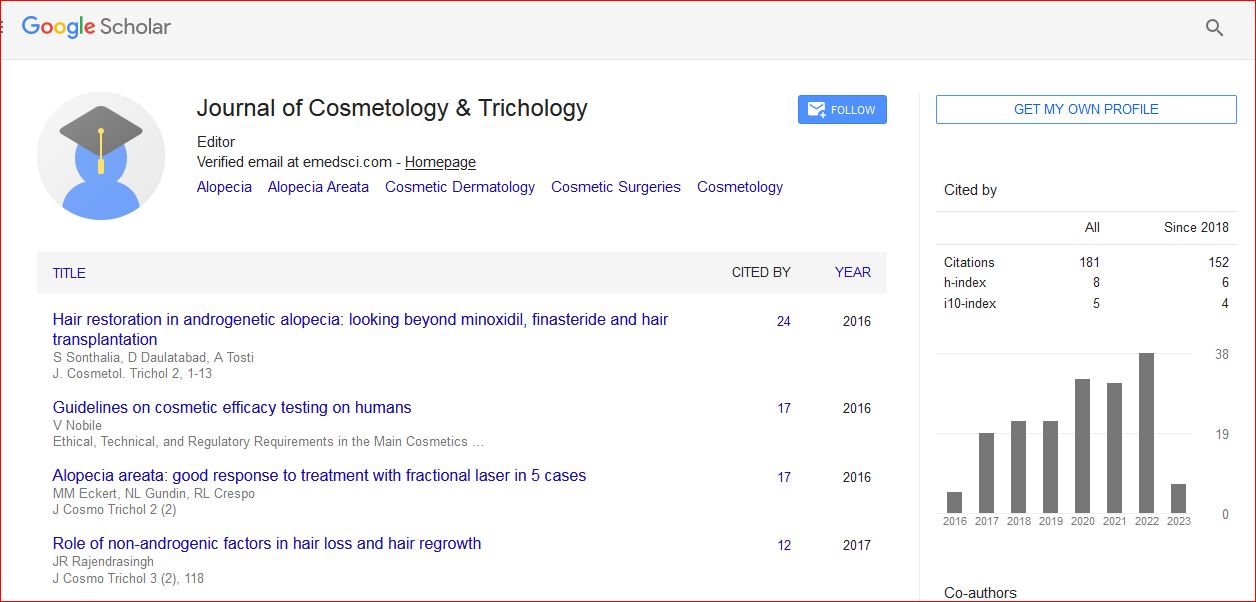
Journal of Cosmetology & Trichology received 180 citations as per Google Scholar report