Opinion - (2025) Volume 15, Issue 5
Received: 01-Sep-2025, Manuscript No. jnt-26-178960;
Editor assigned: 03-Sep-2025, Pre QC No. P-178960;
Reviewed: 17-Sep-2025, QC No. Q-178960;
Revised: 22-Sep-2025, Manuscript No. R-178960;
Published:
29-Sep-2025
, DOI: 10.37421/2161-0959.2025.15.583
Citation: Figueroa, Mateo. ”Sex Differences Impact Chronic Kidney Disease Progression And Outcomes.” J Nephrol Ther 15 (2025):583.
Copyright: © 2025 Figueroa M. This is an open-access article distributed under the terms of the Creative Commons Attribution License, which permits unrestricted use, distribution and reproduction in any medium, provided the original author and source are credited.
The progression and outcomes of chronic kidney disease (CKD) exhibit notable sex-specific differences, with women often demonstrating a slower decline in kidney function. However, they are more frequently affected by certain kidney diseases such as lupus nephritis. Despite this, women encounter distinct challenges in achieving optimal treatment responses and accessing adequate healthcare, highlighting a growing recognition of sex-specific considerations in the comprehensive management of CKD and its associated complications, including cardiovascular risk and anemia [1].
Investigating the underlying sex-specific mechanisms that drive the development of kidney fibrosis is a critical area of research. It is widely believed that variations in immune responses, the influence of sex hormones like estrogen and testosterone, and differing genetic predispositions collectively contribute to the observed disparities in susceptibility and the rate at which kidney damage progresses between sexes. The development of targeted therapeutic strategies that explicitly account for these sex-based differences holds significant promise for improving patient outcomes [2].
In the context of polycystic kidney disease (PKD), a genetic disorder characterized by cyst formation in the kidneys, sex-based differences are also apparent in both disease onset and its subsequent progression. Typically, men tend to experience an earlier onset of PKD and a more rapid progression of the disease compared to women. A comprehensive understanding of these disparities is fundamental for the development of personalized management strategies that are tailored to the specific needs of each sex, including potentially differing responses to established therapies like tolvaptan [3].
The efficacy and safety of immunosuppressive therapies, particularly in the management of glomerular diseases such as lupus nephritis, are significantly influenced by sex. Given that women are disproportionately affected by lupus, they may exhibit varied responses to specific immunosuppressant medications. This necessitates meticulous monitoring of treatment effectiveness and potential adjustments to therapeutic regimens to optimize outcomes and minimize adverse events [4].
Cardiovascular disease (CVD) stands as a major and often debilitating complication of CKD, and it is well-established that sex differences exist in both the risk factors that predispose individuals to CVD and the ultimate outcomes. Notably, women diagnosed with CKD face an elevated risk of experiencing cardiovascular events when compared to men without CKD. Furthermore, the clinical presentation and the optimal management strategies for CVD in women with CKD may differ, underscoring the need for individualized preventive approaches [5].
Anemia, a common co-morbidity in CKD, also presents unique sex-specific considerations that warrant careful attention. While women are generally more susceptible to anemia due to factors such as regular menstruation, the body's response to treatments like erythropoiesis-stimulating agents (ESAs) and iron supplementation can also vary between sexes. These sex-based differences in treatment response emphasize the importance of adopting individualized treatment plans [6].
The intricate role of sex hormones in maintaining kidney health and influencing the pathogenesis of kidney diseases is a subject of ongoing investigation. Estrogen, for instance, has been shown to exert protective effects in certain kidney conditions, while higher levels of androgens might be associated with increased kidney injury in men. Continued research efforts are essential to fully elucidate these complex hormonal influences on disease mechanisms and therapeutic interventions [7].
Genetic factors play a substantial role in shaping the observed sex differences in kidney diseases. Variations within genes that are critical for immune system regulation, hormone signaling pathways, and the developmental processes of the kidney can lead to differential susceptibility to disease and distinct patterns of progression between men and women. A thorough understanding of these genetic underpinnings is indispensable for the advancement of personalized medicine approaches in nephrology [8].
The immune system is a pivotal player in the development and progression of kidney injury. Sex differences in the functional characteristics of immune cells and the profiles of secreted cytokines can significantly impact how kidney diseases evolve. Women often exhibit a more robust innate and adaptive immune response, which, while potentially beneficial in some contexts, can also contribute to the development of autoimmune kidney diseases [9].
Disparities based on sex can also be observed in the access to and uptake of essential kidney replacement therapies (KRT), such as dialysis and kidney transplantation. Various factors, including socioeconomic status, the availability and quality of social support systems, and potential physician bias in treatment recommendations, can influence referral rates and the choices made regarding KRT. These disparities can ultimately have a significant impact on the long-term health outcomes for both men and women requiring such interventions [10].
Chronic kidney disease (CKD) exhibits significant sex-based variations in its progression and overall outcomes. While women may experience a more gradual decline in kidney function, they are more prone to specific kidney conditions like lupus nephritis. Furthermore, women often face unique obstacles in achieving satisfactory treatment responses and in accessing equitable healthcare, underscoring the increasing acknowledgment of sex-specific factors in managing CKD and its related issues, including cardiovascular risks and anemia [1].
Elucidating the specific sex-driven mechanisms contributing to kidney fibrosis is of paramount importance. It is hypothesized that differences in immune system activity, the influence of hormones such as estrogen and testosterone, and genetic variations contribute to the varied susceptibility and progression rates of kidney damage between sexes. The implementation of targeted therapies that consider these sex-specific differences is expected to enhance patient outcomes [2].
In the realm of polycystic kidney disease (PKD), sex differences are evident in terms of disease onset and progression, with men generally presenting with an earlier onset and a faster disease trajectory. Understanding these sex-based disparities is crucial for developing management strategies tailored to each sex, including the potential for differential responses to therapeutic agents like tolvaptan [3].
The effectiveness and safety of immunosuppressive treatments for glomerular diseases, such as lupus nephritis, are notably influenced by sex. As women are more commonly diagnosed with lupus, their responses to certain immunosuppressants may differ, necessitating careful monitoring and potential modifications to treatment plans to ensure optimal care [4].
Cardiovascular disease (CVD) is a significant complication of CKD, and sex differences are well-documented in both risk factors and outcomes. Women with CKD have a higher risk of CVD events compared to men without CKD, and their clinical presentation and management of CVD may diverge, requiring the implementation of tailored prevention strategies [5].
Anemia associated with CKD also presents sex-specific considerations. While women are more likely to develop anemia due to factors like menstruation, their response to treatments such as erythropoiesis-stimulating agents (ESAs) and iron therapy can also differ from men, emphasizing the need for individualized treatment approaches [6].
The complex role of sex hormones in kidney health and disease is a subject of active research. Estrogen, for example, can offer protective effects in certain kidney conditions, while androgen levels might influence the extent of kidney injury in men. Continued research is vital to fully unravel these hormonal influences on disease pathogenesis and therapeutic responses [7].
Genetic factors contribute significantly to the sex differences observed in kidney diseases. Variations in genes that regulate immune responses, hormone signaling, and kidney development can lead to differential susceptibility and progression rates. A deep understanding of these genetic underpinnings is essential for advancing personalized medicine in the field of nephrology [8].
The immune system plays a crucial role in kidney injury, and sex-based differences in immune cell function and cytokine production can affect disease progression. Women often exhibit a more potent innate and adaptive immune response, which can be advantageous but also contribute to the development of autoimmune kidney diseases [9].
Sex-based disparities are also observed in access to and utilization of kidney replacement therapies (KRT), including dialysis and transplantation. Factors such as socioeconomic status, social support networks, and physician recommendations can influence referral rates and treatment choices, ultimately impacting long-term outcomes for both men and women requiring these life-sustaining interventions [10].
Sex significantly influences the progression and outcomes of chronic kidney disease (CKD), with women often experiencing a slower decline in kidney function but facing unique challenges in treatment and care access. Sex-specific mechanisms involving hormones, genetics, and immune responses contribute to disparities in various kidney diseases like lupus nephritis and polycystic kidney disease, where men may have earlier onset and faster progression. Cardiovascular disease is a major complication with differing risks and presentations between sexes in CKD patients. Anemia in CKD also shows sex-specific considerations, impacting treatment responses. Understanding these sex differences is crucial for developing tailored therapies and improving overall patient management and access to kidney replacement therapies.
None
None
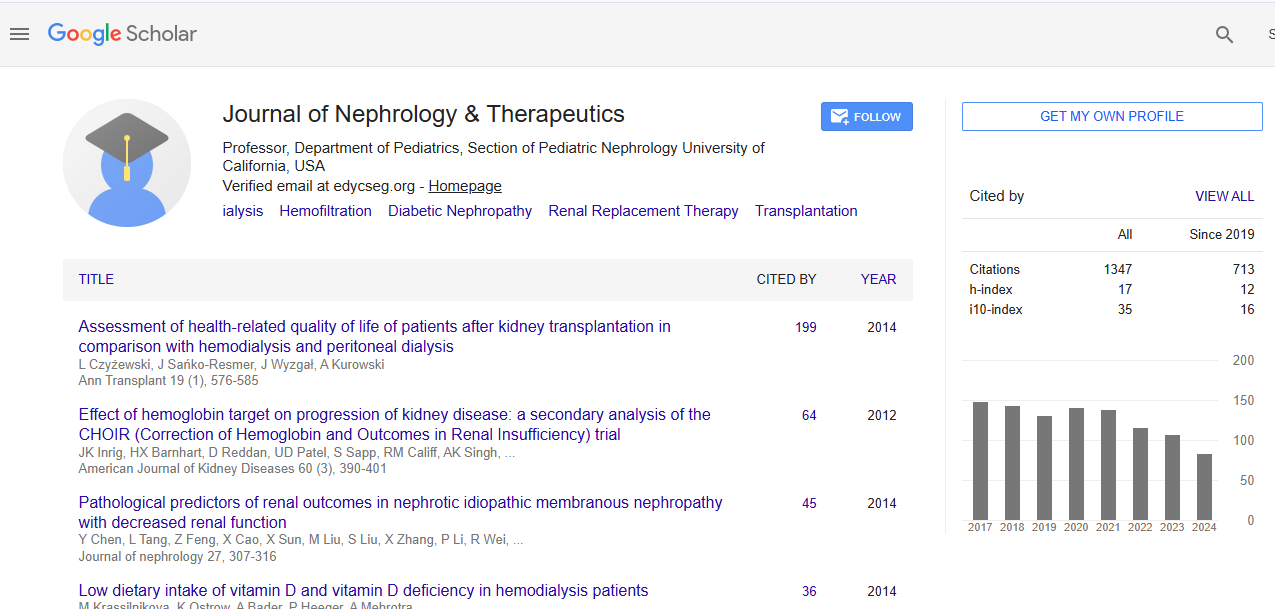
Journal of Nephrology & Therapeutics received 784 citations as per Google Scholar report