Short Communication - (2025) Volume 11, Issue 6
Received: 01-Dec-2025, Manuscript No. jctt-26-188440;
Editor assigned: 03-Dec-2025, Pre QC No. P-188440;
Reviewed: 17-Dec-2025, QC No. Q-188440;
Revised: 22-Dec-2025, Manuscript No. R-188440;
Published:
29-Dec-2025
, DOI: 10.37421/2471-9323.2024.10.358
Citation: Mwangi, Daniel. ”Scalp-Skin Health: Advances in Biomolecules and Aging.” J Cosmo Tricho 11 (2025):358.
Copyright: © 2025 Mwangi D. This is an open-access article distributed under the terms of the Creative Commons Attribution License, which permits unrestricted use, distribution and reproduction in any medium, provided the original author and source are credited.
The intricate relationship between hair and skin health is a multifaceted area of dermatological study, with a growing appreciation for the interconnectedness of these two vital integuments. Recent research has begun to elucidate how scalp conditions can manifest externally, profoundly impacting overall cosmetic appearance and individual confidence. Understanding the microbiome of the scalp has emerged as a critical frontier, with studies exploring its role in hair follicle cycling and the integrity of the skin barrier, leading to innovative biotechnological approaches for targeted treatments and a focus on cultivating a healthy scalp environment for vibrant hair and clear skin [1].
Complementing the understanding of microbial influences, the biochemical mechanisms governing hair pigmentation and its relationship to skin photodamage are under intense investigation. The protective role of melanin, the primary pigment responsible for hair and skin color, is being further defined, with research examining how factors influencing melanosome formation and transfer can impact both hair color stability and the skin's natural defense against harmful UV radiation, presenting potential targets for cosmetic interventions by exploring the interplay between hair follicle melanocytes and epidermal keratinocytes [2].
Furthermore, the significant influence of androgens on both hair growth cycles and sebaceous gland activity is being systematically explored. These hormonal signals are critical for maintaining scalp health and ensuring adequate skin hydration. Detailed analysis of the molecular pathways involved, including the pivotal role of androgen receptors, offers crucial insights into conditions like androgenetic alopecia and acne, suggesting therapeutic avenues for regulating hair follicle miniaturization and sebum production [3].
Environmental stressors, such as pervasive pollution and relentless UV radiation, represent another significant challenge to the health of both hair and skin. Research is actively investigating the impact of these external agents on hair shaft integrity and skin photodamage, focusing on the underlying oxidative stress mechanisms. The proposal that antioxidants and protective barrier enhancers can effectively mitigate such damage, thereby maintaining hair strength and skin elasticity, is gaining traction, with particular attention paid to the synergistic effects of combined environmental insults [4].
In the realm of advanced cosmetic ingredient development, biotechnological applications are revolutionizing approaches to hair and skin rejuvenation. Cutting-edge research highlights the efficacy of peptides and growth factors, detailing their mechanisms of action in stimulating collagen synthesis, promoting hair follicle regeneration, and improving skin texture. The potential for topical delivery systems to significantly enhance the efficacy of these potent agents is also a key area of exploration [5].
Scalp inflammation has been identified as a common underlying factor in a diverse range of dermatological conditions that significantly affect hair health. Conditions such as psoriasis and seborrheic dermatitis are being studied to understand how inflammatory mediators can disrupt the delicate hair growth cycle and compromise the scalp's crucial barrier function, leading to both hair thinning and noticeable skin irritation. Consequently, anti-inflammatory strategies are being advanced as essential therapeutic avenues [6].
As individuals age, the biochemical and physiological changes that occur in hair, including loss of luster, reduced tensile strength, and altered texture, become more pronounced. Concurrent skin aging processes, characterized by diminished elasticity and increased wrinkling, are also being examined in relation to these hair changes. The interconnectedness of these aging phenomena, with a particular emphasis on the role of free radicals and declining cellular function, is a central theme in current gerontological research [7].
Plant-derived stem cells and bioactive compounds are emerging as promising natural alternatives for promoting hair growth and skin regeneration. This area of research highlights their inherent antioxidant, anti-inflammatory, and growth-factor-like properties, offering a sustainable approach to combating hair thinning and improving overall skin vitality. The scientific basis supporting the efficacy of these botanical extracts is undergoing critical evaluation [8].
Essential fatty acids play a fundamental role in maintaining the integrity of both the scalp and the skin barrier. Specific fatty acids, such as linoleic acid and alpha-linolenic acid, are known to contribute significantly to epidermal hydration, reduce transepidermal water loss, and effectively modulate inflammatory responses. These functions are crucial for supporting healthy hair growth and preventing common issues like skin dryness and irritation, with deficiencies leading to adverse consequences [9].
Finally, the intricate communication pathways between the hair follicle and its surrounding skin environment are being increasingly recognized as vital for maintaining scalp and hair health. This complex crosstalk involves structures such as the dermal papilla, sebaceous glands, and immune cells. Disruptions in this dialogue are strongly implicated in various scalp disorders and hair loss conditions, prompting the development of novel therapeutic strategies aimed at restoring this crucial biological dialogue [10].
The study of the scalp microbiome reveals its critical role in hair follicle cycling and the maintenance of skin barrier function, paving the way for biotechnological interventions that promote a healthy scalp for optimal hair and skin health [1].
Research into melanogenesis uncovers the protective functions of melanin against skin photodamage and its influence on hair pigmentation, suggesting targets for cosmetic treatments to address pigmentation disorders and hair graying by understanding melanosome dynamics and melanocyte-keratinocyte interactions [2].
The signaling pathways of androgens in hair follicles and sebaceous glands are critical for scalp health and skin hydration, with implications for conditions like hair loss and acne, offering insights into regulating follicle miniaturization and sebum production through androgen receptor modulation [3].
Environmental factors such as pollution and UV radiation induce oxidative stress, impacting hair shaft integrity and skin photodamage. Strategies involving antioxidants and barrier enhancers are being explored to counteract these effects and preserve hair strength and skin elasticity, acknowledging the combined impact of multiple stressors [4].
Biotechnological advancements are driving the development of novel cosmetic ingredients, particularly peptides and growth factors, which show promise in stimulating collagen production, hair follicle regeneration, and improving skin texture, with ongoing research into optimized topical delivery systems for enhanced efficacy [5].
Scalp inflammation, a common feature in dermatological conditions like psoriasis and seborrheic dermatitis, significantly disrupts the hair growth cycle and compromises the skin barrier, leading to hair thinning and irritation. Anti-inflammatory therapies are therefore essential for managing these conditions [6].
Aging affects both hair and skin through molecular and cellular changes. Hair loses luster and strength, while skin loses elasticity. The interconnectedness of these aging processes, influenced by oxidative stress and reduced cellular function, presents opportunities for therapeutic interventions [7].
Plant-derived stem cells and phytochemicals are gaining attention for their potential in promoting hair growth and skin rejuvenation due to their antioxidant and anti-inflammatory properties. Their ability to mimic growth factors offers a natural approach to improving hair vitality and skin health [8].
Essential fatty acids are crucial for maintaining the skin barrier and scalp integrity. Their role in epidermal hydration, reducing water loss, and modulating inflammation supports healthy hair growth and prevents dryness and irritation, highlighting the importance of adequate intake [9].
The complex communication between the hair follicle and the surrounding skin microenvironment, including dermal papilla, sebaceous glands, and immune cells, is essential for hair biology. Dysregulation of this crosstalk can lead to scalp disorders and hair loss, necessitating strategies to restore this dialogue [10].
This collection of research highlights the interconnectedness of hair and skin health, exploring factors from the scalp microbiome and hormonal influences to environmental stressors and aging. Recent advancements in biotechnology, including the use of peptides, growth factors, and plant-derived stem cells, offer promising avenues for rejuvenation and treatment. The role of inflammation, essential fatty acids, and the intricate communication between the hair follicle and skin are also emphasized as critical determinants of scalp and hair vitality. Understanding these complex mechanisms is key to developing effective cosmetic and therapeutic strategies.
None
None
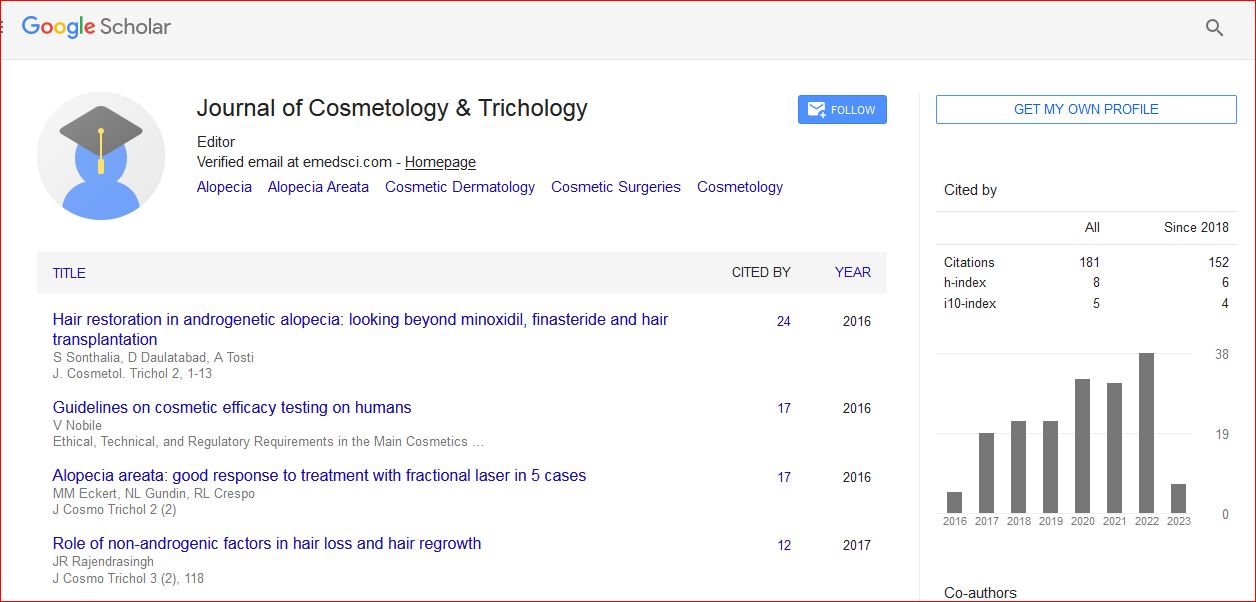
Journal of Cosmetology & Trichology received 180 citations as per Google Scholar report