Opinion - (2025) Volume 16, Issue 3
Received: 02-Jun-2025, Manuscript No. jbsbe-26-183298;
Editor assigned: 04-Jun-2025, Pre QC No. P-183298;
Reviewed: 18-Jun-2025, QC No. Q-183298;
Revised: 23-Jun-2025, Manuscript No. R-183298;
Published:
30-Jun-2025
, DOI: 10.37421/2165-6210.2025.16.504
Citation: Kibet, Samuel. ”Revolutionizing Healthcare With Implantable Bioelectronic Devices.” J Biosens Bioelectron 16 (2025):504.
Copyright: © 2025 Kibet S. This is an open-access article distributed under the terms of the Creative Commons Attribution License, which permits unrestricted use, distribution and reproduction in any medium, provided the original author and source are credited.
Implantable biosensors and bioelectronic devices represent a paradigm shift in modern healthcare, offering unparalleled capabilities for continuous, real-time monitoring of physiological parameters directly within the human body. This advanced technology facilitates targeted therapeutic interventions, providing deep insights into disease progression and individual patient responses to treatments. The miniaturization and biocompatibility of these devices are crucial for their seamless integration and long-term efficacy in clinical settings. Their wireless communication features further enhance their utility, enabling remote data access and management, which is pivotal for personalized medicine and the early detection of various health conditions. These innovations are fundamentally transforming how we approach chronic disease management and neurological interfacing, promising a future of more proactive and precise healthcare interventions. The development of materials that are both biocompatible and biodegradable is a cornerstone for the success and safety of implantable bioelectronic devices. Researchers are actively exploring novel polymers and advanced nanomaterials designed to integrate harmoniously with biological tissues. This research aims to minimize adverse immune responses and ensure that the devices can eventually degrade harmlessly after fulfilling their intended purpose. Addressing the challenges related to chronic inflammation and device rejection through biomaterial innovation is essential for widespread adoption. Wireless power transfer and robust data communication systems are indispensable for the operational integrity of implantable devices. These technologies eliminate the need for percutaneous wires, a common source of infection and patient discomfort. Cutting-edge advancements in inductive coupling and radio frequency transmission ensure a continuous power supply and facilitate remote monitoring. This seamless connectivity not only enhances patient comfort and device longevity but also enables efficient data integration with external platforms for sophisticated analysis and personalized feedback. Minimally invasive implantation techniques are critical for minimizing patient trauma and accelerating recovery times associated with the placement of implantable biosensors. The application of advanced surgical robotics and sophisticated micro-fabrication methods allows for the insertion of these devices through very small incisions. This approach significantly improves patient outcomes and expands the potential clinical applicability of these technologies. The focus is on developing devices that are not only highly functional but also exceptionally easy and safe to deploy in a clinical setting. Bioelectronic interfaces tailored for neural applications, including brain-computer interfaces and neuroprosthetics, mark a significant frontier in medical technology. These sophisticated devices are designed to restore lost sensory or motor functions by directly interpreting and interacting with neural signals within the brain. Despite considerable progress, significant challenges persist in achieving long-term operational stability, acquiring high-resolution neural data, and ensuring biocompatibility within the intricate neural environment. Continuous glucose monitoring (CGM) systems stand out as a prominent and highly successful application of implantable biosensor technology, dramatically improving the management of diabetes. These devices furnish real-time glucose level readings, empowering individuals to make proactive adjustments to their insulin regimens and lifestyle choices. Current research efforts are concentrated on elevating accuracy, minimizing the need for frequent calibrations, and extending the operational lifespan of these sensors to enhance patient convenience and achieve superior glycemic control. The integration of artificial intelligence (AI) and machine learning (ML) with the vast datasets generated by implantable biosensors is unlocking transformative potential for predictive diagnostics and highly personalized treatment strategies. AI algorithms possess the remarkable ability to analyze complex patterns within physiological data, thereby facilitating the early detection of disease onset or emergent complications. Furthermore, AI can optimize therapeutic responses in real-time, heralding a new era of proactive and exceptionally effective healthcare management. Energy harvesting techniques are undergoing rapid development to provide sustainable power sources for implantable bioelectronic devices, thereby reducing their dependence on conventional batteries. Innovative methods such as piezoelectric, thermoelectric, and bio-fuel cell energy harvesting can efficiently convert ambient biological energy into usable electrical power. This capability is crucial for extending the operational lifetime of implantable devices and minimizing the frequency of invasive battery replacement procedures, especially for long-term applications. The incorporation of sophisticated microfluidic systems within biosensors opens up new possibilities for implantable devices, allowing for the precise manipulation and in-depth analysis of biological samples directly within the body. These advanced microfluidic systems are capable of performing complex biochemical assays in situ, which is essential for the accurate detection of various biomarkers indicative of disease states. The miniaturization and inherent automation capabilities of microfluidics are fundamental to creating compact, potent, and highly effective biosensing platforms. Crucially, the cybersecurity and data privacy surrounding implantable biosensors and their associated bioelectronic devices are of paramount importance, given their capacity to collect highly sensitive personal health information. Implementing robust security protocols is indispensable to safeguard against unauthorized access, prevent data breaches, and mitigate the risks of malicious manipulation of device functionalities. Ethical considerations and evolving regulatory frameworks are critical in addressing these vital aspects of connected health technologies.
Implantable biosensors and bioelectronic devices are fundamentally reshaping the landscape of healthcare by enabling continuous, real-time monitoring of physiological parameters and facilitating targeted therapeutic interventions directly within the body. These advanced systems offer unprecedented insights into disease progression and patient responses, paving the way for personalized medicine and the early detection of health issues. Key factors driving their adoption across diverse medical applications, from chronic disease management to neural interfacing, include their miniaturization, biocompatibility, and sophisticated wireless communication capabilities. The development and utilization of biocompatible and biodegradable materials are indispensable for ensuring the long-term efficacy and safety of implantable bioelectronic devices. Significant research efforts are being directed towards novel polymers and nanomaterials that can seamlessly integrate with biological tissues, thereby minimizing immune responses and promoting harmless degradation after their intended lifespan. This focus on advanced biomaterials directly addresses the critical challenges associated with preventing chronic inflammation and device rejection, ensuring better patient outcomes. Wireless power transfer and data communication mechanisms are essential components that ensure the functionality of implantable devices, effectively eliminating the need for percutaneous wires, which are often associated with infection risks. Innovations in inductive coupling and radio frequency transmission technologies enable continuous power supply and facilitate remote monitoring, significantly enhancing both patient comfort and the overall longevity of the devices. This connectivity also supports the seamless integration of collected data with external platforms for comprehensive analysis and personalized feedback. Minimally invasive implantation techniques are vital for reducing patient trauma and shortening recovery periods associated with the insertion of implantable biosensors. The deployment of advanced surgical robotics and sophisticated micro-fabrication techniques allows for the precise placement of these devices through small incisions. This approach leads to improved patient outcomes and expands the applicability of these technologies in various clinical settings, emphasizing safe and efficient deployment. Bioelectronic interfaces designed for neural applications, such as brain-computer interfaces and neuroprosthetics, represent a rapidly advancing area of research and development. These devices aim to restore lost sensory or motor functions by establishing direct communication with neural signals. However, considerable challenges remain in achieving long-term stability, high signal resolution, and ensuring adequate biocompatibility within the complex and sensitive neural environment. Continuous glucose monitoring (CGM) systems exemplify a highly successful application of implantable biosensor technology, significantly enhancing the management of diabetes mellitus. These systems provide real-time glucose readings, allowing patients to make timely and informed adjustments to their insulin therapy and lifestyle. Ongoing research aims to further improve accuracy, reduce the need for frequent calibrations, and extend the sensor lifespan, ultimately improving patient convenience and glycemic control. The integration of artificial intelligence (AI) and machine learning (ML) with data from implantable biosensors is unlocking new avenues for predictive diagnostics and personalized treatment strategies. AI algorithms can analyze complex patterns in physiological data, enabling the early identification of disease onset or complications and optimizing therapeutic responses in real-time. This synergistic approach promises more proactive and effective healthcare solutions. Energy harvesting techniques are being actively developed to provide sustainable power for implantable bioelectronic devices, thereby decreasing their reliance on traditional batteries. Methods such as piezoelectric, thermoelectric, and bio-fuel cell energy harvesting can convert ambient biological energy into electrical power. This is crucial for extending the operational lifetime of implantable devices and reducing the need for invasive battery replacements, especially for long-term applications. The development of sophisticated microfluidic systems integrated with biosensors enables precise manipulation and analysis of biological samples within implantable devices. These systems can perform complex biochemical assays in situ, facilitating the detection of various biomarkers for disease diagnosis and monitoring. The miniaturization and automation offered by microfluidics are key to creating compact and powerful biosensing platforms for medical applications. The cybersecurity and data privacy of implantable biosensors and bioelectronic devices are critical concerns, particularly as they collect sensitive personal health information. Establishing robust security protocols is essential to prevent unauthorized access, protect against data breaches, and ensure the integrity of device functions. Evolving ethical considerations and regulatory frameworks are vital for addressing these critical aspects of connected health technologies.
Implantable biosensors and bioelectronic devices are revolutionizing healthcare through continuous, real-time physiological monitoring and targeted therapies. Key advancements include biocompatible materials, wireless power and data transfer, minimally invasive implantation techniques, and sophisticated bioelectronic interfaces for neural applications. Examples like continuous glucose monitoring showcase their impact. The integration of AI and ML enhances predictive diagnostics and personalized treatments. Sustainable power through energy harvesting and precise sample analysis via microfluidics are critical developments. Cybersecurity and data privacy are paramount concerns for these sensitive health technologies.
None
None
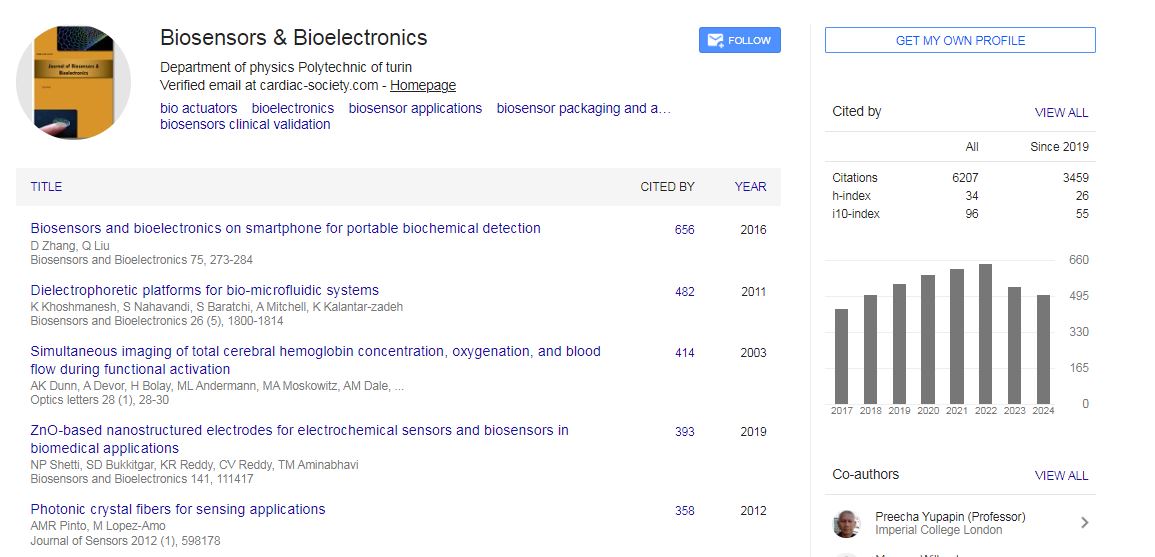
Biosensors & Bioelectronics received 6207 citations as per Google Scholar report