Perspective - (2025) Volume 9, Issue 4
Received: 02-Nov-2025, Manuscript No. jmbp-25-175116;
Editor assigned: 04-Nov-2025, Pre QC No. P-175116;
Reviewed: 18-Nov-2025, QC No. Q-175116;
Revised: 24-Nov-2025, Manuscript No. R-175116;
Published:
29-Nov-2025
, DOI: 10.37421/2684-4931.2025.9.279
Citation: Alvarez, Diego. ”Resilient Antiviral Development: Broad-Spectrum and Beyond.” J Microbiol Patho 09 (2025):279.
Copyright: © 2025 Alvarez D. This is an open-access article distributed under the terms of the Creative Commons Attribution License, which permits unrestricted use, distribution and reproduction in any medium, provided the original author and source are credited.
This article discusses broad-spectrum antiviral agents designed to combat a wide range of viruses by targeting conserved viral processes or host factors for replication. This represents a strategic shift towards more resilient antiviral strategies against emerging threats and drug resistance[1].
Remdesivir for COVID-19, as detailed in this report, solidified its role as an important early antiviral intervention. It demonstrated efficacy and safety in hospitalized patients, accelerating recovery and reducing disease progression. This was critical for establishing an effective treatment during the pandemic[2].
This paper explores host antiviral factors in COVID-19, examining how an individual's genetic makeup and immune responses influence susceptibility and disease severity. Understanding these natural defenses can help discover new targets for antiviral drugs that bolster inherent mechanisms, rather than directly attacking the virus[3].
Mechanism-based pan-antiviral therapeutics target common host-pathogen interactions, aiming to develop drugs effective against a broad array of viruses. This smart approach minimizes the need for highly specific treatments, preparing for known viruses and future unknown outbreaks[4].
This review focuses on targeting host-cell machinery for antiviral development. Disrupting cellular processes vital for viral entry, replication, or assembly can stop various infections. This strategy potentially reduces antiviral resistance, representing a significant avenue for novel broad-spectrum agents[5].
Repurposing existing small molecules and natural products as antivirals accelerates drug discovery. Screening approved drugs or natural compounds for antiviral activity dramatically speeds up treatment availability, especially during pandemics, by efficiently finding new uses for understood compounds[6].
This paper provides a concise overview of antiviral therapy for COVID-19, covering drugs developed or repurposed during the pandemic. It discusses their mechanisms, efficacy, and clinical application, consolidating knowledge of effective strategies against SARS-CoV-2 and highlighting areas for future development[7].
Advances in direct-acting antiviral (DAA) therapy for chronic hepatitis C virus (HCV) infection have been revolutionary. DAAs transformed HCV treatment into highly effective, short-course therapies with high cure rates, demonstrating the power of targeted antiviral development for persistent viral infections[8].
This article discusses recent developments and future prospects for antiviral agents targeting influenza. Effective antivirals are crucial for treatment and control, especially for severe cases. The paper delves into novel mechanisms to overcome resistance and improve efficacy against evolving influenza strains[9].
Computational approaches are indispensable for new antiviral discovery. This review highlights how advanced algorithms, machine learning, and molecular modeling identify candidates, predict binding, and optimize properties pre-lab. This speeds up drug discovery, reduces costs, and accelerates finding effective antiviral treatments[10].
Antiviral development is strategically shifting towards broad-spectrum agents that combat a wide range of viruses, moving beyond the traditional one-drug-one-bug approach. This involves identifying and targeting conserved viral processes or host factors crucial for viral replication [1]. A core concept in this area is the development of mechanism-based pan-antiviral therapeutics, which aim to target common host-pathogen interactions that various viruses exploit within human cells [4]. another promising direction involves targeting the host-cell machinery itself. Disrupting cellular processes essential for viral entry, replication, or assembly can effectively stop a broad array of viral infections. This strategy also holds the advantage of potentially reducing antiviral resistance, as viruses find it harder to evolve around fundamental host-cell functions [5].
Accelerating the availability of new treatments is paramount, especially during pandemics. One smart play is repurposing existing small molecules and natural products. This approach screens already approved drugs or natural compounds for antiviral activity, dramatically reducing the time and cost associated with de novo drug discovery by finding new uses for compounds we already understand [6]. Furthermore, computational approaches have become indispensable in this quest. Advanced algorithms, machine learning, and molecular modeling are actively used to identify potential drug candidates, predict their binding affinity, and optimize their properties early in the development pipeline. This technological integration significantly speeds up the drug discovery process and reduces costs by narrowing down the most promising compounds before lab experiments begin [10].
The COVID-19 pandemic significantly highlighted the urgent need for effective antiviral interventions. Remdesivir emerged as an important early antiviral, with its final report solidifying its role by demonstrating efficacy and safety in hospitalized patients, accelerating recovery and reducing disease progression. This was a critical step in establishing one of the first effective treatments during the initial phase of the pandemic [2]. Beyond direct viral targeting, understanding host antiviral factors in COVID-19 is crucial. Research explores how an individual's genetic makeup and immune responses influence susceptibility and disease severity, revealing potential new targets for antiviral drugs that bolster inherent host defense mechanisms against SARS-CoV-2 [3]. Overall antiviral therapy for COVID-19 has been extensively reviewed, covering the landscape of drugs developed or repurposed, their mechanisms, efficacy, and clinical application, consolidating knowledge for managing the disease [7].
The success of direct-acting antiviral (DAA) therapy for chronic hepatitis C virus (HCV) infection stands as a testament to the power of targeted antiviral development. DAAs have revolutionized HCV treatment, transforming it from a challenging regimen to highly effective, short-course therapies with cure rates exceeding 95%. This progress offers a blueprint for approaching other persistent viral infections [8]. Meanwhile, influenza continues to be a global health concern, necessitating ongoing development of antiviral agents. While vaccines are vital, effective antivirals are essential for treatment and control, particularly for severe cases or when vaccine matching is suboptimal. New drugs are evolving to overcome resistance and improve efficacy against different influenza strains, emphasizing the need to stay ahead of this constantly evolving virus [9].
These collective efforts across various viral infections and therapeutic strategies underscore a profound commitment to developing more resilient and effective antiviral defenses. From targeting broad viral vulnerabilities and host pathways to leveraging computational power and drug repurposing, the field is evolving rapidly. The insights gained from specific pathogens like SARS-CoV-2 and HCV, combined with proactive strategies against evolving threats like influenza, define a dynamic landscape of innovation. This truly means a future with better preparedness and more potent tools to combat both known and emerging viral pathogens.
Antiviral drug development is moving towards more resilient strategies, shifting from a one-drug-one-bug approach to broad-spectrum agents. This involves identifying and targeting conserved viral processes or host factors that many viruses rely on for replication. New approaches include developing pan-antiviral therapeutics that target common host-pathogen interactions, and disrupting host-cell machinery essential for viral entry, replication, or assembly to reduce resistance likelihood. Repurposing existing small molecules and natural products is a smart way to accelerate drug discovery, especially during pandemics, by finding new uses for known compounds. Computational methods, including algorithms, machine learning, and molecular modeling, are also becoming indispensable, speeding up candidate identification and optimization. Real-world applications highlight these efforts. Remdesivir, for instance, became an important early antiviral intervention for COVID-19, demonstrating direct-acting antiviral efficacy in hospitalized patients. Furthermore, understanding host antiviral factors in COVID-19 reveals how an individual's genetic makeup and immune responses affect disease susceptibility, pointing to new targets that bolster natural defenses. An overview of antiviral therapy for COVID-19 consolidates knowledge of strategies against SARS-CoV-2, indicating both successes and areas for further development. These developments collectively demonstrate a strategic and technological advancement in combating viral threats, aiming for more effective and broadly applicable treatments.
None
None
Nathaniel RC, Jonathan ZL, Timothy FK. "Broad-spectrum antiviral drug development".Science 373 (2021):eabj0955.
Indexed at, Google Scholar, Crossref
John HB, Kay MT, Lori ED. "Remdesivir for the Treatment of Covid-19 â?? Final Report".N Engl J Med 383 (2020):1813-1826.
Indexed at, Google Scholar, Crossref
Sumit S, Debarati G, Srijani G. "Antiviral host factors in COVID-19: Implications for disease susceptibility and therapeutic interventions".J Med Virol 95 (2023):e28178.
Indexed at, Google Scholar, Crossref
Xiaolin C, Qi W, Bo Z. "Mechanism-based development of pan-antiviral therapeutics: Targeting common host-pathogen interactions".Eur J Med Chem 236 (2022):114349.
Indexed at, Google Scholar, Crossref
Giulia DP, Marilena C, Giovanna MPDG. "Targeting the host-cell machinery for the development of novel broad-spectrum antiviral agents".Front Pharmacol 14 (2023):1198656.
Indexed at, Google Scholar, Crossref
Wei W, Kaiyuan W, Lingli Z. "Repurposing of Small Molecules and Natural Products as Antivirals: Current Status and Future Perspectives".Viruses 14 (2022):1805.
Indexed at, Google Scholar, Crossref
Jason AR, Andrew HY, Jeffrey LC. "Antiviral Therapy for COVID-19".Clin Chest Med 42 (2021):785-802.
Indexed at, Google Scholar, Crossref
Yanning L, Xiaojun H, Ling L. "Advances in direct-acting antiviral therapy for chronic hepatitis C virus infection".Infect Dis Poverty 9 (2020):115.
Indexed at, Google Scholar, Crossref
Yoshihiro K, Hiroaki M, Gabriele N. "Antivirals for influenza: recent advances and future prospects".Curr Opin Virol 48 (2021):108-115.
Indexed at, Google Scholar, Crossref
Anupama S, Rohit K, Nitesh K. "Computational Approaches for the Discovery and Development of Antivirals".Curr Pharm Des 29 (2023):2368-2384.
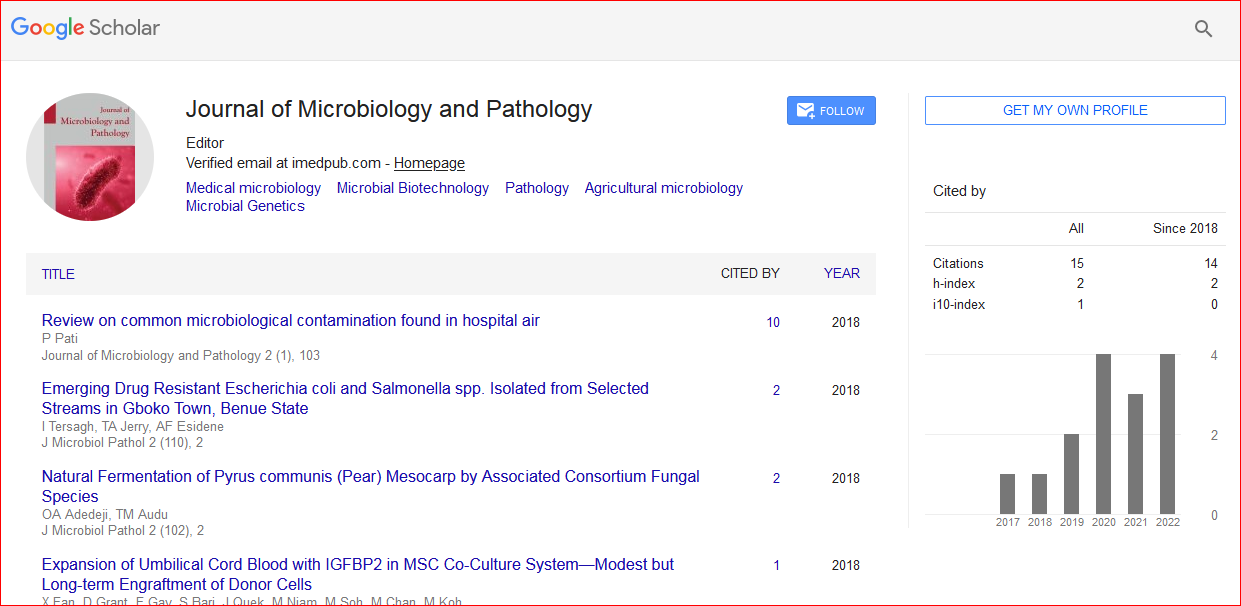
Journal of Microbiology and Pathology received 18 citations as per Google Scholar report